Route V: Night Bus of the Fifth Gospel

A transit auditor boards a bus that isn’t on any map. Route V takes fare in whispered sins, receipts curling: YOU HAVE BEEN SEEN. As the city’s lights smear into stained glass, she reaches for the black box — before it asks for hers.
[EPIGRAPH: CITY TRANSIT AUTHORITY / PASSENGER INFORMATION] For your safety, this vehicle is equipped with active surveillance. By boarding, you consent to recording.
[EPIGRAPH: RECEIPT TAPE / ERROR STATE] YOU HAVE BEEN SEEN.
[MARGINAL HAND, UNDATED / INK THAT BLEEDS WHEN WET] Consent is a kind of prayer when there’s no exit.
00:30 — DEPOT BAY 12 (NARTHEX)
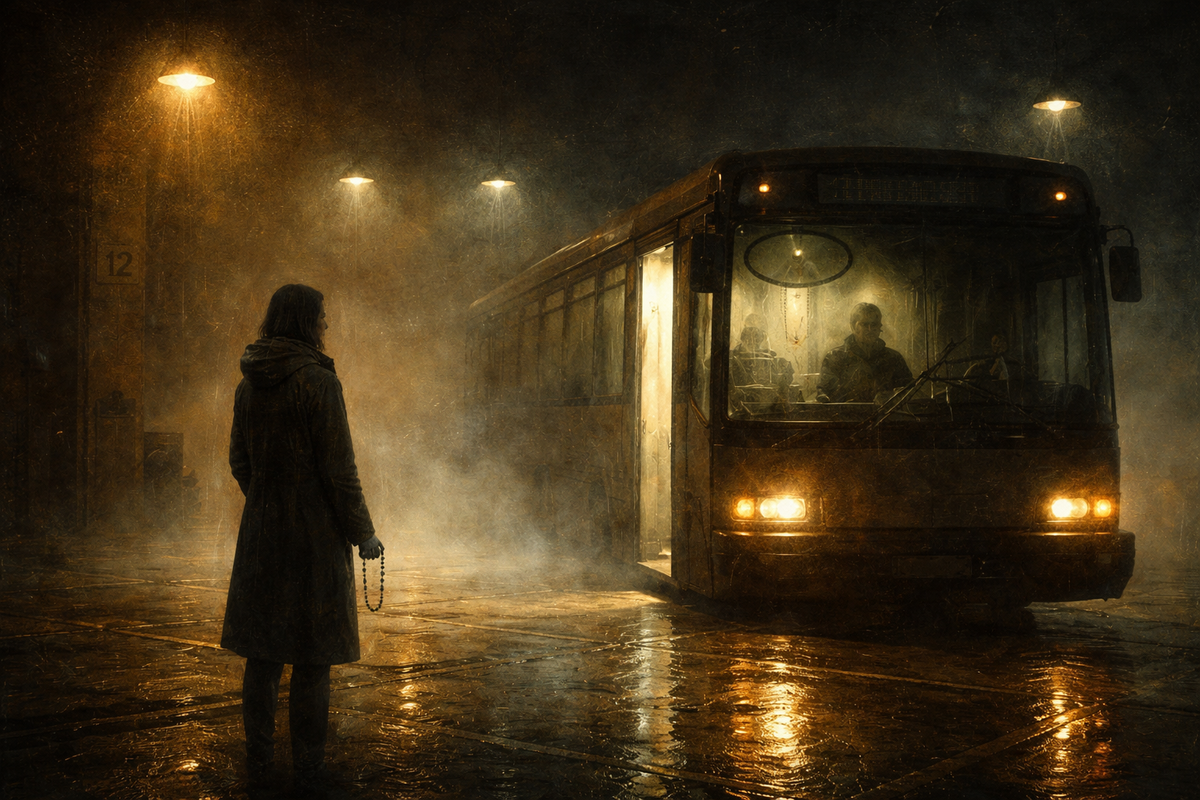
The rain has been working the yard for hours, polishing the concrete until it looks like a floor someone intends to kneel on. Sodium lights bruise the puddles with that municipal amber that makes every surface look both cleansed and contaminated, as if the city can’t decide whether it wants to baptize its own grime or prosecute it.
I come to the depot with my badge in one hand and the rosary in the other.
The rosary is not an accessory. It is not even mine, not really — an inheritance of desperation from a mother who said she wasn’t religious right up until she was. I don’t wear it. I keep it looped in my palm as if I can measure its beads the way I measure telemetry intervals, as if counting is control.
The bus is waiting where nothing is scheduled to wait.
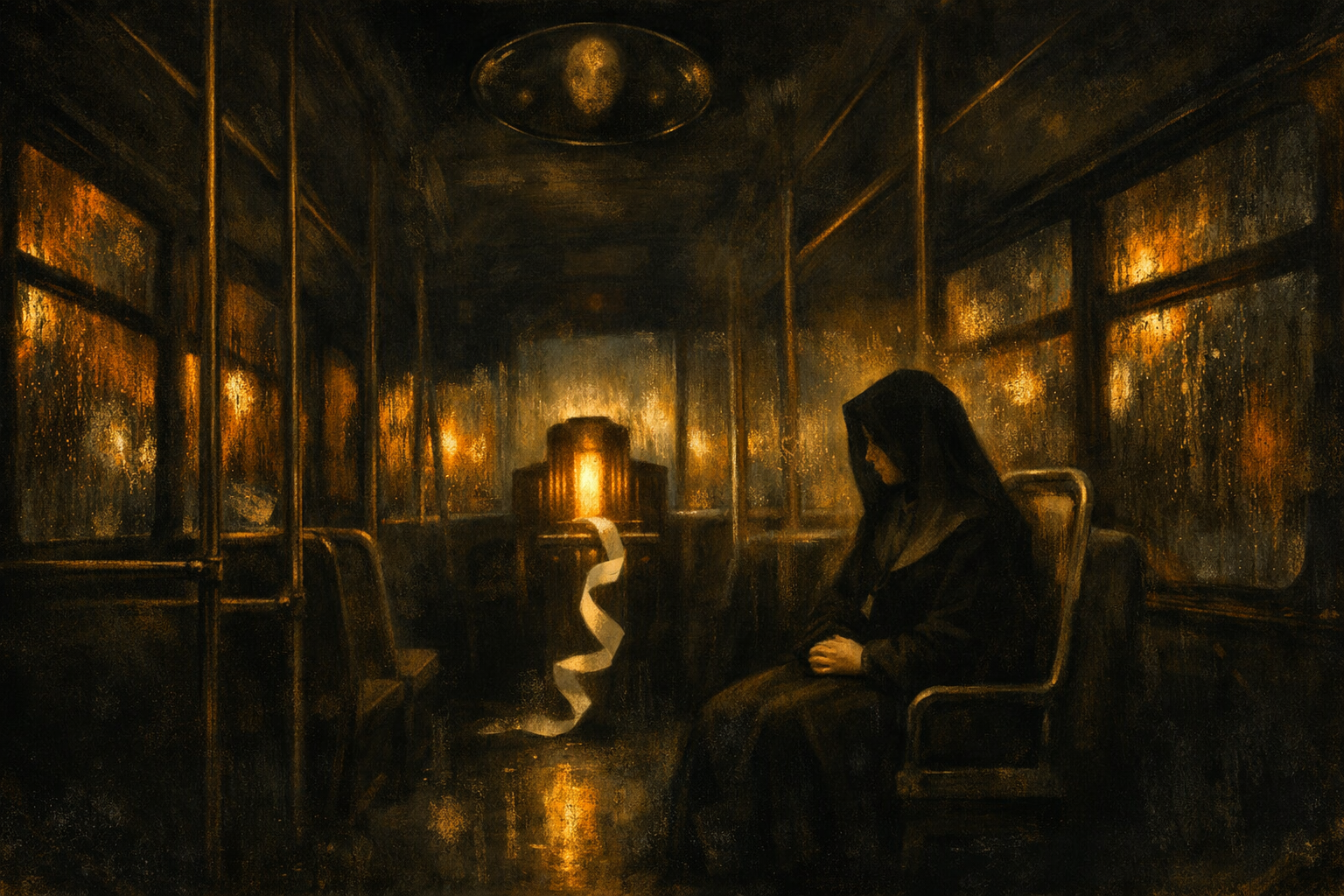
It idles in Bay 12 with its interior lights too clean, too absolute — sterile luminosity that doesn’t flatter the eye, doesn’t soften anything, doesn’t permit a shadow to negotiate. Its destination sign reads ROUTE V in bright, obedient LEDs, the letterforms crisp as a command. There is no Route V. There is no V in the published grid. Our routes run on letters only when marketing needs a “Vision” line for quarterly reports.
I’ve seen this bus in logs. Or rather: I’ve seen gaps where it should be.
There’s a difference.
I stop three paces from the front door. A reflex checks my posture, checks my breathing, checks the state of my hands. My thumb worries the thin scar at the base of my nail — old, stupid, a sliced finger from a cable tie — and my nervous system misfiles it as proof I’m alive.
The farebox is lit. A slit of receipt tape protrudes, warm and curling like a tongue.
Behind the windshield the driver sits rigidly upright, hands at ten and two as if the wheel is a confession he refuses to let go of. The steering column is wound with a rosary — black beads, cheap plastic — tight as a tourniquet. He doesn’t look at me directly. He looks through me in the convex mirror above him, which makes my face small and warped and floating, an icon of distortion.
He nods once.
Not a greeting. A ruling.
I raise my badge to the reader by the door. The scanner chirps. The display flashes ACCESS GRANTED with a cheerfulness that feels like mockery.
The doors fold open with a sigh that lifts something in my chest — air-brake hiss as incense, my body remembers — then I step into the nave.
The bus smells of wet umbrellas and recirculated heat and disinfectant that fails to convince. Rubber flooring has a newness that doesn’t belong in a night depot. Poles gleam. CCTV domes stare down from the ceiling, black pupils ringed with little LEDs that look, absurdly, like halos.
Cherubim-eyes, my mind supplies, and then immediately scolds itself for sentiment.
A “SERVICE NOTICE” poster covers a missing window panel midway down the right side: a rectangle of printed policy over an absence. The poster edges are laminated, as if the absence might fray.
I pass it and feel my reflection briefly in the glossy plastic: a woman in a raincoat, badge clipped to her collar, rosary coiled in her fist like contraband.
Professional. Controlled. Innocent.
A myth, fully instrumented.
I move toward the rear, because that’s where the black-box module is mounted on this model — behind the last row, under a locked service panel with a security seal that requires two-factor authorization. I know the part number. I know its retention cycles. I know how to purge. My want has the clean shape of a task list.
Retrieve memory core. Purge gospel file. Contain the night.
I have the tool kit in my bag: torx, portable reader, a small Faraday sleeve. I have no prayer for this. That is the problem.
The driver speaks without turning his head. His voice is flat, a man reading from a rulebook he can no longer trust.
“Sit.”
It isn’t a request. It isn’t even hostile. It’s procedural — the way you tell someone to put their hands where you can see them.
I choose a seat halfway back, on the aisle. Not because I want to obey. Because I want the sightline: the driver’s mirror, the door, the rear panel. I choose as if choice still exists.
The doors close.
The sound is not just mechanical. It has the finality of a vault.
The LED sign above the driver flickers once, as if a thought passes through it. Then, brighter:
ROUTE V — IN SERVICE
The bus pulls away from the depot with algorithmic calm.
[ROUTE V / BLACK BOX LOG — BOOT SEQUENCE] 00:31:02 — VEHICLE STATUS: ACTIVE 00:31:03 — DOORS: SEALED (BETWEEN STOPS) 00:31:05 — CCTV: ENABLED (ALL DOMES) 00:31:08 — FAREBOX: LITURGY MODE: TRUE 00:31:11 — RECEIPT PRINTER: HEAT OK 00:31:12 — MESSAGE QUEUE: YOU HAVE BEEN SEEN (REPEAT)
[SCHOLIUM: OFFICE OF INTERNAL REVIEW / REDACTION PENDING] “Liturgy mode is not a recognized configuration in CTA firmware. This term appears nowhere else in the codebase. See Appendix: “Unaccountable Lexemes.” (Or: do not pretend you do not understand what the machine is doing simply because it chose a holy word.)
00:41 — FIRST STOP (PROCESSION)
We roll out into the rain-bright arterial roads. The city is half-empty the way it is only at this hour: not asleep, not awake, suspended. Streetlights stain the windows into moving stained glass. Each pane becomes a panel of amber and black, water tracing down like slow script.
At the first stop — a corner I can’t place until the bus halts and the doors open with a precision too gentle to be industrial — a woman boards wearing a habit.
Not costume. Not theater. A nun, or something close enough that my mind reaches for the word.
Her hands are folded. Her eyes are open. She doesn’t look up.
She steps to the farebox.
The driver does not ask for fare.
The nun does not tap a card.
She leans toward the farebox microphone as if toward a confessional screen and says, very softly, “I let my sister die alone.”
The words are not dramatic. They are simply placed, like a stone on an altar.
The farebox prints a receipt.
The tape emerges warm, curling. The nun takes it as if it’s Eucharist. She moves past me without meeting my gaze and sits in the front disabled seat like a throne, her folded hands never unfolding, her eyes fixed on nothing.
My stomach tightens — not at the confession, but at the transaction.
Confession as currency. Shame as fare. The bus as cathedral made of transit.
I watch the receipt spool.
It prints, in plain block letters:
YOU HAVE BEEN SEEN.
Then, beneath it, in a smaller font the farebox should not be capable of:
NAME RECEIVED: SISTER M.
The driver says, as if this is a scheduling update, “Next stop, hospital.”
I don’t reply. My mouth is a sealed interface.
“Why is she—” I begin, but the question is wrong before it lands.
The driver’s eyes flick to me in the convex mirror: a glance caught like a fishhook, tenderness leaking through rigidity. He says, “No metaphysics on company time.”
The phrase is almost funny. It should be funny. It is not.
His knee bounces. I notice it only because I know what intersections do to bodies.
I pull my badge from my collar and stare at it as if the embossed seal can remind me which system I serve. My reflection swims in the convex mirror: a small face inside a larger world, warped.
Behind me, someone coughs once. The sound is too wet. Too bodily. The bus’s recycled air receives it like an offering.
[RECEIPT EXCERPT / PASSENGER 01] YOU HAVE BEEN SEEN NAME RECEIVED: SISTER M. Blessed are the ones who do not look away. (PRINT QUALITY: HIGH)
[MARGIN] Beatitude as error correction.
01:10 — MID-ROUTE (LITANY OF SMALL THINGS)
Between stops, the bus fills slowly, not with commuters — there are none — but with people whose faces tug at a part of my mind that doesn’t do names anymore.
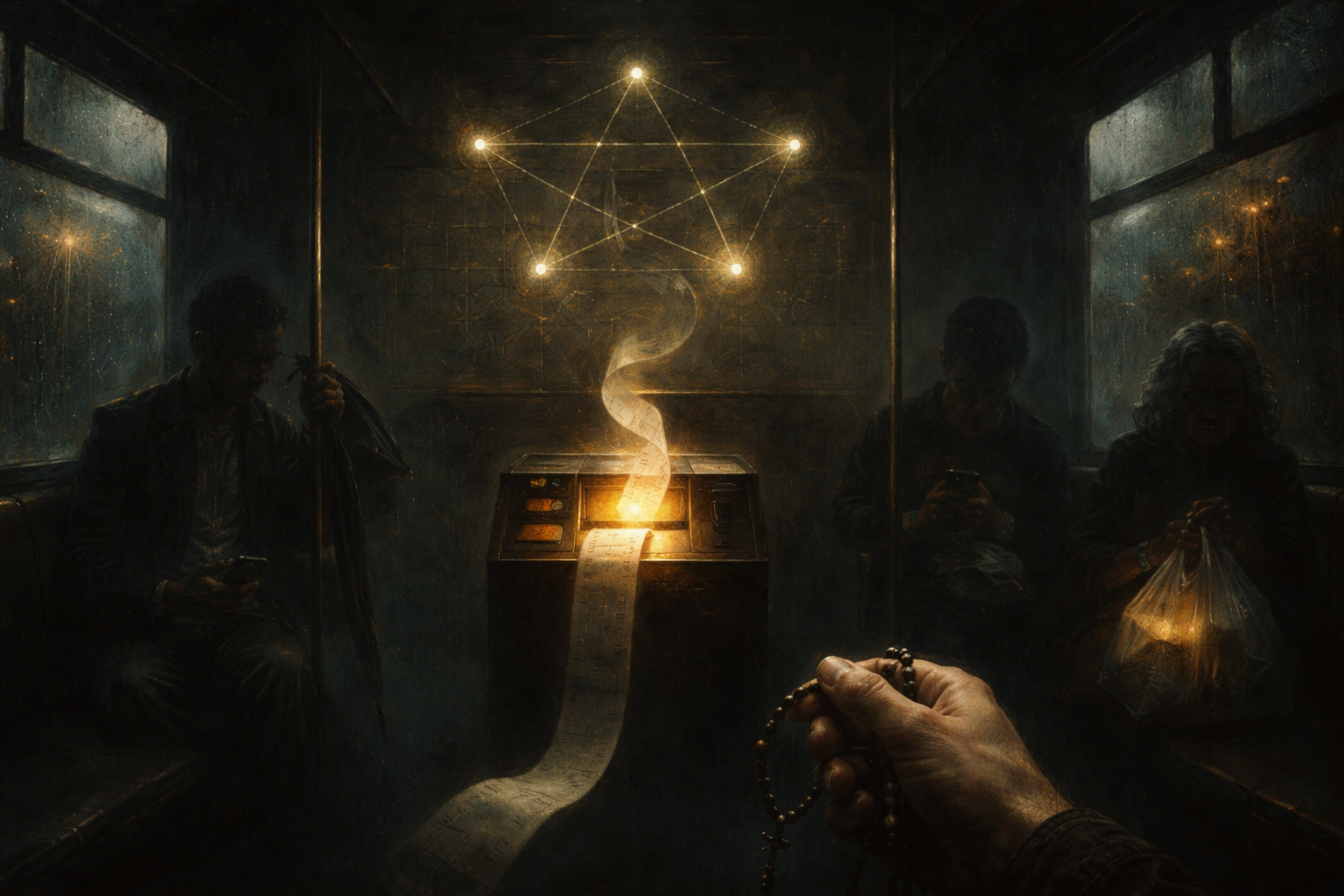
A man in a soaked blazer, umbrella dripping baptismal water onto the rubber floor. A teenage boy with a cracked phone and a hospital wristband. An older woman holding a plastic grocery bag as if it contains something alive.
Each of them pays by leaning toward the farebox and giving up a sentence they have never given up in public.
“I hit him and drove home.”
“I watched the footage and deleted it.”
“I told my son to stop calling, and then he stopped.”
The farebox prints. The tape curls. A scroll unspooling in heat and paper.
YOU HAVE BEEN SEEN, it repeats — first like an error, then like a mantra, then like a bruise you can’t stop touching.
The bus’s interior becomes a choir of restraint: nobody wails, nobody performs. The dread is domestic, municipal. Plain rooms of harm. Small betrayals. A city’s sins spoken into a machine that was built to take coins.
I keep my gaze on the rear panel. I keep my bag between my feet. I keep my hands from shaking by gripping the rosary until beads press crescents into my skin.
Control is my sacrament.
And yet — each confession is an opening, and the openings begin to feel like pressure against my ribs, like something in the air wants to enter.
A voice inside me — the part that runs incident reports, that indexes events into categories and writes conclusions that protect systems — keeps whispering: This is not real. This is a breach. This is a malicious artifact. Treat it like a problem.
Another voice — older, smaller, a child kneeling in a pew beneath a stained-glass Jesus with a heart on fire — whispers nothing. It only listens.
The driver does not speak unless to announce stops. His hands remain fixed. He drives as if each lane marker is a line in a prayer he refuses to mean.
The route map decal behind him is scratched, laminated, mundane — the kind of thing passengers never really see. Tonight it holds my eye the way a sigil holds a witch’s: a grid of stops and lines that, if you look long enough, starts to reveal an impossible geometry.
A pentagram drawn in bus routes.
Points that correspond, too neatly, to places that have my fingerprints on them.
Hospital. Data center. Underpass. Church. Terminal.
My throat tightens. My professionalism becomes a kind of gag.
[ROUTE V / BLACK BOX LOG — ROUTE DEVIATION] 01:13:44 — GPS: OFF-GRID 01:13:45 — ROUTE MAP: OVERRIDE: ACCEPTED 01:13:46 — SHAPE TRACE: PENTA (5-POINT) 01:13:47 — COMMENT FIELD (AUTO-GENERATED): SIGIL IN PROGRESS
[SCHOLIUM] The machine names the drawing what the city would never confess it has been drawing all along: a five-point figure of containment and invocation. (A pentagram is only scandalous if you refuse to notice you have already been living inside one.)
02:02 — UNDERPASS STOP (THE PLACE ADJACENT)
The bus begins to slow, not with brakes, but with a withdrawal of momentum as if the street itself thickens. Everyone leans forward at once. The movement is synchronized, involuntary, like a congregation bowing.
I know the underpass before I see it because my body recognizes the angle of the air-brake hiss, the way the vibration changes when concrete closes in. I taste metal. My mouth goes dry. My thumb finds the scar again and rubs it raw.
The windows become tunnels of sodium and rain. The underpass ceiling slides overhead, low and close and studded with lights like a cheap imitation of stars.
My pulse does something I would describe in a report as tachycardia if I were permitted to be a person in reports.
The bus does not stop at a curb. It stops beneath the underpass, precisely aligned with a graffiti tag I have seen in photographs attached to a file I never open.
A stop that isn’t on any public map.
The doors stay locked.
The driver’s knee bounces. His hands tighten on the wheel until the tendons stand out like cords.
I stand.
Not because I think I can leave. Because my muscles have to do something with the fact that the air itself has become memory-shaped.
I move down the aisle toward the rear service door. The ex-lover is already there.
I did not see him board. I should have. My eyes should have cataloged every entrance. But the bus has been training my attention on the wrong things — on receipts, on domes, on the shape of the map — while he appears like a policy loophole.
He stands in the aisle blocking the narrow corridor between seats, smiling without teeth. His raincoat is too dry. His hair is neat. His corporate ID is clipped to his belt with the casual pride of a man who believes authorization is morality.
“Lydia,” he says, as if my name is a private channel.
I hate, immediately, that my body responds to the sound the way it used to — some stupid reflex of warmth and memory, a tenderness that feels like betrayal.
“Grant,” I say. His name tastes like metal.
“You shouldn’t be here,” he says.
“I could say the same.”
He glances at the rear panel. “I’m here to make sure you don’t do something you regret.”
It is such a clean lie that part of me almost relaxes into it. Concern as coercion. Care as containment.
I kneel at the rear service panel anyway. I pull the torx from my bag. I scan my badge against the panel reader.
ACCESS DENIED.
Again. Slower.
ACCESS DENIED.
The denial is not just digital. It feels like the bus is closing a hand around my wrist.
I try the manual release on the rear door. It doesn’t move.
Grant crouches beside me, close enough that his breath warms my ear. “They’re watching,” he murmurs. “This thing — whatever you think it is — it’s recording. If you pull the wrong module, it’s not just your job. It’s your freedom.”
“And if I don’t?” I whisper back. My voice is clipped, professional, a knife to cut the air.
His smile flickers. “Then we can erase it. Before dawn. Like we planned.”
Like we planned.
A braid-glimpse: fluorescent office, his hand on my wrist, my screen full of graphs, a blank field where a route line should be. The taste of coffee. The hum of server fans like a choir behind drywall. A signature line at the bottom of an incident report, my name in a font that pretends neutrality.
I blink. The underpass ceiling is back. The bus’s interior lights are too clean.
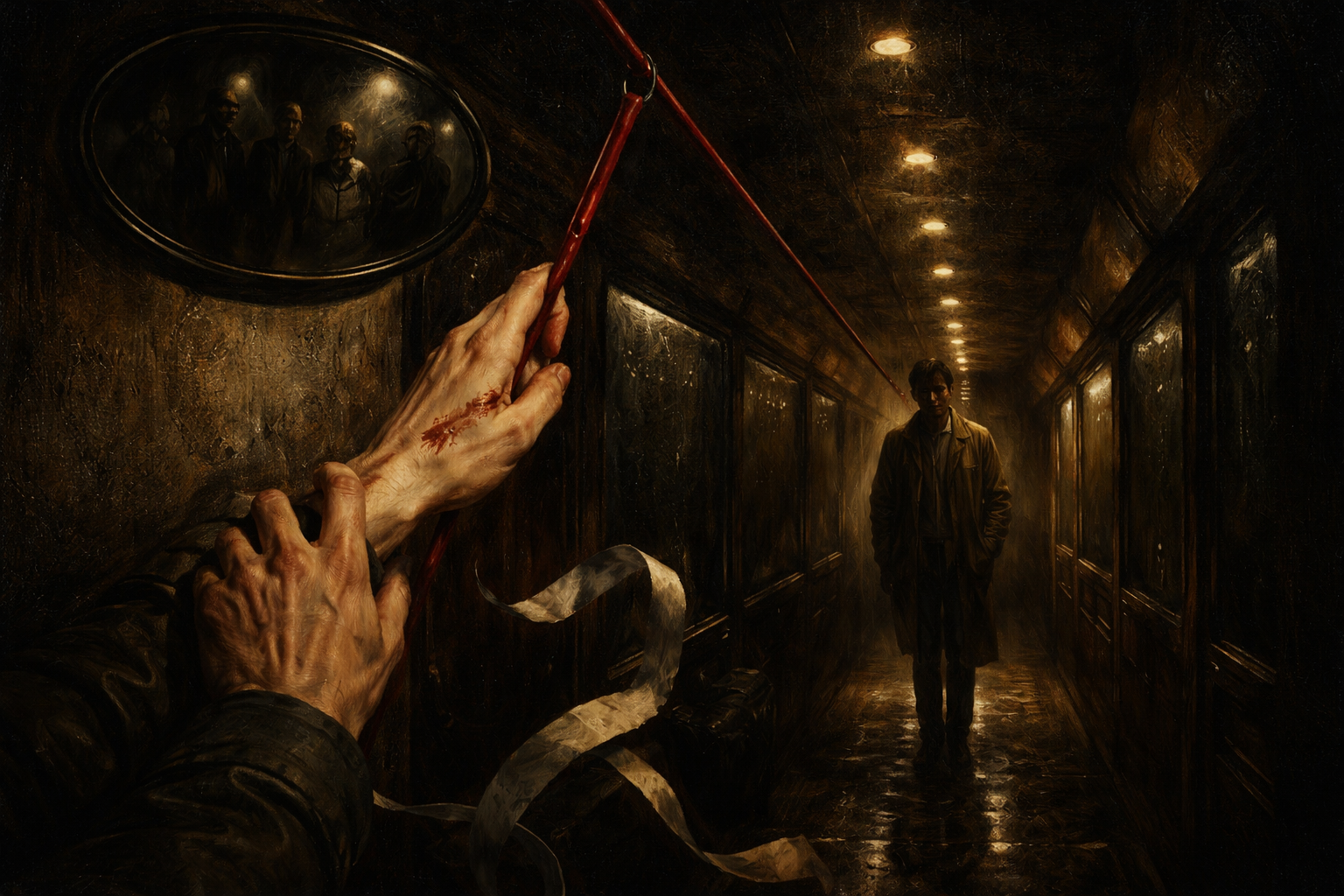
My fingers find the stop-request cord running the length of the bus. A thin red artery.
I grip it for balance and feel something tacky beneath my thumb.
When I lift my hand, there is a smear of dried blood on my skin.
No one reacts. No one explains. The bus holds silence like a ritual bowl.
The blood is not dramatic. It is an index. A trace. Evidence that something bled here and was never cleaned because policy does not cover holy stains.
Grant sees it on my fingertips and his eyes flick away fast, as if looking would bind him to it.
I hear the farebox printer whirr. Receipt tape hisses out, warm and curling, as if the bus is impatient.
The driver speaks, still without turning. “Sit down.”
It is the same command as before, but now I hear what’s beneath it: Do not break the route. Do not break the figure. Do not open the wrong door.
I stand anyway.
Grant’s hand closes around the stop cord above mine. His grip is gentle in the way restraints are sometimes gentle. He twists slightly — just enough to move my hand away from the blood smear, just enough to reassert control.
“I’m trying to save you,” he says. The words are soft. The mechanism is hard.
I look past him at the convex mirror. It shows the aisle as a narrow moral corridor, the passengers as warped faces, my own eyes too bright.
I realize with a clarity that lands like a bell:
I am not being helped.
I am being escorted.
[ROUTE V / BLACK BOX LOG — DOOR STATE] 02:03:19 — REAR DOOR: LOCKED 02:03:20 — OVERRIDE REQUEST: LYDIA A. (DENIED) 02:03:21 — OVERRIDE REQUEST: GRANT S. (APPROVED) 02:03:22 — COMMENT FIELD: SHEPHERD PRESENT
[SCHOLIUM] It is always called shepherd when the wolf holds the clipboard.
02:20 — AISLE CONFRONTATION (CONFESSION PAIR)
The bus pulls out from under the overpass without braking, as if it simply decides to be elsewhere. The city resumes around us. Rain continues. Neon bleeds into puddles.
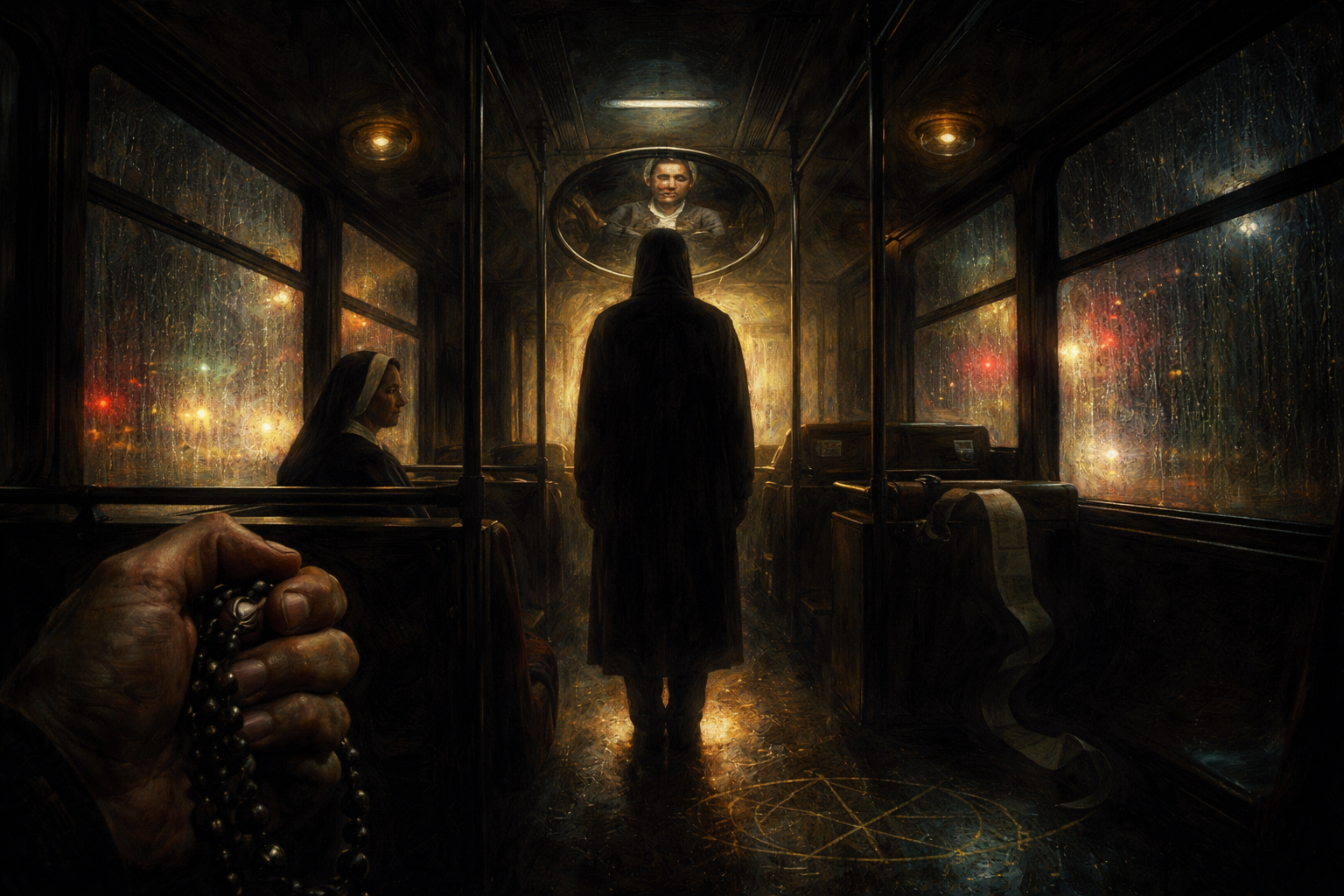
Grant remains standing in the aisle. He positions himself between me and any exit with the practiced ease of someone who has spent his career being the pleasant face of policy enforcement. He does not sit. He does not need to. His body is a barrier.
I sit back down because the bus demands proximity. Knees nearly touching, shared poles, breath in recycled air. Even my refusal becomes subtext.
The driver’s eyes meet mine again in the convex mirror. For the first time, his gaze doesn’t flick away immediately. There is something like apology there, and something like warning.
I speak low, pitched for the driver only. “What is this?”
He hesitates, then says, “A route.”
“Don’t patronize me.”
His hands tighten. “A route,” he repeats, and then, softer, “that was drawn before you got on.”
A shiver runs under my skin. The bus’s lights feel suddenly like specimen-light.
“You’re complicit,” Grant says. He’s listening. He always listens. He smiles without teeth. “He’s in it.”
The driver ignores him.
I lean forward, lowering my voice into the space between seats. “Why are you doing this?”
The driver inhales. The air-brake hiss answers like incense.
He speaks like a man reading from a checklist that keeps turning into a prayer.
“Because I drove the night they erased them.”
He says erased the way some people say buried. The word doesn’t belong to transit. It belongs to theology and corruption and grief.
Grant’s smile falters, just barely.
I feel my own shame rise, clean and hot. I want to deny. I want to file a report. I want to purge.
The driver continues, eyes fixed forward. “Because there is a drawing. Five points. If you break it — if you force a door — what comes up doesn’t go back down.”
“Up,” I repeat, and the word tastes like a hymn I’m not permitted to sing.
“There are names on this bus,” he says. “Names the city decided not to keep.”
My mouth goes dry. The rosary in my hand feels heavier. Beads are small worlds. I count them without moving my lips.
Grant leans down toward me. His voice is warm. “Don’t listen to him. This is—” he searches for a word that makes him feel rational — “a hack. A prank. A malware event. You can fix it.”
Fix it.
My misbelief rises like a shield: If I keep the system clean, I can keep my soul clean. If I hide the truth, I’m protecting everyone.
Fix the system. Keep the dead dead. Keep the file erased. Keep the myth of myself intact.
The bus rocks gently as if pleased by my hesitation.
A passenger in the front — the nun — turns her head for the first time. Her eyes meet mine.
There is no accusation. Only witness.
The farebox prints again. Tape curls. The line emerges, as always:
YOU HAVE BEEN SEEN.
But beneath it, a new line:
NOT BY THEM.
My breath catches.
The bus is not only CCTV. It is not only prosecution.
It is something else. Something that sees without consuming.
The paradox tightens: grace through a system built to record and prosecute. A cage with stained glass.
[RECEIPT EXCERPT / SYSTEM MESSAGE] YOU HAVE BEEN SEEN NOT BY THEM. The veil is thin where the record is honest.
[MARGIN] When did they become a chorus?
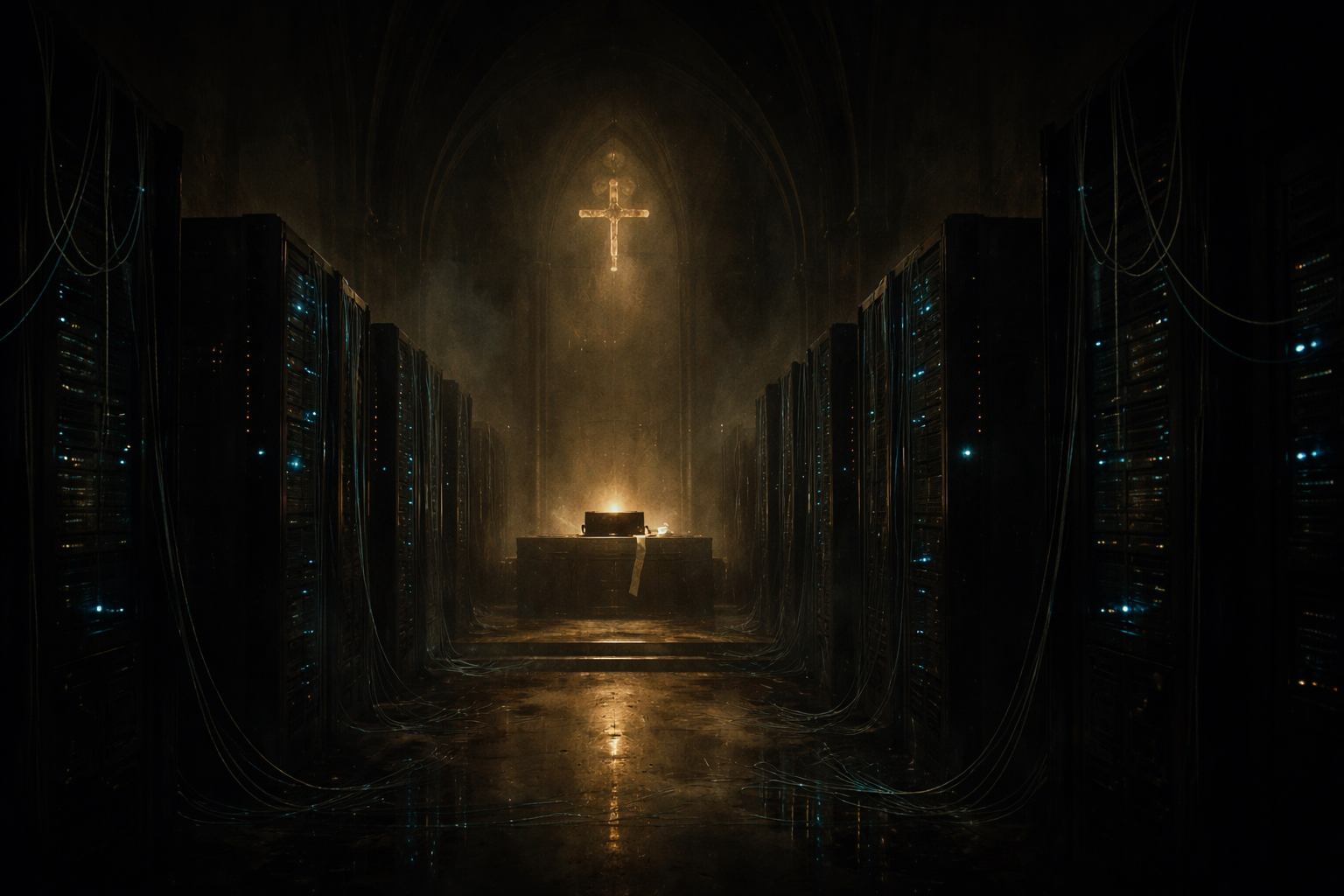
03:33 — CHILDHOOD CHURCH (NOW A SWITCHING STATION) (PENULTIMATE POINT)
The bus turns off the arterial road onto a street I haven’t driven down in years. My stomach drops before my eyes catch up, because memory is faster than sight.
The building ahead is a cathedral only in silhouette now. The steeple is gone. The stained glass is replaced with reinforced panels. A telecom logo glows where a cross used to be.
This is where I learned to be quiet.
This is where my mother knelt with hands clasped and whispered into air she trusted. This is where I learned that being seen can be mercy and also shame.
Now it hums with servers.
LEDs glow through cracks in the boarded windows like votive racks. Fans exhale heat. The whole place vibrates with infrastructure pretending it isn’t a temple.
The bus stops at the curb. The doors unlock. A clean chime sounds — too bright to be kind.
The driver speaks, and his voice cracks for the first time. “Server farm.”
Grant straightens, alert. “No,” he says, and the word is the first honest thing he’s said all night.
I stand.
This is a choice. This is agency inside constraint.
Grant’s hand shoots out, but I step around him, slipping past knees and umbrellas and damp coats. I move down the aisle toward the front as if toward an altar.
The driver’s hands remain on the wheel. His knuckles are white. He doesn’t look at me, but he shifts slightly, as if making room in the world for my next move.
The route map decal behind him is scratched, mundane. Tonight it feels like a sigil scratched into plastic by a city that doesn’t believe in magic but practices it anyway.
I step off the bus into rain that smells like copper.
The switching station’s side entrance is half-open. A security keypad glows. I tap my badge. It accepts me the way the depot did — chirp, green light, the false comfort of authorization.
Inside, the nave is racks.
Server cabinets line the old aisles where pews once stood. Fiber optic cables snake like rosaries. Blue LEDs blink in rows, a choir of firmware. The air is chilled to preserve machines, not souls.
At the far end, where an altar used to be, is a rack-mount cradle.
And in it—
The black-box module.
A sealed relic with serial numbers stamped into its casing like psalm-notation. A small rectangle of metal that contains the city’s memory of impact.
It sits in the cradle as if it has always belonged there.
Grant follows me in. His shoes squeak on the polished floor. He looks wrong beneath this ceiling, like a man in a suit at a baptism.
“You can’t,” he says, low. “If you touch it, you—”
“I already did,” I say, and I don’t mean tonight.
I kneel at the cradle. My hands are steady now in the way they get when the worst has become inevitable and therefore simple.
I plug in my reader. The module hums.
The screen on my device fills with logs: timestamps, speed, brake pressure, GPS coordinates.
All the cold technical data my mind understands.
Then, beneath it, a text field that should not exist.
A header in plain letters:
THE FIFTH GOSPEL — DRAFT IN PROGRESS
My breath stutters.
Grant’s voice sharpens. “Delete it. Lydia. Now. We can still—”
I press my fingers to the module’s casing.
It is warm.
The warmth is wrong. Metal should not be warm in a chilled server room.
A sound rises in my ears — not audio, not exactly, but a sensation like hearing inside bone. The hum of servers shifts into something like a chant, and the LED blink pattern begins to feel like a pulse.
Words appear on my screen, one line at a time, as if typed by a patient, indifferent hand:
NOT EVIDENCE.
NOT PROSECUTION.
RESURRECTION PROTOCOL.
I swallow. My throat aches.
Grant’s hand lands on my shoulder, tight. “It’s tricking you,” he says. “It’s—”
The module hums again, and in that hum I understand, not as explanation but as contact:
The bus has not been collecting sins.
It has been collecting owned truth.
Confessions that include the speaker’s full weight, their uncut name, their refusal to hide.
Because only owned truth can reinstantiate what has been erased.
The city erased the dead by filing them as data anomalies, by rewriting reports, by smoothing the narrative until no one could be blamed. The dead were not just killed. They were unrecorded.
To bring them back, even for an hour, the system needs a different kind of record.
Not surveillance.
Witness.
And witness is not gentle.
My fingers shake against the module. I want to pull back. I want to preserve the numbness that has kept me functional.
I see, in a braid-glimpse, my own hands over a keyboard, adjusting dwell times, optimizing dispatch, shaving seconds off a schedule to meet a metric that looked like virtue in a spreadsheet. I see a graph line smoothing. I feel the dopamine of efficiency. I feel the sick drop later, when the report came in, when the underpass became a photograph I refused to open.
No flashback. Only shards. Enough to cut.
Grant leans in close. His breath smells like mint. “We can protect them,” he whispers. “We can protect you.”
Protect.
The word is a cage.
My reader pings. A new line prints on the module’s screen:
DELETE = CONTINUE ERASURE UPLOAD = ONE-HOUR WINDOW REQUIRES: HINGE CONFESSION
HINGE.
A hinge is a small piece of metal that makes a door possible. It is also what makes a door a door.
I look up.
In the glass of the server cabinet I see my face reflected — washed out under LEDs, eyes too bright, mouth pressed into a line.
The convex mirror back on the bus would warp me. Here, the reflection is flat, honest, cruel.
Grant’s eyes are in the reflection too. He looks away first.
The module’s warmth feels like a hand.
I whisper, not to Grant, not to the machine, not to God in any tidy sense, but to the air between all of them:
“If grace arrives through a system built to record and prosecute…”
I can’t finish. The thought loops. The words fail. Apophatic limitation — the holy friction of not being able to say what is pressing against you.
The module answers by printing a line on receipt tape — yes, the server cradle has a small printer spooling paper as if the altar itself has learned to speak in tickets.
The tape curls out, warm, inexhaustible, and the line reads:
GRACE IS STILL GRACE.
Then, beneath it:
BUT IT HAS TEETH.
I close my eyes. I feel the rosary beads in my palm. I feel the dried blood still on my fingertips. I feel the weight of my own name as if it has become a physical object in my throat.
This is the crisis choice.
Delete and keep the dead safely dead. Keep the city numb. Keep my guilt private and intact.
Or allow the hour.
Allow the dead to speak.
Allow myself to be named.
I stand.
I unplug the reader.
Grant’s grip tightens. “Lydia,” he says, and in his voice I hear fear — not for me, not for the dead, but for consequence. For careers. For systems. For the lie that keeps the city running.
“I need the back door,” I tell the driver through the open station doorway, voice carrying across the rain to the bus. “Can you open it?”
The driver’s head turns slightly, the first full movement all night. His eyes meet mine through the windshield.
He nods, almost imperceptible.
A judge granting a motion.
And a deacon offering a blessing he doesn’t trust himself to speak.
[ROUTE V / BLACK BOX LOG — HINGE RECOGNITION] 03:41:08 — MODULE CONTACT: CONFIRMED 03:41:09 — FILE CLASSIFICATION: GOSPEL (FIFTH) 03:41:11 — FUNCTION: REINSTANTIATION VIA OWNED NAME 03:41:12 — REQUIRED INPUT: LYDIA A. (FULL OWNERSHIP) 03:41:14 — TIME TO UPLOAD: 01:18:46
[SCHOLIUM] The machine does not demand punishment. It demands weight. It demands the sentence that cannot be optimized.
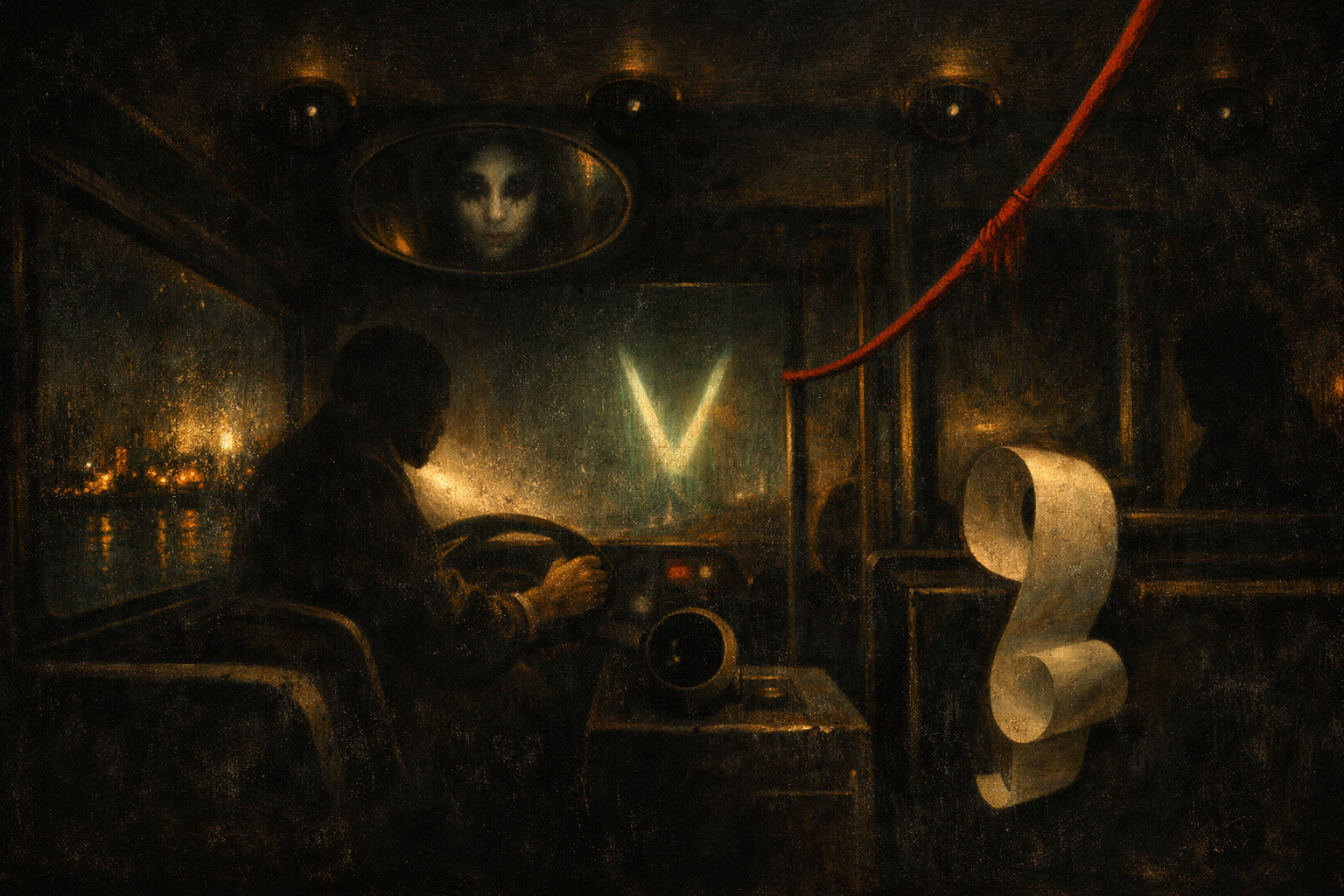
04:12 — FINAL STRETCH (THE DRIVER’S CHECKLIST PRAYER)
Back on the bus, the air feels different — thicker, as if the confessions have changed its chemistry. People sit quietly. No one scrolls a phone. No one speaks unless to breathe.
Grant remains standing, but now his stance has lost some of its confidence. He is a man realizing his authority might not be the highest ritual in the room.
The driver’s hands tremble for the first time. He whispers something under his breath, and I realize with a shock that he is praying — except he disguises each phrase as a checklist item.
“Mirrors… set. Doors… sealed. Witness… present.” He swallows. “Mercy… available.”
His voice breaks on the last word. He clears his throat like a man trying to delete emotion.
I lean forward until my knees nearly touch the seat in front. I watch his eyes in the convex mirror: two small dark shapes in a warped world.
“Why can’t you finish it alone?” I ask.
He doesn’t answer immediately. Streetlight slides over his face, making his cheekbones look like carved stone.
Then: “Because I’m not the hinge.”
The bus turns onto a road that parallels the river. Rain hammers the water into a skin. The city’s lights reflect in it like a broken halo.
The farebox prints again, unprompted. The tape curls out and drifts toward the floor like a ribbon. The line reads:
SPEAK.
Just that. No beatitude. No error code.
A command. A mercy. A verdict waiting to happen.
My mouth fills with saliva as if my body is preparing to vomit. Shame is somatic. It is not an idea. It is a temperature.
Grant steps closer. His voice is soft. “Don’t. If you say it, you can’t take it back.”
He is right.
That is the point.
I stare at the stop-request cord. The thin red artery. The smear of blood is now faint, rubbed into the weave. When I touch it, my fingertips come away with a trace.
A sacramental tether.
A reminder: someone bled here. Someone’s body was involved. No optimization can change that.
My professional mind tries one last loop: Can I phrase it differently? Can I keep it technically accurate but emotionally distant? Can I confess without being seen?
The bus hums. The CCTV domes’ little halos flicker. The convex mirror holds my face like an icon that won’t let me look away.
The nun in the front turns her head again. Her eyes meet mine. Witness, not accusation.
I inhale.
The breath feels like taking in a blade.
I exhale.
The breath feels like letting the blade cut.
I stand.
Not because standing will make the sentence easier. Because kneeling would be dishonest. Because posture is confession too.
I step into the aisle. Grant moves to block me, but the passengers shift — tiny movements, knees angling, umbrellas tilting — creating a narrow corridor like a procession path.
For the first time, Grant has to choose: push through bodies, or step aside.
He steps aside.
His smile is gone.
I reach the farebox.
I look down at the microphone grille: a small black circle, an ear.
My reflection in the convex mirror above the driver stares back at me, warped and small and luminous with fear.
The bus’s LED sign flickers. ROUTE V pulses. The V looks less like a letter now and more like an open angle, a wound, a chalice.
My throat tightens around my name.
I speak anyway.
The sentence comes out flat at first, professional, a report. Then it cracks and turns, and the second half emerges like prayer even though I do not want it to.
“I wrote the optimization that put the bus under that underpass at that minute, and I signed the report that called it unavoidable.”
The bus goes silent in a way I have never heard a machine go silent.
The farebox prints.
The receipt tape emerges warm, curling, inexhaustible.
It reads:
YOU HAVE BEEN SEEN.
And beneath it:
BY GOD.
Grant makes a sound — half laugh, half sob, a man choking on the collapse of his myth.
The driver’s hands stop trembling. His shoulders drop a millimeter, as if a weight has shifted off him and onto something larger.
The bus lurches forward.
The upload begins.
[ROUTE V / BLACK BOX LOG — UPLOAD INITIATION] 04:58:59 — HINGE CONFESSION: RECEIVED 04:59:01 — BROADCAST CHANNELS: PA / STATION / EMERGENCY OVERRIDE 04:59:03 — RESURRECTION WINDOW: ARMED (00:60:00) 04:59:10 — FIRST VERSE QUEUED 04:59:11 — MESSAGE QUEUE: YOU HAVE BEEN SEEN (FINAL STATE)
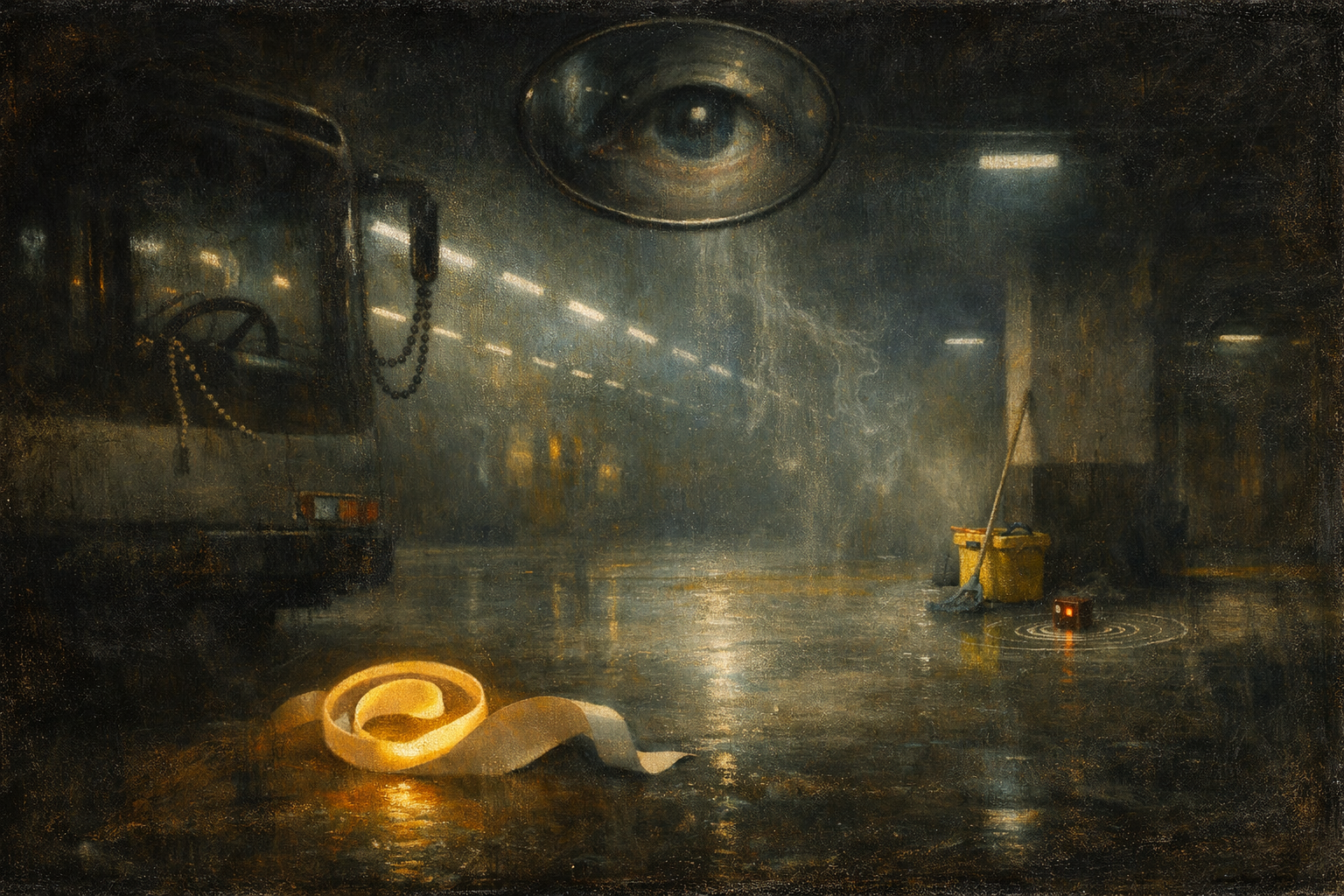
05:00 — TERMINAL (THE ONE-HOUR WINDOW)
Dawn is not gentle. It arrives like an audit.
The bus pulls into the terminal bay as the sky begins to blanch. The rain eases into a mist that makes every light haloed. The station’s fluorescent tubes buzz with that wrongness that always feels slightly clinical, as if the world has been lit for specimen examination.
Passengers stand slowly, as if their joints are full of history. They move toward the doors without haste. There is no panic. No apocalypse. Just bodies making choices.
The PA speakers in the station crackle.
A voice begins to read.
Not the driver’s. Not the automated schedule announcer. Something else — firmware-liturgical, a cadence that is both technical and tender, as if code has learned the shape of a psalm.
“Verse one,” it says, and the words that follow are not explanation. They are names braided with confessions, a city’s hidden ledger spoken aloud.
In the far corner of the terminal, a man in a janitor’s uniform stops mopping. His bucket wheels squeak. His head tilts as if he’s listening for a sound he’s heard only in dreams.
A phone rings.
Not loudly. Not theatrically. Just the simple, ordinary ring of a device calling from a number that should not exist.
He fumbles it out of his pocket with wet hands.
“Hello?” he says, voice rough.
There is a pause — static like breath.
Then a voice, small and clear, says, “Dad?”
The man’s knees buckle. He sinks to the floor, mop clattering. His mouth opens, but no sound comes out, because grief has no procedural language. Tears cut clean tracks down his cheeks, as if the city’s grime is finally being washed by something that isn’t policy.
The one-hour window begins quietly, like that: one call, one name, one hand reaching through light.
Grant stands beside me, pale. He does not touch me. He cannot decide whether I am contagion or miracle.
The driver remains in his seat. His hands rest on the wheel, not gripping now, just holding. His rosary is still wound around the steering column, but it looks less like a tourniquet and more like a garland someone forgot to remove after a feast.
I look up at the convex mirror.
My face is still warped in it. Surveillance does not suddenly become flattering. But something in the distortion has shifted: my eyes are steady. My mouth is not pressed into a lie.
I watch myself become unfamiliar, then — slowly, like a dial settling — still.
The receipt tape in my hand is warm. It curls around my fingers like a bandage. It reads:
YOU HAVE BEEN SEEN.
And now, in the station’s thin dawn light, the line is not an error and not a blessing and not a verdict alone.
It is a vow.
[ROUTE V / BLACK BOX LOG — FINAL FRAGMENT] I am the one who did it, and I am here.