The Afterglow Font

3:17 a.m. A nightclub medic keeps an overdose breathing in the rain — until a mylar-lined kiddie pool gleams like a baptismal font. With cameras rolling and a lighting tech offering blind spots, she must choose what gets saved, and what gets erased.
3:17 a.m.
The bass came through the service corridor like a heart you couldn’t consent to. It didn’t ask; it imposed. It pressed its low frequency through cinderblock and into my teeth, into the thin bones of my wrists when I leaned an elbow on the staff door and waited for the latch to catch. Every night it tried to entrain me. Every night I pretended the matching in my own pulse was coincidence.
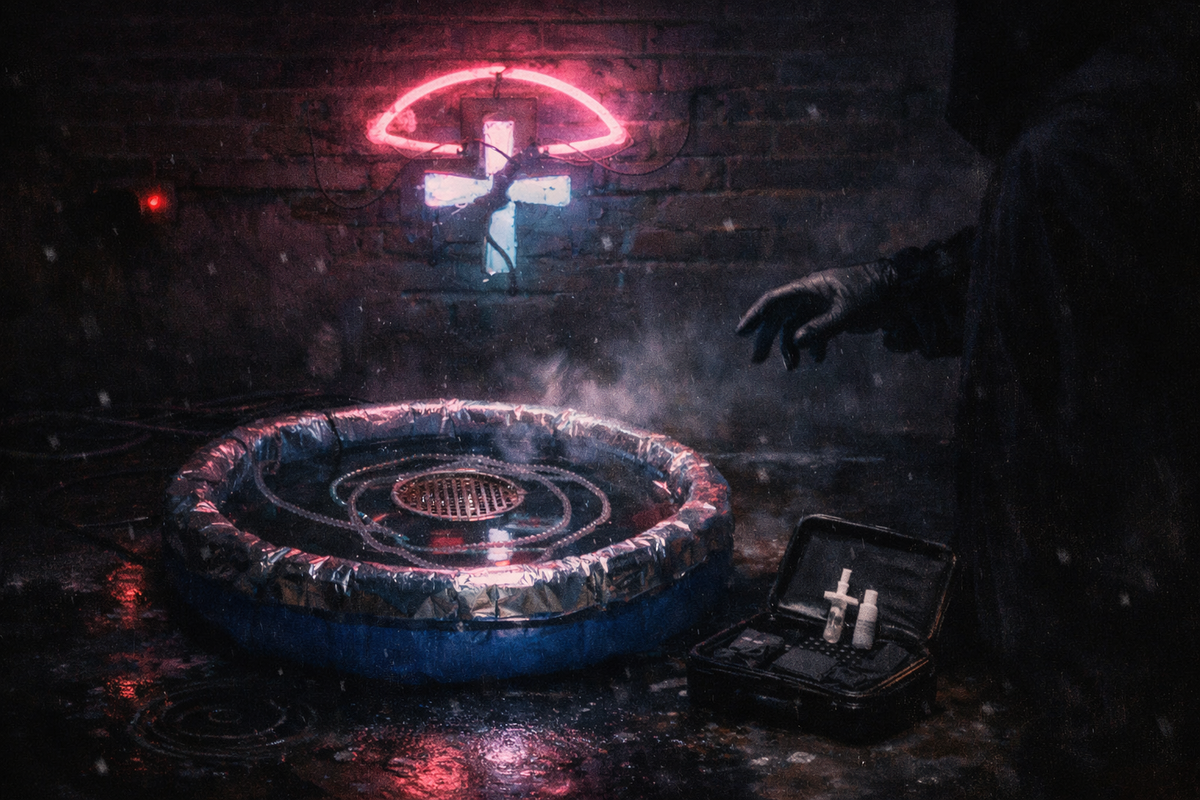
I laid my kit out on a flattened liquor box by the mop sink, edges squared to the grout lines as if right angles could hold anything in place. Gloves. Pocket mask. Two intranasal naloxone sprays — sealed like communion in plastic. One vial and a syringe for IM if the spray wasn’t enough. Alcohol wipes that smelled like a hospital hiding itself. A saline flush I almost never used but kept because carrying it felt like carrying an answer. Finger pulse ox — cheap red digits that blinked like a verdict.
I tapped the oximeter against my palm until the display steadied. Ninety-eight, on me. Fine. Functional. No drama.
That phrase was Sharpied above the UV stamp pad on the wall — NO DRAMA — someone having made it a rule and then, beneath it, someone else having made it a threat: OR ELSE. The stamp pad sat in its shallow tray like an offering plate, the ink black in ordinary light, bruised violet under the club’s UV wand. Door-stamps and wristbands. Admission as mark. Return as mark. Nobody got into anything here without being touched.
The stamp itself was a little plate with a single simple shape, worn smooth from thousands of wrists: a cross if you squinted, a broken halo if you didn’t. One arm stunted at the upper left corner, as if the sign had been damaged mid-revelation and nobody bothered to replace it. A cheap icon designed to be seen only under the right light.
My thumb hovered over it. Habit. Superstition. The part of me that wanted every object to behave.
I pressed the stamp once, not to my skin — never my skin — just to the cardboard box beside my kit, a test print, a pointless ritual. I flicked the UV wand on.
The shape bloomed. A clean little broken cross in fluorescent ink. It looked too deliberate for a nightclub mark. It looked like something you’d see painted on a forehead by a hand that believed in what it was doing.
My stomach clenched. The bass slipped into a familiar break, the drum pattern that had haunted half of dance music for decades, and my throat tightened around a word that wasn’t mine anymore.
Amen.
It wasn’t even a word on the dancefloor; it was a loop, a sample, a theft. But the cadence hit the same place in me it always had, like someone pressing a thumb to the soft spot between my ribs.
— water cold as coins, a hand between my shoulder blades, the smell of citrus oil and damp hymnals, my mother’s palm firm on the back of my head, pushing me down, not cruel, just certain —
I blinked hard. The corridor’s LED strip buzzed. The mop sink gurgled and swallowed the rinse water I’d poured earlier, the drain making its small hungry sound. I tore an alcohol wipe open and scrubbed the cardboard stamp away until the ink smeared into nothing.
It didn’t quite disappear. Under the UV, a faint ghost of the broken cross lingered in the fibers.
I snapped the UV wand off. Darkness returned to normal.
If you asked me what I believed, I would have said I believed in protocols. I would have said it like an alibi.
I zipped my kit, teeth of the zipper whispering like beads when they ran true. I checked my watch.
3:17.
Patrol tended to idle by the block around the forty-five, bored headlights dragging over puddles. Sanitation had a hose-down scheduled for four, a municipal baptism in chlorine and pressure, washing the alley clean enough for daylight to pretend nothing happened there.
The neon over the back door — the broken halo/cross in actual glass and gas — was on a timer I didn’t control. It always cut at four, a mercy the building granted itself.
The staff door camera sat above the frame, a little box with a tiny red REC light. I never met that eye. I kept my gaze on hands, on wrists, on readouts, on any part of a person that didn’t ask to be seen back.
The latch clicked.
I pushed into the alley and the rain hit my face like thrown change.
The neon spill painted the puddles a sick pink-blue, oil-sheen rainbows turning gasoline into stained glass. My breath fogged and caught the light, little halos that hid and revealed in the same exhale. Somewhere deeper in the club, the bass kept its litany, heartbeat through brick.
Behind the stacked kegs, where the alley narrowed into a dead-end triangle of brick and pipe, something flashed — mylar catching neon and throwing it back. A flicker that wasn’t the sign. An afterimage before the image had time to form.
My body slowed before my mind agreed.
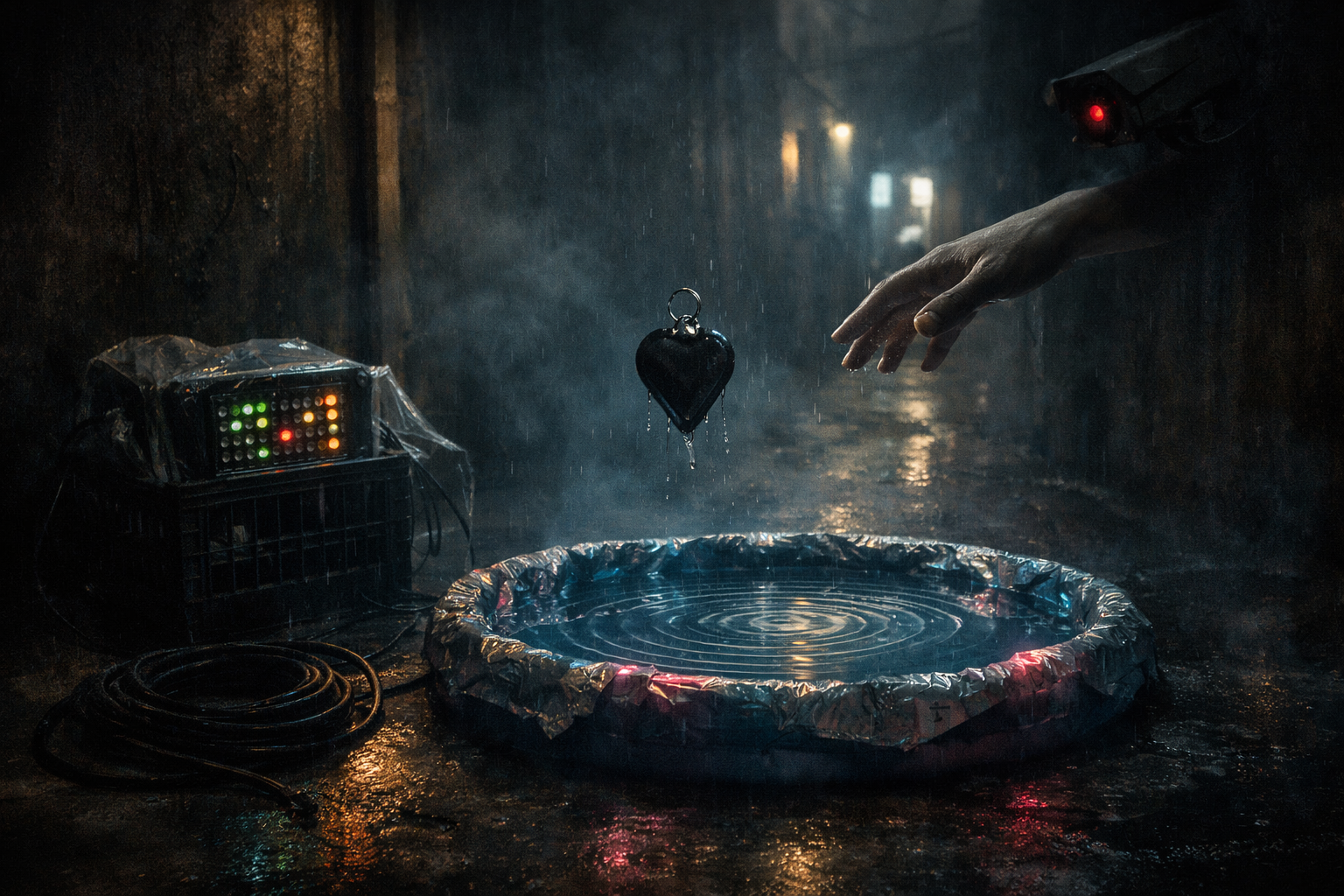
A kiddie pool sat back there like a joke someone had tried to sanctify. Cheap blue plastic, rim lined with mirrored mylar taped down in obsessive seams, each strip flattened with a thumb as if smoothing out a wound. In the center of the pool someone had cut in a drain grate, metal squares like teeth. Two clear hoses ran into it from a spigot on the wall, their coils looped around the pool like rosary beads you could trip on. An extension cord lay too close, black rubber already slick with rain. Above it all, zip-tied to a rusted pipe, a strip of LED neon hummed — ballast-throat sound, that faint electrical ache you feel more than hear.
The light bled in the rain. In my eyes, it afterimaged.
The font.
The word arrived in me fully formed and unwelcome. Not something I used. Not something I believed in. But the shape of it — the water held in a circle, the drain-mouth waiting — hit a place under my sternum like recognition.
Condensation filmed the brick behind it. In the wet, fingerprints. Smears. Half-sigils somebody had drawn in the fog of breath and then wiped away, leaving ghosts of gestures, confession erased and reappearing with each exhale.
A puddle shifted under my boot. A thin stream of water crawled toward the extension cord.
No.
I stepped back, heart ticking up, pulse trying to sync with the bass like a bad habit. My job wasn’t to find secret altars behind clubs. My job was bodies: airway, breathing, circulation. Keep the lights on until dawn.
The staff door banged and voices spilled out, sharp with urgency and annoyance.
“—out, out, take him out back.”
Something heavy scraped across concrete.
My kit was in my hand before my thoughts finished assembling. Gloves. Now.
Jax hooked a man under the arms and dragged him through the door like liability with a pulse. Shaved head, earpiece, shoulders wide enough to be a wall. He didn’t look at the man’s face. He looked at my kit, saw it, and relief flickered across his mouth like a signal.
“Medic,” he snapped when he saw me. Not my name. Never my name. “We got one.”
Behind him, the floor manager hovered half in the doorway, jaw clenched around the math of headlines. Two patrons had followed, phones already raised, screens glowing like small confessionals, hungry for a story with a body in it.
“No filming,” Jax barked, but his voice was foam against the tide. Shame wanted an audience. So did mercy. So did the club’s algorithmic little gods.
The man hit the ground on his side, shoulder splashing into a puddle. Rain slicked his hair flat. A UV wristband clung to his wrist like seaweed, and the stamp beneath it — club ink — had already started to bloom on wet skin, purple-black petals spreading.
I dropped to my knees. Cold soaked through denim immediately, rain finding every seam, making my body a conductor.
“Sir,” I said, loud enough for the phones, professional enough to sound like this was ordinary. “Can you hear me?”
His lips were blue at the edges. His breathing — if it was breathing — was a shallow hitch, a half-remembered motion. Pupils pinned. Sweat cutting through rain on his forehead.
I tilted his head back, fingers under his jaw, thumb at his chin, careful. Airway. His tongue sat heavy. No swallow. No cough.
I didn’t look at his eyes. My gaze went to wrists, to the stamp, to the pulse point in his neck. To numbers.
“Call 911,” I said.
The floor manager’s mouth tightened. “We don’t—”
“Call,” I repeated, and my voice had the flat edge I used when I needed authority faster than empathy. Protocol as prayer. “Now.”
Jax hesitated, the club policy tugging on his arm like a leash, then he turned away and called.
I tore a naloxone pack open. The plastic crinkled like breaking ice. My hands were steady because they were doing something. Doing was my only form of peace.
I counted his respirations. Three in ten seconds. Too slow. Too shallow. His pulse under my fingers was there — fast, weak, a drum under water.
I got the pocket mask on, sealed it to his face, and started rescue breaths. One. Two. Three. The bass through the wall gave me a tempo I hated.
In the moment I pushed air into a stranger’s lungs, my mind did what it always did when I wasn’t watching it: it laid another night over this one like transparent film.
— bathroom tile cold under my knees, a body folded wrong in the stall, someone’s voice saying “wait for the supervisor” like bureaucracy could restart a heart, my own hands busy with forms instead of breath —
The memory didn’t play like a movie. It came as sensation: the metal taste of panic, the refusal in my eyes to look at a face.
I forced myself back into this man’s chest rise. Into the click of my own inhale behind the mask.
“Stay with me,” I said, because you say it even if you don’t know who you’re talking to — the person on the ground or the part of yourself that thinks waiting is the same as killing.
I sprayed naloxone into his nostril, plunger firm. One dose.
Behind me a voice — bright, curious — asked, “Is he dead?”
“Back up,” I said without turning. “Give space.”
Space was the one thing the alley couldn’t afford.
A shadow moved near the kegs. Someone stepped into the neon spill and the rain broke him into light.
He was thin, hood up, lanyard at his throat, fingers stained with gaffer tape residue. He didn’t look like security or management. He looked like the system that made everything else possible — the person you only noticed when the lights failed.
His eyes went to my hands, not the man’s face. To my kit, to the angle of my wrist, to the naloxone packaging, like he was reading a schematic.
“You’re in the eye,” he said.
I kept breathing. “What?”
“The dock cam.” His chin tipped, precise, toward the little box above the loading dock. Tiny red REC lit in the rain, unwavering.
“Let it see,” I said. My voice tried for indifference. My pulse betrayed me. “He needs an ambulance.”
The hooded man crouched beside me without asking, close enough his shoulder nearly brushed mine, close enough his body blocked one phone’s angle. Tenderness as obstruction. His hand lifted as if to reach for my kit, then stopped, hovering — not taking, not touching, like a blessing withheld.
“Name?” he asked.
The wrong question, the wrong time. It made a sound in my skull like a fuse sparking.
“He’s overdosing,” I said.
“I know.” His gaze flicked, again, to the mylar flash behind the kegs. To the kiddie pool that was not a kiddie pool. “Bring him.”
“Where?” I didn’t look up. I didn’t give him my eyes. I gave him my work.
“Not here.” He nodded toward the dead-end triangle. “Blind spot. Two minutes. Then the timer cuts.”
“Timer for what.”
He glanced at the broken neon halo/cross over the back door. It flickered once, like a pulse check. “For the light.”
I heard myself thinking: light as permission, light as witness, light as threat.
Jax’s voice carried from under the awning. “Dispatch says fifteen. You want police with it?”
“No,” the floor manager snapped too fast. “No police.”
The hooded man’s jaw tightened at that word. Authority did something to him; you could see it in the way his thumb sought a small square on the lanyard — like an absent itch.
He reached, suddenly, and closed his fingers around my wrist.
Not intimate. Not quite gentle. Firm enough that my shaking stopped as if he’d clamped the right wire.
“You’re flooding him,” he said.
“I’m breathing for him,” I snapped.
“Your rhythm,” he said, and it came out both technical and tender, which was worse. “Slow. He needs air, not your fear.”
I hated him for hearing it. I hated myself for being heard.
He didn’t let go. His thumb pressed lightly on the bone above my glove, guiding the timing. One breath. Pause. Another. Let the chest fall. Let the body decide.
The bass inside the wall hit the Amen break again, and the word rose in me like bile.
Amen.
I swallowed it. I breathed anyway.
The man on the ground took a shallow gasp that wasn’t mine. Not enough, but something.
The hooded man finally looked at my face long enough for his eyes to try to catch mine. I looked at his hands instead.
“What do they call you?” I asked, because naming him felt like a way to reduce him.
His mouth twitched. “Deacon,” he said. Like it was a joke that had become a job.
Of course.
Deacon turned his head toward the phones. “You,” he said, voice flat. “Put that down.”
One patron laughed. Another kept filming.
Deacon’s thumb tapped the lanyard again. A small click. Somewhere, the lighting rig inside the club shifted, a strobe test pattern leaking briefly through the loading dock door seam — white slices of light like confession frames.
The phones wobbled. The camera’s red eye didn’t blink.
Deacon met my gaze again, and this time I felt the asymmetry like a weight: he had the blind spots; I had the drug that could pull a person back.
“Bring him,” he said. “Or we do this as content.”
3:28 a.m.
We moved the man in a choreography that wasn’t compassion and wasn’t indifference. It was practiced crisis. Jax took shoulders. I took hips, keeping the jaw forward, head tilted back, airway open. The man’s arm flopped, fingers dragging through water, leaving wet lines that filled in immediately.
Deacon walked backward ahead of us, one hand held out in a stop gesture toward the patrons, the other carrying a milk crate with his DMX console strapped to it under a clear plastic cover. Little LEDs blinked in tidy grids, green and red and amber — an altar made of status lights.
Rain pooled. The extension cord looped near the font like a snare. Deacon’s voice cut through, sharp.
“Watch the cord. Step over — now.”
I stepped. Jax stumbled, caught himself. The milk crate bumped Deacon’s thigh; he steadied it like a child.
The font was closer now, its cheapness obscene and its care unmistakable. Someone had wiped the rim; it shone under neon. Water in the pool vibrated with the bass, surface trembling in small concentric rings that made the mylar throw fractured light back at us. The drain grate waited in the bottom, mouth open.
I set the man down on the wet concrete beside it, not in it. Not yet. My hands refused that leap without permission, as if something in me knew the difference between care and commandeering.
Deacon knelt and wiped the rim again anyway, palm moving in tight circles until his knuckles went pale. The gesture wasn’t sanitation. It was devotion with a rag.
“This is—” I began.
“Don’t,” Deacon said without looking up. “Don’t call it what it is.”
“A kiddie pool?” The word came out like a laugh I didn’t mean.
Deacon’s head snapped up, and for a moment his eyes were sharp enough to cut. “A font,” he said. Quiet. Heavy. “A place you wash what you can name.”
The bass thumped. The neon hummed. Rain drummed on mylar. The city gathered itself around us like it could smell a story.
I put the pulse ox on the man’s finger. It blinked and struggled through wet, cold skin. Numbers flickered — 74, 68, 79 — settling low. His oxygen saturation wasn’t dying but it wasn’t living easy.
“Okay,” I said to myself. “Okay.”
Deacon’s gaze went to the oximeter like it was an icon of his own kind — proof the body could be measured and still slip away.
“He can’t consent,” I said, because the word had become a wall I could hide behind.
“Then he can’t be washed,” Deacon answered.
“He’ll die.”
Deacon’s fingers hovered over the water, not touching. The neon lit his hand from below, bones in a pink-blue glow. “He might die anyway,” he said. “Don’t turn it into a conversion story.”
Conversion story. The thing people demanded from ruin: a narrative arc, a clean end, a miracle with good lighting. The thing I’d been trying to manufacture out of protocols for years.
I checked the man’s breathing again. Still shallow. Still there. I drew up the vial and syringe with hands that suddenly weren’t as steady. A tremor, small, showing itself like a fault line.
Deacon’s hand slid over mine without asking, his fingers closing around my wrist. It was the same grip as before — firm, guiding, not quite gentle. He steadied my shaking like he was damping oscillation in a circuit.
“Push slower,” he murmured. “You’ll tear.”
“Don’t tell me how—”
“I’m not telling you,” he said. “I’m keeping you from breaking.”
His breath fogged in the neon, a halo that hid his face for a second. His thumb pressed on my pulse point. Pastoral, invasive.
He let go only when the needle was in and the naloxone was delivered. The man didn’t flinch. His body stayed heavy, stubbornly undecided.
Phones hovered at the edge of the alley mouth, screens catching every angle Deacon couldn’t block. Jax held them back with his shoulders, but people leaned, hungry.
The floor manager’s voice hissed into an earpiece: “No drama, no drama, get him out of sight—”
Deacon’s thumb found the DMX blackout button like a rosary bead. The button was worn smooth, a small square of plastic that controlled what could be seen.
“Blackout buys us a breath,” he said to me. “Not mercy.”
He pressed.
The neon spill on the loading dock dimmed as the club’s exterior floods cut. The patrons’ phone screens became the brightest things in the alley. The dock camera’s red REC eye kept glowing, unbothered. It didn’t need light; it needed only a lens.
Deacon’s jaw tightened. He looked up toward that camera, then back to the font. His world was built of visibility and its absence. He worked in the space between.
“What do you want?” I asked him, and I meant it more than I wanted to admit.
Deacon wiped the rim again. “I want the rules to hold,” he said. “Otherwise this becomes another feature. Another vibe. Another clip.”
“And I want—” My mouth wanted to finish the sentence with something noble.
I wanted him washed. I wanted the word baptism to mean clean and not complication. I wanted to do one correct thing in a filthy place and have it erase the wrong thing I’d done by waiting. I wanted absolution by proxy.
What came out was: “I want to keep him alive long enough to decide.”
“Then decide with consent,” Deacon said, and the word consent sounded less like law and more like wound.
The man’s chest rose in a deeper breath. His eyelids fluttered. Naloxone did what it did: yanked a person back toward pain.
His fingers twitched.
Deacon lifted a hand, palm open, hovering above the font like he was measuring heat. “If he speaks,” he said. “If he gives it. Then we can wash.”
“Name?” The floor manager barked from the door. “Does anyone know who he is?”
Jax glanced at me. “He’s got a wallet. We can—”
“No,” Deacon snapped, and the word was a gavel. “Not that.”
“It’s just a name,” Jax said, exasperated.
“It’s not,” Deacon said, and his eyes flicked to the red REC light like it was proof. “Names are how the city owns you. Names are how they file you. Names are how the church used to own you. If you say it wrong, you don’t wash. You brand.”
Brand. The word landed in my mouth metallic.
The neon sign above the back door flickered again, a hard stutter. The timer’s warning. The light had a schedule. Grace did not.
My watch: 3:36.
Rainwater ran along the brick, found cracks, gathered, slid toward the font as if pulled. The drain grate waited, patient.
Deacon’s hand disappeared into his hoodie pocket. Something hard made the fabric tent. He drew it out.
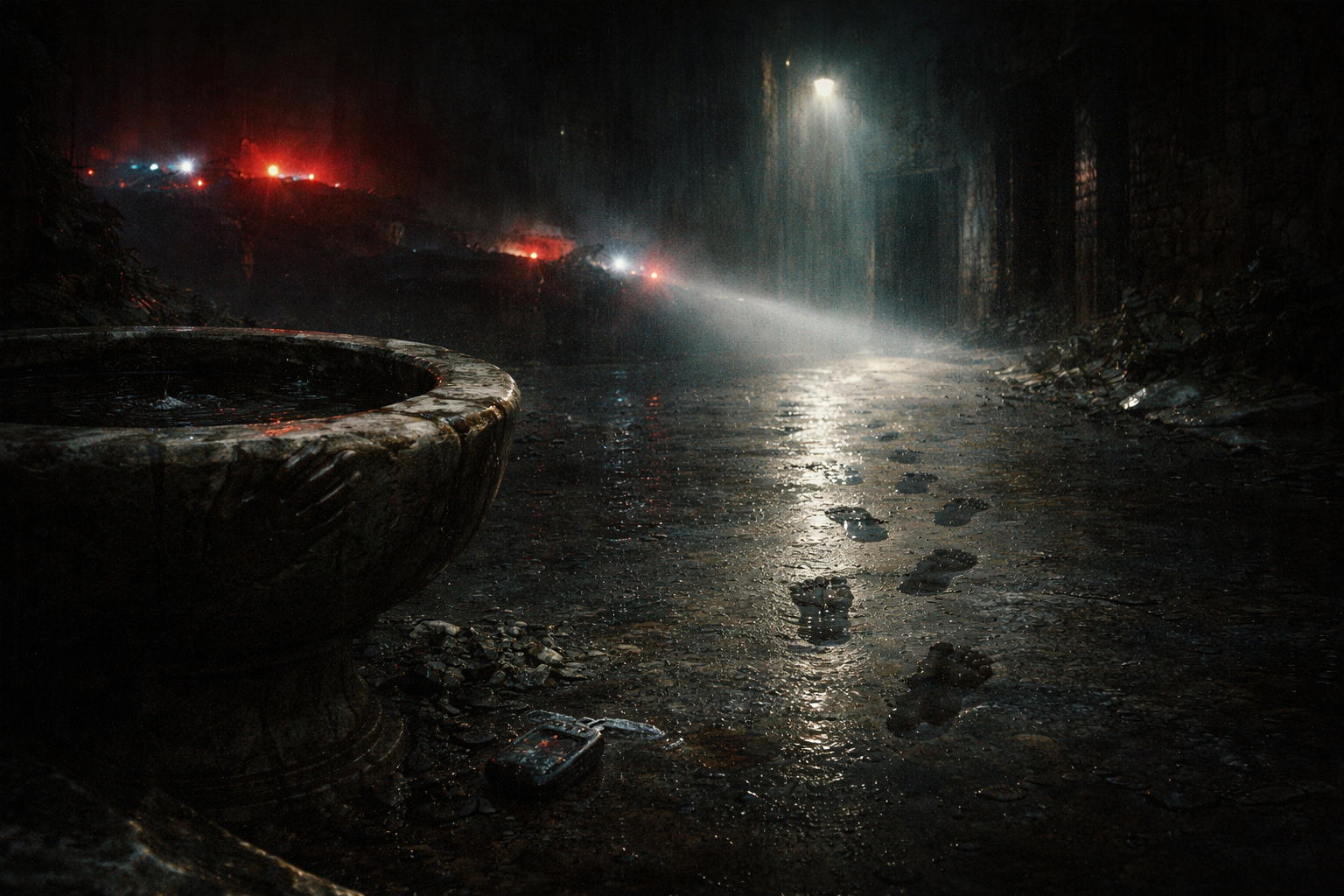
A black key-fob. Corporate plastic with a serial number stamped in pale gray. No symbol. Just access.
“DVR closet,” he said. “I can get in. We can scrub the feed. The dock cam never saw this.”
The floor manager’s eyes sharpened. The idea of erasure always did that to people.
Jax exhaled. “Thank God,” he muttered, not looking at anyone.
The word god was so casual and so wrong in that alley that my skin prickled. Deacon’s jaw tightened as if it had been a trigger.
“There’s a patrol pass,” Jax added. “They’ll see the ambulance. They’ll see the crowd. We need it clean.”
Clean. The word hit the inside of my teeth like it wanted to chip them. There was no clean here. There was only containment and the things you told yourself to justify it.
Deacon held the key-fob out to me, palm up. Rain beaded on it, tiny lenses.
“If you want to do it fast,” he said, low enough only I could hear, “we use the name on his ID. We wash. We delete. Rule kept. No cops. No church. No management. No record.”
My stomach turned. It wasn’t nausea; it was recognition.
Making it not exist.
The old night rose behind my eyes again, not as memory but as pressure — fluorescent buzzing, tile, paperwork, a supervisor’s voice, the moment when doing nothing had been reframed as policy, and then later, daylight making everything ordinary.
I kept my face blank. I kept my hands moving. Hyper-competence as anesthesia.
The man coughed, wet and violent. His body jerked as if rejecting the air I’d given him. He gagged and tried to roll. I caught his shoulder, guided him into recovery position, hand firm at his hip. Vomit and rain mixed and ran toward the drain grate. The grate drank it without comment.
His eyes snapped open. Wide. Bloodshot. Pupils blown now in the neon, too much light. He sucked air like he’d been under water.
He stared at me. In his eyes the neon reflected — a cheap saint’s halo.
For the first time I met his gaze because there was no other way to keep him here.
“Hey,” I said. “You overdosed. We gave you naloxone. You’re safe. An ambulance is coming. Can you tell me your name?”
His throat worked. He tried to speak and coughed instead. Pain crossed his face like static. He looked from my face to the font, then back, fear and anger braided.
His hand shot out and clamped onto my wrist.
The grip was sudden and desperate, fingers digging into the latex, nails scraping skin through glove. Not romantic. Not symbolic. The simple animal need to hold onto something that wasn’t moving.
His lips moved. A syllable dragged itself out, raw and small.
“—na,” he rasped. Or “no.” Or “Ana.” Or a sound the bass was already looping in my bones: amen stripped of meaning and turned into noise.
My pulse jumped where his fingers pressed. The pain was real. The contact was intimate in the way triage is intimate: bodies pressed together because there was no room for distance.
Deacon stood at the font’s rim, one hand splayed on the mylar tape, the other hovering near the blackout button. He looked like a priest who’d been asked to officiate in an alley and had shown up anyway.
His hand lifted, hovered over the man’s head, then stopped short. Blessing withheld. Restraint as rite.
Under the dock camera’s red eye and the phones’ hungry screens, the neon sign flickered hard. The light stuttered. My watch flashed.
3:41.
The moment narrowed until it was nothing but a choice shaped like my own hands.
I could take the wallet. I could read the plastic name off an ID like it was truth. I could say it over him and push him into the water and call it washing. I could do one clean act in a filthy place and pretend it had power.
Or I could not.
Deacon’s key-fob hung between us like a small dark heart. “We can make this not exist,” he said, almost tender, and I heard the hunger under it — not just to protect the font, but to be necessary. To be the mediator. To hold the holy in his fist like a tool.
My hands trembled. Not from cold.
The bass hit the Amen break again and the word rose, hot and involuntary.
Amen.
My mouth closed around it. I didn’t give it air. I didn’t give it to anyone else as a story.
The man’s grip tightened. His eyes narrowed. His lips shaped the refusal more clearly now. A small shake of his head against the concrete.
No.
Consent, finally audible.
My breath caught. The part of me that wanted a verdict — yes, wash, erase — panicked. My fingers twitched toward the edge of his wristband as if I could slide it up and find the stamp, the mark, the name the club had already given him. My mind reached for procedure like a lifeline.
And then, without deciding to, I felt something else in me shift: the knowledge that my mercy had always been a way to avoid being forgiven. As long as I was the one saving, I never had to offer my own throat to anyone’s witness. As long as I was the rescuer, I never had to be held.
Deacon’s eyes were on my hands. Not my face. He didn’t ask me to look at him. He asked me to speak.
“Your name,” he said, quiet. “If you’re asking this place for anything, you don’t get to stay anonymous.”
I didn’t want to give it. Names were how you were filed. How you were kept. How you were called back.
But I had already been called, hadn’t I? The bass had been calling me all night, that stolen cadence hitting the same old wound.
I swallowed rain.
“My name,” I said, and my voice cracked on the edge of the word like a badly soldered joint, “is Anastasia.”
The full sound of it in my mouth felt like stepping into colder water than you expected. It felt like a door unlatching in my chest.
Deacon’s breath stopped. His eyes widened a fraction, as if the frequency had changed. The DMX console LEDs blinked in a new pattern — maybe coincidence, maybe his thumb moving without thinking. The neon above the door flickered once, then steadied, holding its afterglow a moment longer than the timer should have allowed.
In the font, the water trembled.
Maybe it was the rain striking the surface. Maybe it was the bass vibrating through the brick. Maybe it was the shift in all our bodies as a name entered the air and refused to be erased.
Condensation on the brick thickened. A handprint appeared in it — small, like a child’s, pressed low where no one’s hand was. Then a smear wiped it away as if the wall itself exhaled.
The man stared at me when I said Anastasia. Something moved across his face — not gratitude, not miracle, just the brief startled look of someone hearing a word they’d forgotten they knew. His fingers loosened on my wrist.
I used the slack to reposition my hand under his jaw, keep his airway open, keep him from biting down on his own tongue when the withdrawal hit. I spoke to him again, softer now, not making his voice into my sacrament.
“Can you tell me your name?” I asked. “Only if you want. Only if you can.”
His mouth worked. He swallowed hard, throat raw.
“E—” he rasped. The syllable tore out of him like cloth snagged on a nail. “Eli—”
A name beginning. A name offered. Or a mistake. Or the brain reaching for the first familiar sound.
His eyes flicked toward the font. Fear sharpened again. He shook his head once, small, definite.
“Don’t,” he whispered.
Consent, now a wound that wouldn’t close. A gift I didn’t get to spend.
“Okay,” I said, and the word came out like letting go.
Deacon exhaled, breath fogging the neon into a halo that hid his face. He didn’t touch the water. He didn’t run the strobe. He didn’t do the cue he’d built for this moment. He stood with his hands open, restraint as his only liturgy.
The phones at the alley mouth shifted, restless, trying to make the scene mean something. The dock cam’s red REC light watched, tireless.
A siren dopplered into the bass, two rhythms arguing.
“Ambulance!” Jax shouted.
3:49 a.m.
Paramedics pushed into the alley with a stretcher, voices crisp with authority that didn’t need to announce itself. Red light from the rig flashed across the rain, across the mylar, across Deacon’s hood, making everything look like a warning.
“What’ve we got?” one of them called.
“Opioid overdose,” I said, back in my language, the safe lexicon that kept me from falling into myth. “Two doses naloxone — one intranasal, one IM. Rescue breaths. He’s breathing, altered, vomiting. Sat’s low eighties earlier, improving. Possible precipitated withdrawal.”
The words came clean. They made chaos portable.
The paramedic nodded, already attaching monitors, already taking over the body I’d been holding. The man’s eyes were wild. He looked at me once more, and in them I saw a refusal that wasn’t about me: a refusal to let this night become a story he had to carry.
They lifted him onto the stretcher. Straps clicked. Plastic buckles sounded like handcuffs. He thrashed once, then sagged, exhausted by being pulled back.
As they rolled him toward the ambulance, his hand fell from the edge of the stretcher and brushed the puddle beside the font. Water streaked his fingers. Neon painted them.
In the wet concrete near the kiddie pool, prints appeared.
Not mine. Not Jax’s heavy tread. Not the man’s shoe tread. Small, bare-sole ovals with the faint ridge patterns of skin, as if someone had stepped out of water and walked away.
They began beside the font. They led toward the back door. They did not come from anywhere.
Rain filled them immediately, softening the edges, but for a second they were undeniable.
Deacon saw them. His face went very still. His hand pressed flat to the font’s rim, fingers splayed, as if holding the place in existence by force of touch. He didn’t point. He didn’t explain. Explanation would have cheapened it. He just held.
The floor manager exhaled like she’d been holding her breath for headlines. Phones rose higher to catch the ambulance lights. Content. Conversion. Anything.
The paramedics wheeled the stretcher out. The siren began again, and then it was gone, leaving the bass to reclaim the street.
The alley, for a moment, held a hush that wasn’t silence but suspension. The kind of pause that comes before you decide what you’ll do with what you’ve witnessed.
Then the patrol car turned the corner at the block’s end and its headlights swept across the wet ground like a searchlight. White light combed over the kegs, over the dumpsters, over the puddles, over the small disappearing footprints.
Jax swore under his breath. The floor manager’s hand went to her headset.
Deacon’s gaze snapped to me.
The key-fob was still in his hand. The plastic glistened.
3:57 a.m.
“Closet,” Deacon said. “Now.”
We moved like people who’d rehearsed this under pressure. Deacon hoisted the milk crate with the DMX console, the way someone carries a reliquary. Jax stayed by the door, body broad, keeping management and patrons back with the authority of someone who’d seen enough bodies to stop romanticizing it.
I followed Deacon because the red REC eye above the loading dock had watched my mouth form Anastasia. Because the phones had watched my hands on a stranger’s jaw. Because being seen was being marked, and in this city marks were currency.
The DVR closet door was half-hidden behind pallets, steel and grease-smeared. AUTHORIZED PERSONNEL ONLY. Sin here quietly.
Deacon swiped the key-fob and the lock clicked. The small sound made my stomach drop. Access granted. Judgment deferred.
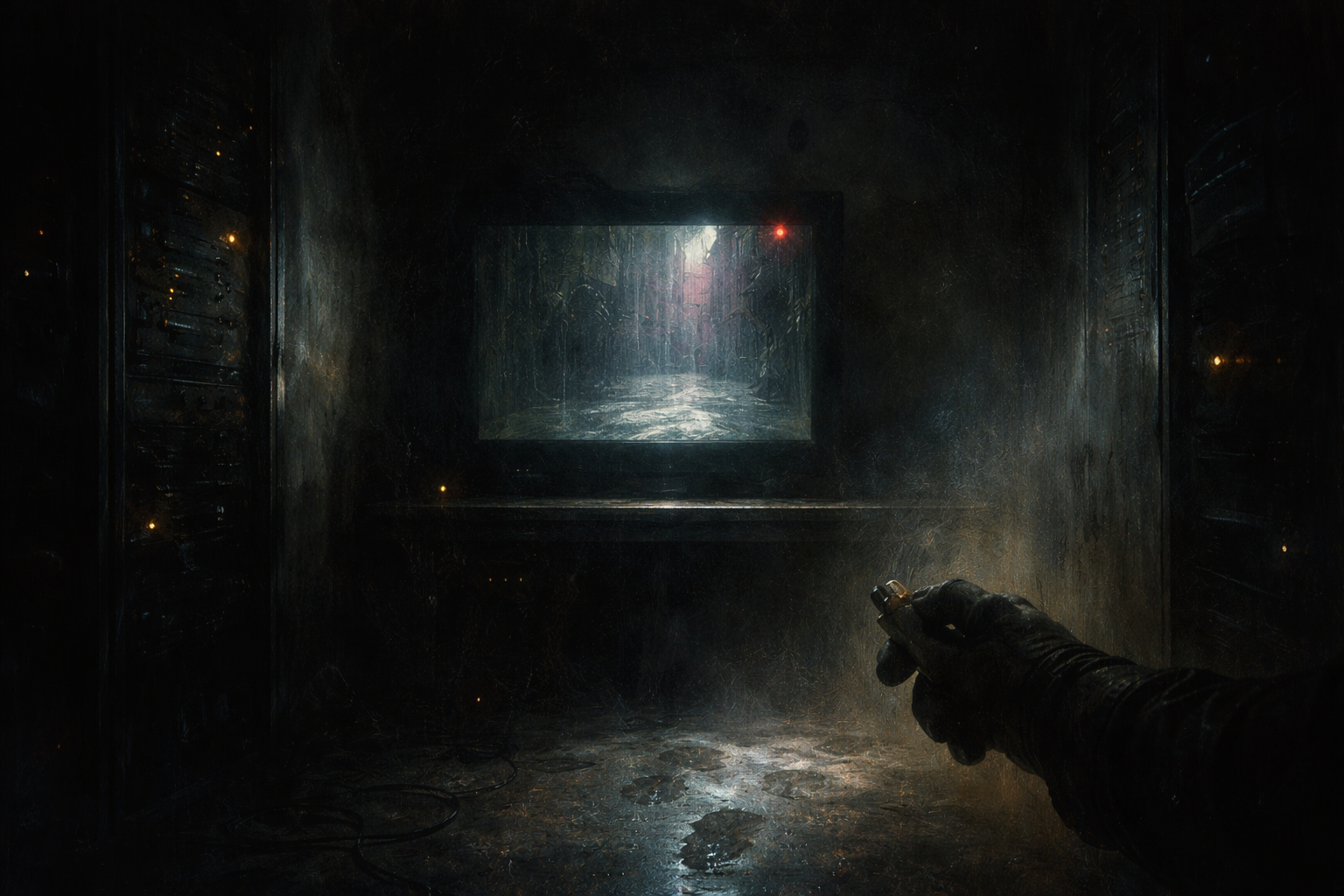
Inside, the air was hot with dust and electronics. Fans whined, constant. Racks of black boxes blinked in neat rows, status lights like votives. A monitor showed four camera feeds at once: main floor, bar, corridor, loading dock. The loading dock feed held the alley in a washed-out rectangle, rain streaking the lens, neon smearing into bruise-color.
In the corner, the red REC icon pulsed.
On-screen, I saw myself kneeling in the rain, hands on the man’s jaw. I saw Deacon’s hood. I saw the font as a bright patch. I saw the phones, screens like mirrors.
I watched my own mouth open, watched it form a name I’d tried to keep small. Anastasia, soundless in the feed but readable if you knew how to read lips, if you wanted to file it.
Deacon set the milk crate down and his hand went automatically to the DMX blackout button, thumb resting there like a habit. His other hand hovered over the DVR controls.
“We can make this not exist,” he said, softer now, as if the closet itself demanded quiet. “We wipe fifteen. We wipe the lip-read. Patrol has nothing. Management has nothing. The holy stays underground.”
“And next time?” I heard my own voice and didn’t recognize it. “Next time, when someone dies and no one calls because the footage never existed — what then?”
Deacon’s jaw worked. He stared at the monitor, not at me. “Next time,” he said, and there was something like shame in it, “we do it again. Or we don’t get to do it at all.”
The moral compromise was never clean. It was always two bad options braided together.
The floor manager’s voice leaked through the door — muffled, impatient. “Is it handled?”
Jax’s deeper voice answered, placating. “Handled.”
Handled. Like a cord. Like a body. Like a story.
Deacon’s fingers hovered over the delete function. The cursor waited. Delete, overwrite, confirm. Three clicks to turn witness into absence.
His tell surfaced: he wiped the edge of the monitor with his sleeve as if smudges were the real danger.
I thought of the stamp pad in the corridor, the broken cross blooming and being wiped away until only a ghost remained. Ink you could pretend not to see if you turned the UV off.
I thought of the small footprints in the rain, already filling in.
I thought of the other night, the one I never let myself watch back. The one without footage, without a witness. The one that had become my private DVR loop, playing whenever I paused.
My hand went to my pocket. I felt for the alcohol wipes. The naloxone. The things I trusted because they had instructions printed on them.
I didn’t have instructions for this.
Deacon looked at me finally, eyes tired. “If they shut this down,” he said, “if they call cops the next time because they saw what happened here tonight — people will die cleaner. Indoors. Without Narcan. Without anyone like you. Without anyone like me. And the city will call it safety.”
His voice was almost a prayer. It tasted like desperation.
“And if we delete,” I said, and my throat tightened, “we become the system that hides it.”
Deacon didn’t deny it. He just held the paradox like a lit candle he couldn’t set down.
I saw my own hands on screen. Saw them holding a jaw open, keeping air in. Saw the moment my mouth formed Anastasia. Saw it be recorded. Saw it become a mark.
I couldn’t decide which part of me wanted deletion more: the part that wanted to protect Deacon’s font, or the part that wanted to erase myself being seen at my worst — shaking, pleading, not in control.
I realized, with a clarity that made my stomach hollow, that I had been asking for erasure my whole life. I had called it professionalism.
Deacon held the key-fob out to me.
“Choose,” he said. “With your name still in your mouth.”
My hand closed around the fob. Warm plastic, obscene.
I handed it back.
Deacon’s fingers closed around it, and then he paused, as if touch itself was too intimate.
He pressed the DMX blackout button once. The loading dock feed on the monitor dimmed for a second, the camera compensating, seeing less, the alley turning to grainy gray.
“Blackout buys seconds,” he murmured again. “Not mercy.”
Then he moved the cursor. Selected the timecode. The last fifteen minutes, the part where my mouth made a name. The part where a body turned blue.
Delete. Overwrite. Confirm.
The monitor blinked. The loading dock feed went black for one breath.
In that black, an afterimage lingered in my eyes: neon water, mylar glare, a handprint in condensation, small wet footprints leading away.
Then the feed returned, live again, recording again, as if the alley had never held anything holy or sick.
The red REC icon pulsed, tireless, judgment rebooted.
Deacon exhaled slowly, shoulders dropping. He looked at me like he wanted to say I’m sorry or thank you or neither.
“You’re marked,” he said.
I almost laughed. “We were already marked.”
Deacon’s mouth twitched, almost a smile, almost grief. “No,” he said, and his gaze flicked to my wrist like he could see through fabric. “Not like this.”
4:05 a.m.
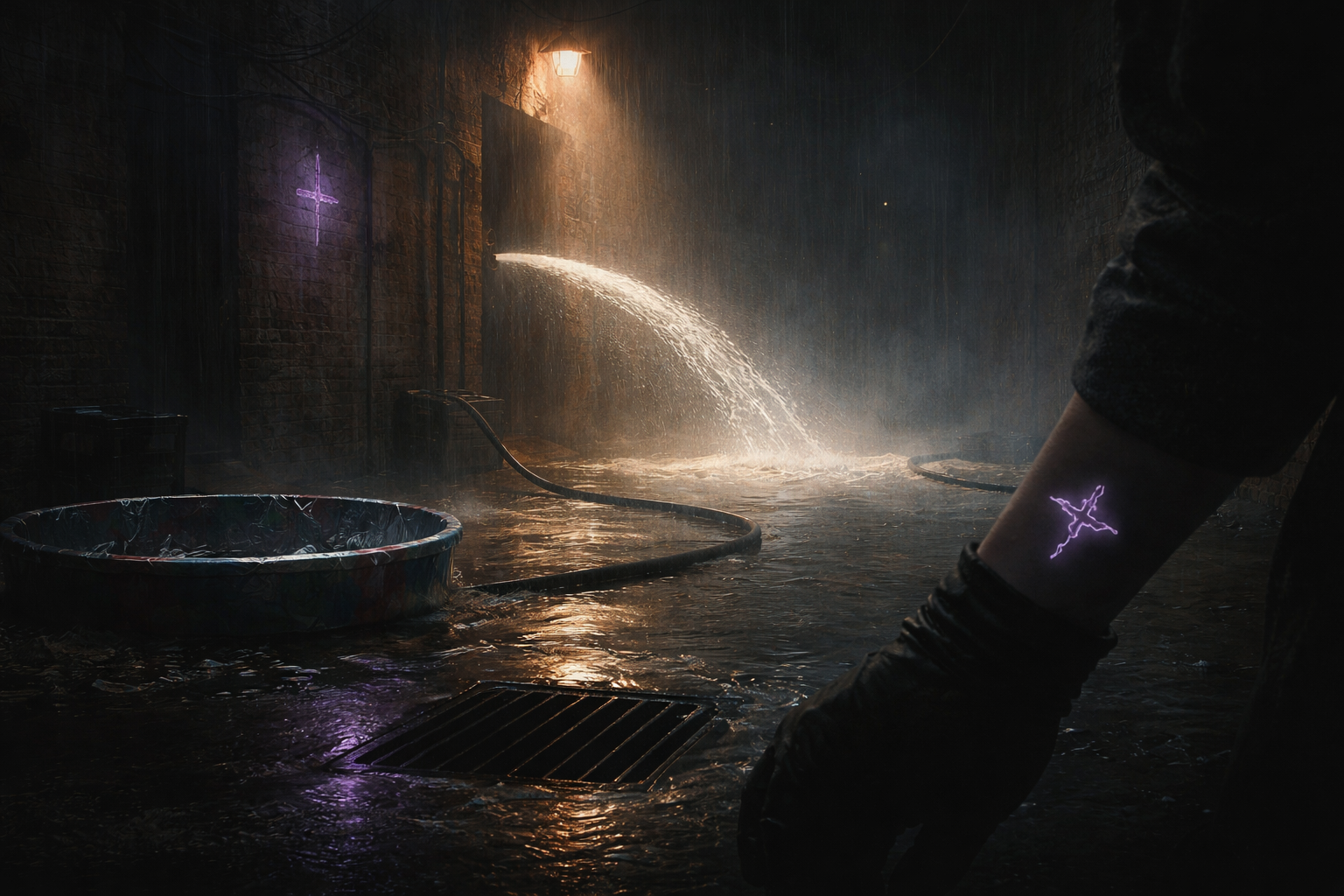
The sanitation truck’s hose roared to life at the alley mouth, a sudden animal sound. High-pressure water blasted the concrete in a wide arc, pushing cigarette butts, napkins, and the night’s confetti toward the drains. The city’s mouths opened and drank. Wash as erasure. Wash as forgetting.
The neon sign over the back door flickered hard — once, twice — then cut. The alley went dim. The mylar in the kiddie pool caught the last light and held it for a second longer than it should have, a cheap afterglow, stubborn as a bruise.
Then it was just rain, sodium streetlight, and the ordinary ugliness of brick.
The font looked pathetic in the new light. Plastic pool. Drain grate. Cables. Milk crate. A place built out of vice and spare parts. Nothing you could take to a church and ask them to bless.
Which was how the city protected itself: by insisting intimacy was just stuff.
Deacon vanished back into infrastructure, into wires and cues and blind spots. Jax went to the door to tell management whatever story would keep them off the news. The patrons drifted away, already scrolling, already converting the night into signal.
I stayed at the edge of the hose-down, water splashing my boots, and watched the ground until the last trace of those small prints — if they’d been real at all — was washed into the drain.
My wrist ached where the stranger’s fingers had dug in. Under the glove, under my sleeve, my skin burned as if bruising from the inside out.
I peeled the glove back an inch, just enough to see the pale strip of wrist.
Something glowed.
A faint bloom of UV ink, invisible in sodium light until the angle caught it — until the afterglow made it legible. A small broken cross, clean-edged, the upper left arm stunted.
The same shape I’d stamped on cardboard at 3:17. The same shape as the neon over the door. The same shape that had lingered as a ghost when I wiped it away.
I stared at it, trying to decide which explanation would let me sleep.
Contamination, I thought. Ink transfer. You touched the pad, you touched your glove, you touched your skin.
Or: the water did it. Or: the alley did. Or: my own need for a mark finally found a medium.
There was no clean answer. Only the mark and the way it refused to fade.
I pulled the glove back down. Covering it didn’t make it vanish. Covering never had.
As I went inside to put my kit away, the bass shifted into a new track. Same pulse. Same litany. The Amen break looped again, familiar as breath, as a heart under somebody else’s hand.
Only now it didn’t feel like ambience.
It felt like my name being called from inside the wall — Anastasia, Anastasia — each kick drum a syllable, each flicker of neon in my tired eyes an address I could no longer pretend was meant for anyone else.