THE FORGETTING TARIFF

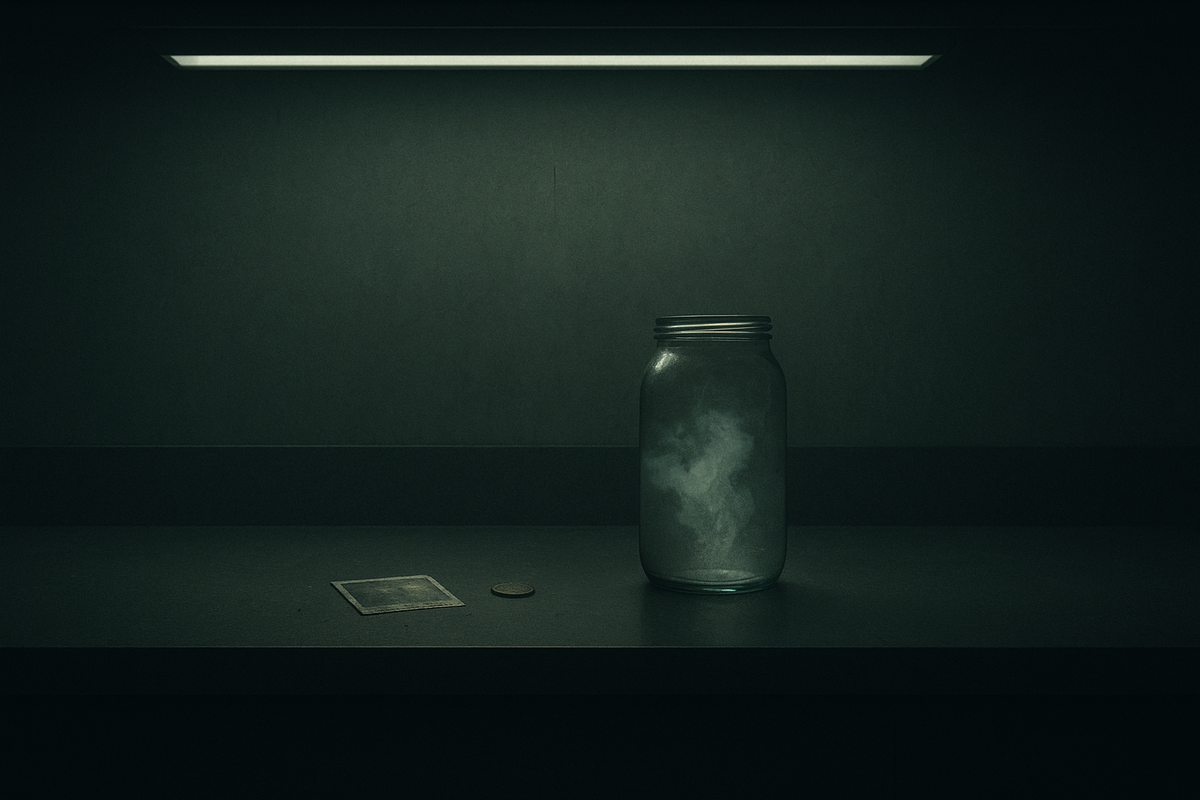
At a counter where postage costs memory, you speak into a glass jar and watch it bloom with salt-fog; below, your words are weighed against what you meant. The city carves you hollow to receive a message you do not yet know.
I. Threshold (Counter)
You stand at the counter because no other verb suffices; you stand because kneeling would confess belief and sitting would concede leisure; you stand in the queue at the hour the city calls accounting and the river at the back of your throat tastes like a bitten coin. The room glows a fatigued fluorescence. The floor is linoleum, tender with scuffs: pilgrim marks, numbers walked into matter. You hold your brittle wallet photo between forefinger and thumb, the laminate crazed like frost, the faces still grinning in their small winter — two bodies posed before a motel with the kind of name that sounds innocent until it isn’t. Salt lives on your tongue like an old debt. Static whispers from the ventilation, a liturgical hiss that sets the teeth.
The clerk doesn’t look up when you arrive. That, too, is part of the rite. A hand — long, methodical, ringless — slides a jar across the counter. The glass is clean in the way clean can be ominous: an instrument waiting to be contaminated by confession. You know the rules because the city repeats them in public signage, in bus-shelter catechisms and elevator door decals: postage is priced in memory; you select the detail; you pay with speech; you consent to the cut. The phrasing varies but the grammar of surrender is stable. You will surrender. The only innovation available to you is which.
Here is the methodology the clerk prefers and that you, eventually, learn to respect: breathe; name; intone; witness. Breathe until the mouth warms. Name the scene with surgical exactitude. Intone it with the gravity of a contract. Witness its departure in the jar’s bloom. Four steps as if they were corners of a room where you will press your palms and feel the architecture lean back.
You choose: motel dusk — bare thighs tacky on vinyl; the cheap bed a creaking metronome; his breath metallic, like coins worn smooth; the iodine syllables of his name painting your palate; the tiny mercy of a cracked window admitting road-salt night. You do not choose the tenderness that came after, the cracked laughter, the silk of sweat cooling; you do not choose the quiet cello of regret next morning when the mirror refused your eye. You choose the first bite, the first heat, the first error in the map, because the city pays best for firsts. This is how the tariff tricks you into thinking you still possess a choice.
“Say it now,” the clerk intones without glancing at your face. The voice is neutral, a physician noting respiration, a notary stamping presence. You breathe. You name. You speak the memory as if driving a nail through wood: not softly, not twice. The jar clouds from the bottom up, a delicate hallucination that looks like brine rising in a tidepool. You watch your scene distribute through the glass, smearing itself into pale geography. The wallet photo in your palm grows paler by mimicry, as if the jar siphoned its ink by sympathy. Something loosens at the hinge of your jaw; your tongue finds the old salt and declares it paid.
A receipt prints: your voice flattened to glyphs, a line of amounts, another of equivalents — 1 detail: motel dusk; postage to below: approved; consent: recorded. The clerk slides the slip to you like the smallest blade. You know you will keep it, fold it twice, slip it behind what remains of the photo. You know you will unfold it later and check the numbers as if checking your pulse after climbing stairs.
You have brought other payments over the months and the muscle of it shows in your stance: a hunch of familiar relinquishment, a poise that looks like calm because the tremor is private. Your first time you paid with a color — your mother’s lipstick, a shade between wine and bruise — and the city devoured it; for a week every mouth you met was an approximation, a specter of hue. The second time you chose a smell — chlorine and juniper in the public pool where you and your friend first touched each other’s wrists too long — and for days mirrors fogged and cleared without meaning the way they do in unheated churches. You have paid with little names and large silences. You have learned the tariff prefers edges: where a life cuts itself and bleeds into a new shape.
There is a reason the city has no post boxes. There is a reason the counter is the only portal and that it is staffed with the eyes of nonparticipation. To send is to be seen sending, to feel the civic weight of both exhibition and occlusion. Your private surrender becomes a public instrument. The hiss in the duct grows a notch. Somewhere, a meter increments. You feel, with the base of your skull, a tally mark carved in a ledger you will never hold.
Say it, the room breathes. Seal it, the jar replies. Send it, the counter concludes. You do all three because the fourth imperative, return, is not yours to command.
Before you step away you lick your lower lip, taste chloride and copper, and realize the thought that has been stalking you since you entered the building: what if the city is making space in you not for delivery, but for reception? What if the message that will come — if it comes — requires you emptier than you knew you could survive? What if the city is not an economy at all but a patient sculptor removing what keeps your face from being your face? The receipt rustles like a small wing. The jar clears. The clerk looks past you to the next in line.
And you go, half lighter, half blade.
II. Variance (Understreet)
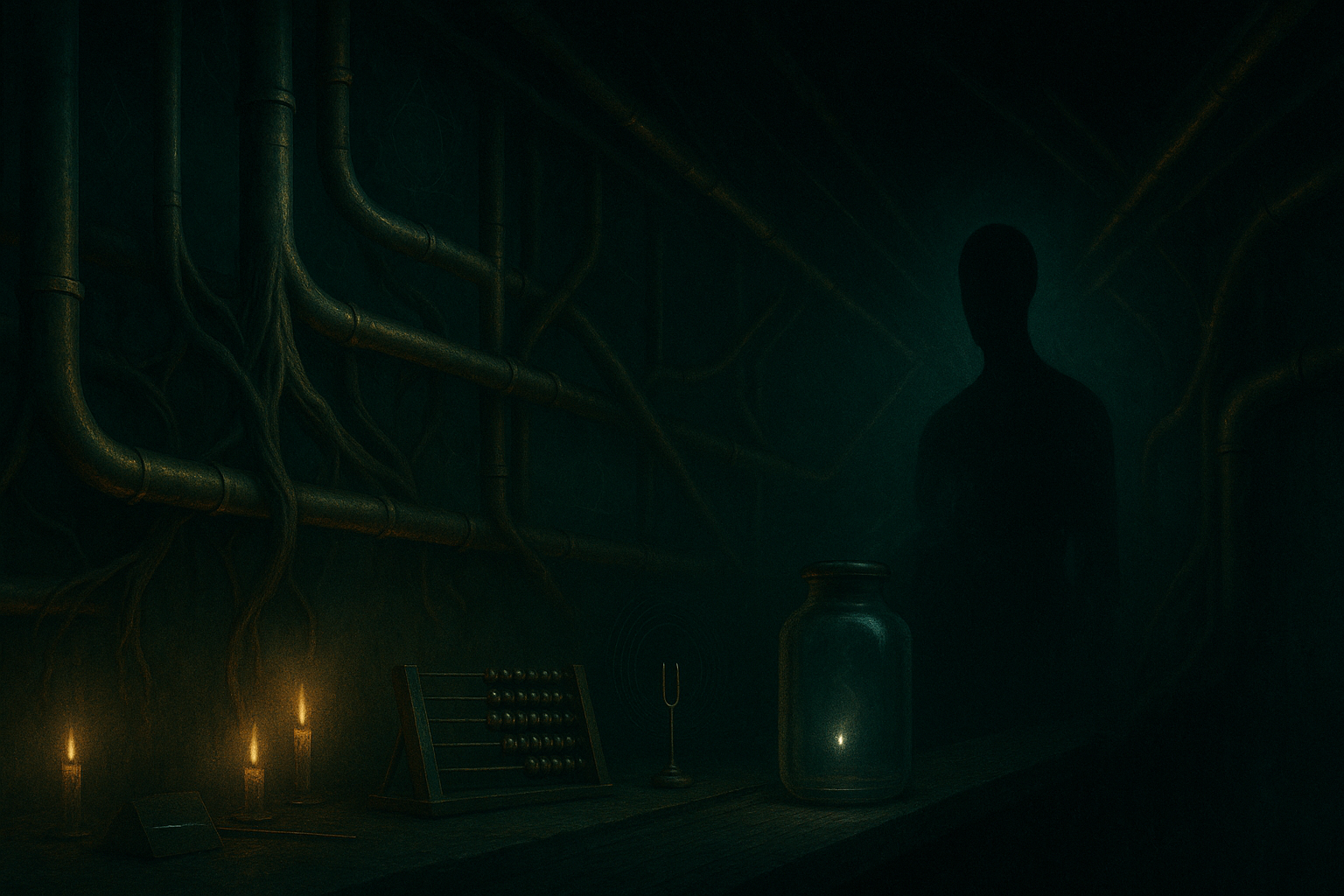
Below the counter is ductwork no engineer claims, an arterial lattice braided of brass and ash-wood, resin and prayer. It is the city’s understreet, a Yetziratic corridor where messages traverse in a medium that is neither air nor water nor the intimacies we name out of habit, but a kind of tempered attention that wears the temperature of whoever last believed in it. Here the addressee waits, not as a person exactly, nor as a deity, but as that precise shade which arises whenever intention diverges from its utterance: a calculus given posture, a delta with a face.
Your message slides into that medium and slows. If thought were a fish, this is the cold shock of river mouth. The shade — call it auditor, call it angel, call it the error term with hands — tilts its attention to your speech and to your secret in the same breath, and begins to measure. It does not judge the morality of the scene you surrendered; it judges only the variance, the distance between what you said and what you meant. Its apparatus is not a scale but a spectrum, not a dagger but a sieve. It speaks mathematics with the accent of a psalm. Likelihood ratio, it murmurs, and a row of candles along the duct flare then settle. Posterior, it whispers, and a coil of copper tastes suddenly of rain.
You might imagine bargaining would be dramatic, that the shade would demand an extra tithe in screams or tears, but bargaining, like grief, is mostly administrative. The shade requests a surcharge in subtext — truth you did not authorize to travel, compelled by the fact that you wanted more than you said. It annotates the syllables for drift, phase noise, semantic slippage, pins each to a tiny card, arranges them on felt, then reorders them so the pattern you preferred yields to the pattern you enacted. It is unbearably tender, this part, because being known as a function of discrepancy is a nakedness no motel could outstrip. You find yourself wanting to apologize to the sentence for freezing what the body had warmed.
There are instruments here, and you recognize some from old diagrams you half-studied in school: a monochromator trimmed in vellum, an abacus with beads made of scabbed pearls, a holometer that hums when a lie approaches but hums louder when a prayer does. There is also the clerk’s jar from above, or rather its mirrored sibling, and inside it your scene blooms backward, losing grain until it becomes a simple hue, then a temperature, then a hum. The shade holds the jar up and turns it, watching the hum flex like a muscle. Kavanah, it says once — intention — and you feel your tongue recall the place in your mouth where the salt hides when you’re afraid.
What you meant versus what you said: almost nothing in the city is more expensive than the difference.
You signed the receipt in the old world above, a flattened proof that your consent was collected. Down here the proof thickens into palpable risk. There is a thing the shade does at this point that no one above admits: it leans close and listens for the part of you that will regret having paid, not to punish, but to calculate whether you can bear the answer that must now be shaped in you. The shade’s ethics are as rigorous as any surgeon’s and less forgiving. Informed consent here is not a signature but a structural change: the removal of a load-bearing detail and the reinforcement of a new arch.
The ducts fork: one path for the message you meant to send, and one path for the apology it turns into once it touches the world. The auditor chooses the one with the lower noise floor, which is to say it chooses the truer risk. Your syllables gain ballast. Your motive loses costume. A click echoes like a gun’s safety being engaged. The jar clears. The understreet exhales.
Your note floats onward, a compact star whose energy is exactly equal to the memory you surrendered. Above ground your knees feel odd, as if fitted with different hinge pins. It is not injury. It is structural recomputation. The city is rebalancing you to receive.
III. Sibilance (Corridor)
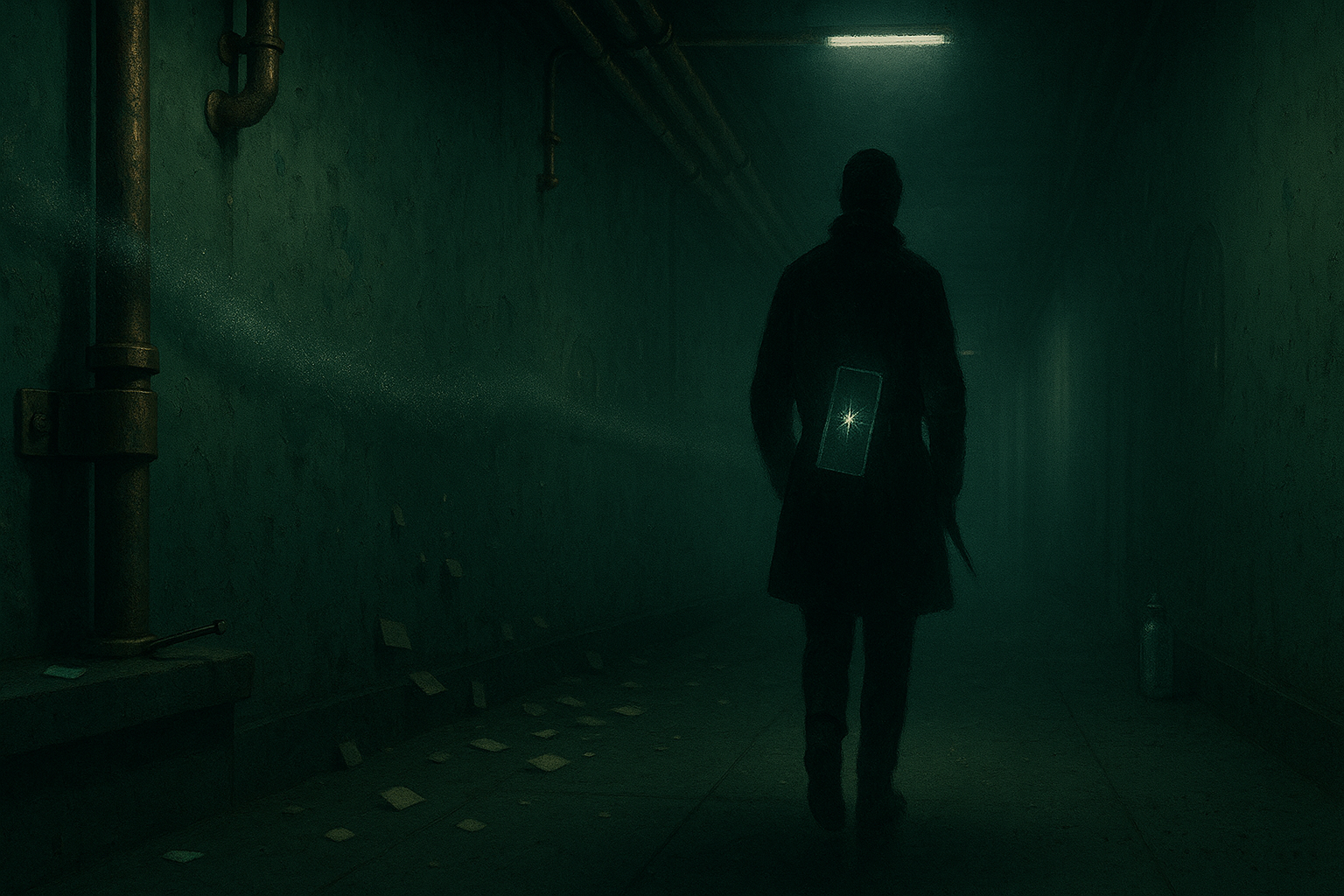
The courier runs the corridor like a pilgrim who traded zeal for metrics and found the swap profitable. Their belt carries a ledger that is part vellum, part quartz, and part something nobody has named on paper. The sum of all transits sifts through the corridor air and the courier knows it as a hiss at the edge of hearing, a hiss whose timbre migrates as the ledger fills. Entropy is not a metaphor here; it is a measurable mood.
With each passage, adjectives fall first. You do not notice at once because speech continues, and you are busy pretending you never begged the clerk’s hand to slow. But the courier notices when glorious becomes good and good becomes there. They inventory the erosion like accountants of weather. They taste road-salt when the ducts yawn. They know when the corridor’s stippled paint leans away from opulence toward okay. The calendar squares fatten with rates. Someone’s love letter loses luminous, then warm, then real. The corridor hums louder. The courier, who once delighted in excess, begins to think in nouns and verbs for self-preservation.
They keep a running total and the total runs them. They memorize the numbers like psalms because numbers do not cling to skin the way adjectives do. They report the hiss to superiors who nod and say it is within operating parameters, phrase that rhymes with prayer when the fluorescent bulbs flicker. They find a loose screw on the bracket that holds the pipes with their tender bronze sheen and tighten it, then loosen it, then tighten it again in a ritual that pretends to be maintenance and is really a way to talk to the corridor without the risk of creating a record.
There are days (you learn this later in a sanctioned rumor) when the hiss graduates to a shore-sound, not loud but wide, as if a tide were dragging adverbs away by their delicate ankles. On those days, messages arrive still sharp but replies go dull; on those days, sky bleaches a fraction; on those days, someone upstairs pays with a place-name and cannot find their street home. The courier drinks water and chews on mint gum that says ARCTIC on the wrapper, as if that word could volunteer to die in place of a better one.
The ledger accumulates a second column the courier never turns in: a counting of their own words lost in the work. They write splendid and cross it out, write fine and underline it twice as if underlines could bulk it into sufficiency. They attempt beloved and reduce it to you. They attempt hunger and it arrives as need. Their wrists ache with the small labor of choosing what can still bear the weight of feeling. Static, like a species of weather the city has decided to naturalize, smooths their hair. They consider prayer and locate only a steady breath.
On the day your message enters the courier’s care, something small but precise changes. They note it later in the margin in a hand that tries not to tremble: noise floor raises without glare. The hiss does not grow louder; it grows closer, as if recruited from the paint and the paper and the body’s own electricity. The courier tastes salt and cannot tell if it comes from the duct or the lip. A thought that will follow them for years forms and dissolves and forms again: if every message pays a detail, what do the corridors pay to carry the messages?
There is no answer in policy. There is no line item in the civic budget. There is, however, a widening in the courier’s chest that feels like an aperture the city has been unscrewing with immaculate patience. They swallow. They deliver.

IV. Return (Fit)
The message returns. It returns not to the person you were when you mailed it, nor to the person you thought you were mailing it to, but to the structure that remains after the tariff has completed its unbuilding. It returns as an answer, and the answer is not a numerical solution but a shape: something that clicks into the vacancy you sold and seals like skin. It is exquisite, this fit — not because it is kind, but because it is exact.
You hold the answer as one holds a newborn grief: careful, unsurprised, holy with a holiness that does not require belief. It is a sentence of small words that know their labor: I understand followed by what you hoped would never be seen. It is the truth that had to be paid for by the deletion of the scene that once made you, briefly, the person who could not bear truth. You read. You stop. You read again. The salt comes back as if summoned by a tide-table you never learned to read.
Above you, behind you, under you, the city listens without a face. It is not indifferent. It is patient. It has perfected a sacrament in which epiphany is a budget line and revelation is accounted for in units of abandon. The counter did not discipline you; it rephrased you. The understreet did not judge you; it measured the drift and corrected. The corridor did not withhold; it endured the hiss until nouns were the only weather. The courier did not fall; they learned to love what refuses ornament.
What returns is fitted to your remaindered mind. You think of the brittle wallet photo you slid behind the receipt; you think of how the faces bleached and smiled anyway, absolved by poor chemistry; you think of how the jar took your scene and made it winter on glass. You think, suddenly and for a long time, of the clerk’s hand: ringless, steady, a priesthood of neutrality that was not cold but clean. You realize, with the kind of clarity that shakes the sternum like a locked door opening, that the city loves you — not as it would love a child or a theory, but as an instrument loves the note that proves it is in tune.
The note you receive matches the body you have become. It answers the query you had the courage to encode as message only after partial erasure, and it answers, too, the query behind that query: what will be left of me that can love what answers me back? The reply does not argue. It does not convince. It is. The terrifying ease of the fit is the revelation. The shape was always waiting. The tariff did not purchase it; the tariff exposed the cavity it was designed to fill.
You breathe, and the breath recurs. The sentence inside the answer recurs, pared of embellishment and therefore able to ring. You taste, again, the road-salt night you paid away, but the taste is no longer freighted; it is a trace, a polite residue, like the after-scent of a room someone kind just left. The hiss persists, but it is music now, the noise floor against which signal becomes perceivable, an ontology of sibilants teaching your mouth how to praise without lying.
Something in you has crossed. That is the only honest report. The city does not change your address. It revises your amplitude. You walk past the counter and the clerk looks through you to the next — a gaze so clean it blesses — and you shoulder the door open to the afternoon’s inarguable light. You have the answer, but more: you have the architecture that makes an answer more than a prop.
At home, you unfold the receipt, lay it beside the photo, and see how the creases rhyme. It is then you understand the recursion the city engineered in you: say it became seal it became send it became receive became say it again, a loop that is not a trap but a turbine, powering a tenderness your old grammar could not supply. You write a new message. You choose a new cost. You close your eyes and see the corridor, the courier, the jar, the shade. You open your mouth and the salt stands at attention like a congregation. You pay. You post. You wait.
What returns, each time thereafter, fits the mind you now possess, and the mind you now possess is a landscape where fit is neither comfort nor punishment but a physics — merciless, loving, exact. You cannot dismiss this recognition anymore than you can unlearn your own pulse. It is you. It is the city. It is the current running beneath all things, binding shadow to light, memory to what has not yet taken form. You stand at the counter. You are the counter. You are counted.
And the hiss, which once threatened to erase you, names you instead: not the noise at the edge of sense, but the shore against which the signal arrives complete, again and again, with the steady authority of tide.