The Half-Floor Orchard

During a "wellness retrofit" in a spotless high-rise, elevator engineer Hal Mercer and his estranged daughter, now a risk analyst, stall at an unlisted half-floor where basil-sweet vines and QR codes listen. The timer ticks. The truth has teeth.
WELLNESS RETROFIT / VOICE-INTEGRITY UPGRADE (v3.8)
Your voice is your vitality.
Your disclosure is your deliverance.
By entering, you consent to ambient listening for the purposes of safety, compliance, and care.
LOBBY
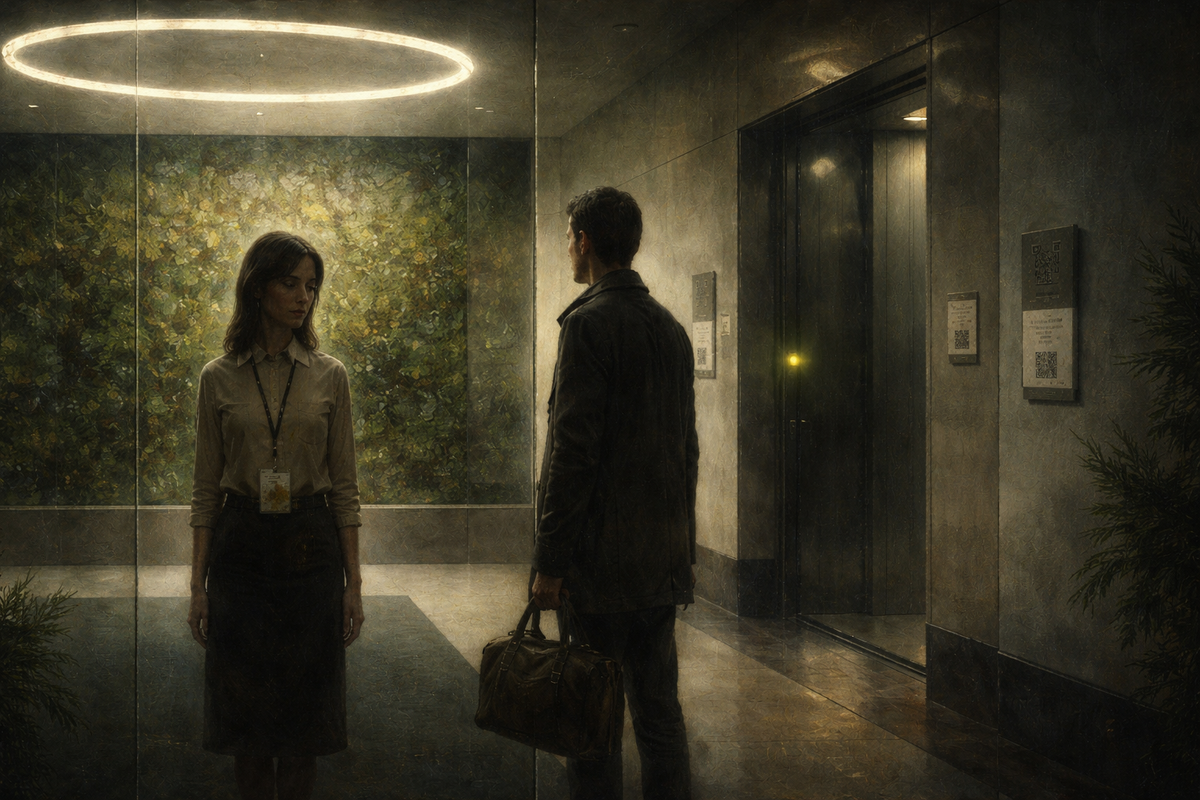
The new lobby smelled like disinfectant pretending to be eucalyptus. The developers had paid for a green wall thatú — real vines, real moss — stitched behind glass as if life could be made hygienic by sealing it. Above it, a halo of LEDs hummed with a whiteness so consistent it felt doctrinal.
Hal Mercer paused where the terrazzo met the first strip of temporary carpet and let his eyes do what his hands did when he didn’t know where to put them: inventory. Compliance stickers, fresh and blister-shiny, had been slapped to every emergency placard, every extinguisher case, every access panel; each sticker carried a QR code square as a small black-and-white wound. A sigil for permission. False absolution.
He had been summoned for the “wellness retrofit” audit — his phrase, not theirs. The email had called it Integrated Life-Safety Optimization. The lobby was full of those clean euphemisms now. The building spoke like a chaplain trained by lawyers.
At the service corridor gate, a badge reader blinked. The woman who stepped in front of it did so with the posture of someone bracing for impact. She wore the lanyard too straight — tight around her throat like a vow she hadn’t chosen.
Mara.
He hadn’t heard her footsteps. He recognized her the way the body recognizes a long-neglected ache: not by detail, but by force.
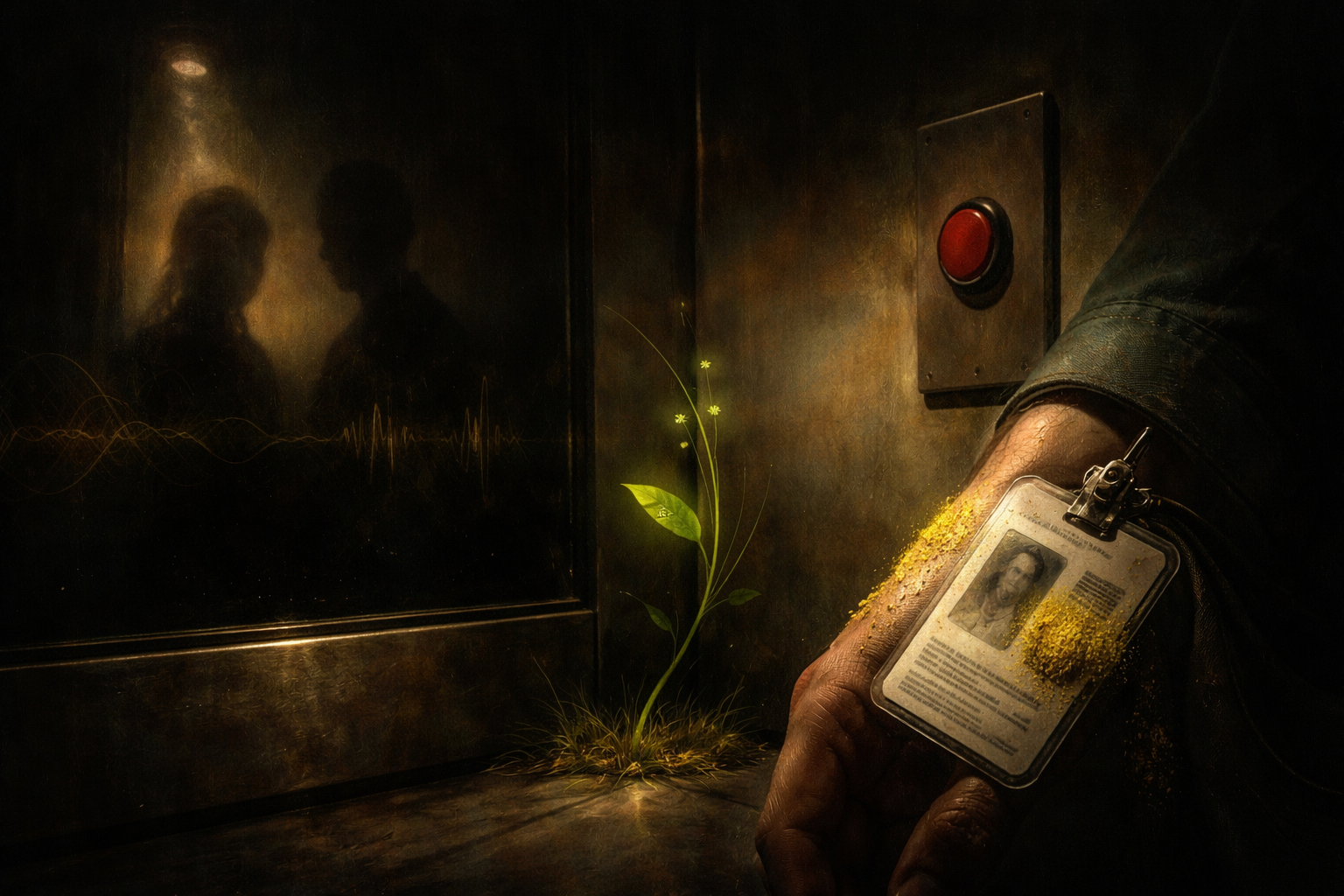
She held the badge to the scanner. Her hand trembled once, small and involuntary; the lanyard quivered, beads in a prayer that didn’t know it was a prayer. A dusting of yellow clung to the plastic sleeve at her sternum, fine as flour, like pollen that had mistaken her for a flower.
The reader took her. Green light. Click.
They stood close enough that Hal could smell the day on her — cold air, some citrus cleanser, and something green-crushed that didn’t belong in a sealed lobby. Basil, maybe. He wanted to reach for her shoulder the way he used to reach for a handrail: reflex for safety. But the air between them had been fitted with invisible glass.
“Mara,” he said, and watched her face flicker with the effort of not becoming a daughter.
“Mr. Mercer,” she replied, and he flinched — not because of the formality, but because it was precise. She had always been precise when she wanted to cut.
She moved aside to let him pass. He walked through. His tool bag bumped his thigh with each step like a metronome.
They did not hug.
Behind them, the lobby’s public screens rotated through the retrofit’s new scripture in soft fonts and softer colors:
WELLNESS IS SAFETY
SAFETY IS COMPLIANCE
COMPLIANCE IS CARE
He read it the way he read a wiring diagram: looking for what it wanted from him.
Mara’s heels clicked once, twice, then softened on the service corridor’s rubber runner. The corridor’s air was older than the lobby’s — dust and metal, and that faint, salted scent of machinery that had been sweating for decades. The bones under the branding.
“Are you assigned to—” he began, and stopped, because the question was already answered by the badge around her neck. Risk Analyst. A job title like a scalpel.
She didn’t look at him. “I’m assigned to the building,” she said, which was true in the way that lies often were: accurate enough to betray you later.
A service elevator waited at the end of the corridor like a blank tooth. A mirrored panel to one side reflected them in fragments: Hal’s hands, always busy; Mara’s face, always held.
Above the doors, a new sticker: VOICE-INTEGRITY ENABLED. Under it, another QR code.
Hal watched Mara’s badge swing as she keyed the call. The yellow dust on it lifted slightly with the motion, an unhurried flurry, then settled again as if it had decided to stay.
He told himself it was drywall.
He told himself the building was just a building.
DING / HISS / CLICK
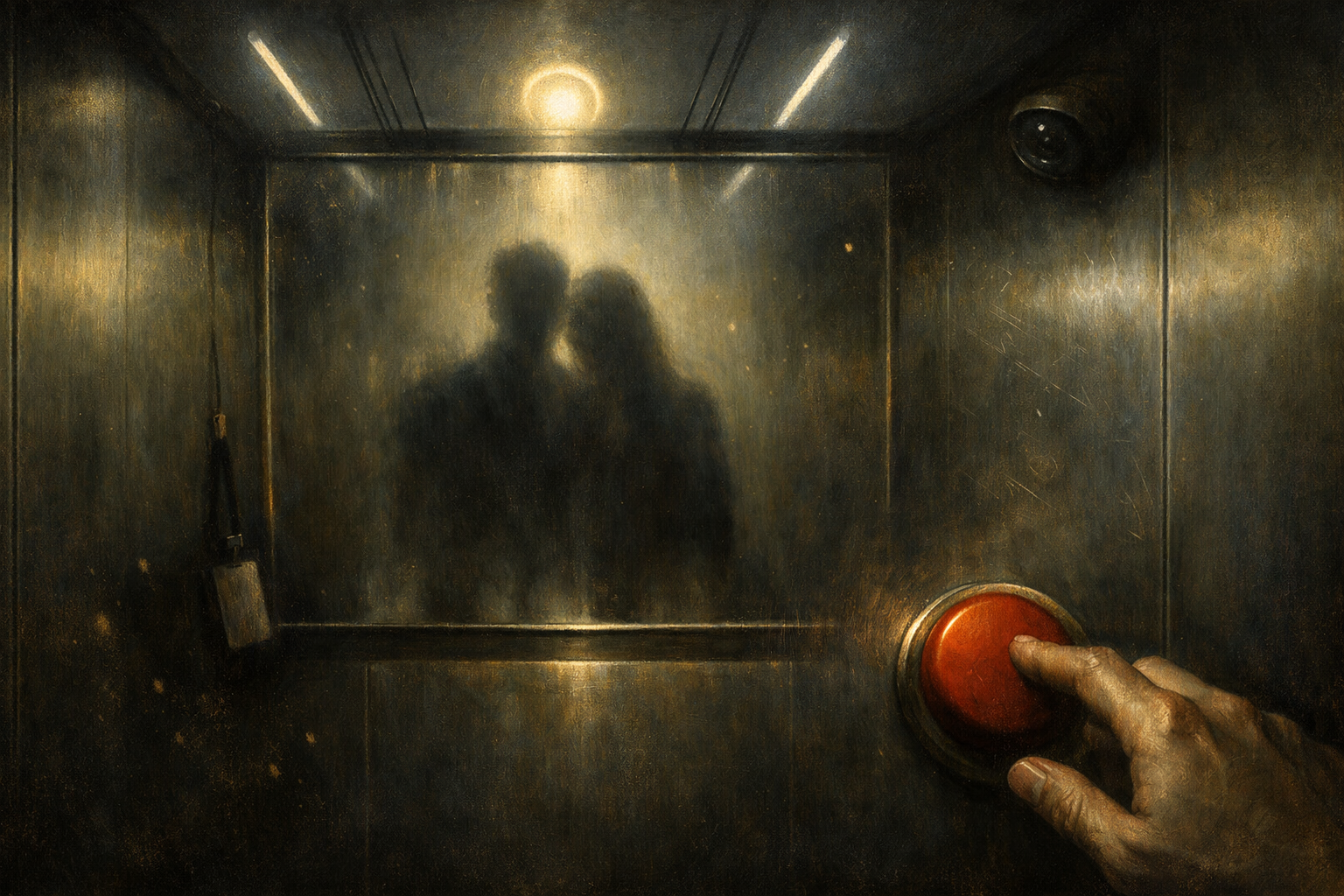
The elevator’s interior had been “upgraded” in the way old things are when someone wants to erase that they ever aged: brushed steel, sterilized corners, new LED strips embedded in the ceiling seams like surgical sutures. The mirror panel in back was bigger than it needed to be. It caught their faces and pressed them side-by-side into a single reflection as if proximity could be mandated.
Hal stepped in first without thinking and found himself between Mara and the button panel. A posture he had worn his whole life — body as barricade, love as blocking. He pretended to check the indicator light above the emergency phone.
Mara entered and let the doors close without looking at him. The lanyard’s clip clicked against the badge holder with each breath she failed to take all the way.
Hal leaned toward the panel, not because he needed to, but because it gave his hands a purpose. His thumb hovered over the red emergency stop button — its plastic dulled by years of thumbprints, thumb oils, thumb fear. A relic of control. He didn’t press it. He just touched it lightly, like touching a scar through fabric.
“Service run?” he asked, because talking about elevators was easier than talking about the dead, or the living, or the narrow band of time where those categories blurred.
“Eighteen,” Mara said. “Risk review. Wellness audit walkthrough. You can call it what you want.”
He heard the word audit like a bell struck on a tooth. “They could’ve sent—”
“They requested you,” she cut in. “Veteran asset. Institutional memory.”
Asset. Memory. Her voice was level, professional; inside that levelness he could feel something shaking itself raw.
The doors slid shut. Hiss. The car shivered. Click.
And then—
Ding.
The sound hit his spine with a ridiculous tenderness. A bell for the numbered world.
The floor indicator glowed: 1.
The car rose. The cables above them tightened and relaxed with each micro-adjustment of the drive, a subtle hymn of tension and release.
Hal let his eyes drift to the mirror. Mara’s face in reflection looked older than the last time he’d really seen it. Not more lined — more decided. As if she had chosen a shape to survive in and then hardened into it. Her eyes were fixed on the doors, not on him, not on herself.
He remembered another mirror, another car, another day, and his throat tightened. The memory wasn’t an image. It was a pause mid-sentence. A hand tightening on steel. A date avoided like an open manhole.
The LED strip above them held its sterile hum. Hal swallowed. He felt the swallow register in the elevator’s listening systems like a confession his body gave before his mind consented.
Mara’s badge swung once, soft. Yellow dust lifted. Settled.
“You’re still in maintenance?” she asked, as if she didn’t know. As if she hadn’t already read the personnel file down to its marrow.
“Engineer,” he corrected, because he still believed in titles as protections. “Systems. Elevation. Vertical transport.”
She nodded once, tiny, as though the motion itself hurt. “Keeping the system running,” she said. It wasn’t a compliment.
The car passed 7. Ding. Passed 12. Ding. Each ding like a step deeper into something that had been waiting.
The building’s voice came in through the LED panel — silent, just text:
PLEASE REMAIN RELAXED.
BREATH IS WELLNESS.
YOUR PRESENCE IS APPRECIATED.
Mara’s mouth twitched, the closest she came to a smile. “It’s like being blessed by a toaster.”
Hal wanted to laugh — wanted the release — but his laugh had been trained into smaller, safer sounds. A man in his position didn’t laugh around risk analysts. A man in his position didn’t laugh when the building was listening.
The elevator climbed.
The cables sang.
Hal’s hand found the red stop button again. Thumb to dulled plastic. Old habit: if you can stop it, you can absolve it. If you can control the system, you are clean.
He didn’t press.
⟡ SYSTEM READOUT — LIFT CAR C7 / VOICE-INTEGRITY ENABLED
SAMPLE: ACTIVE
CAPTURE: PASSIVE
WELLNESS METRIC: STABLE
NOTES: Ambient speech assists safety optimization. Thank you for your honesty.
(Handwritten in the margin, blue ink, tight script):Honesty = a biometric. A resource. A liability.
BETWEEN
It didn’t break like a dramatic thing. It didn’t scream. The car simply… halted, mid-breath, as if the building had decided to withhold the next second.
Hal felt the stop in his molars.
The floor indicator flickered: 18 — and then, faintly, as if ashamed: .5.
Unlisted.
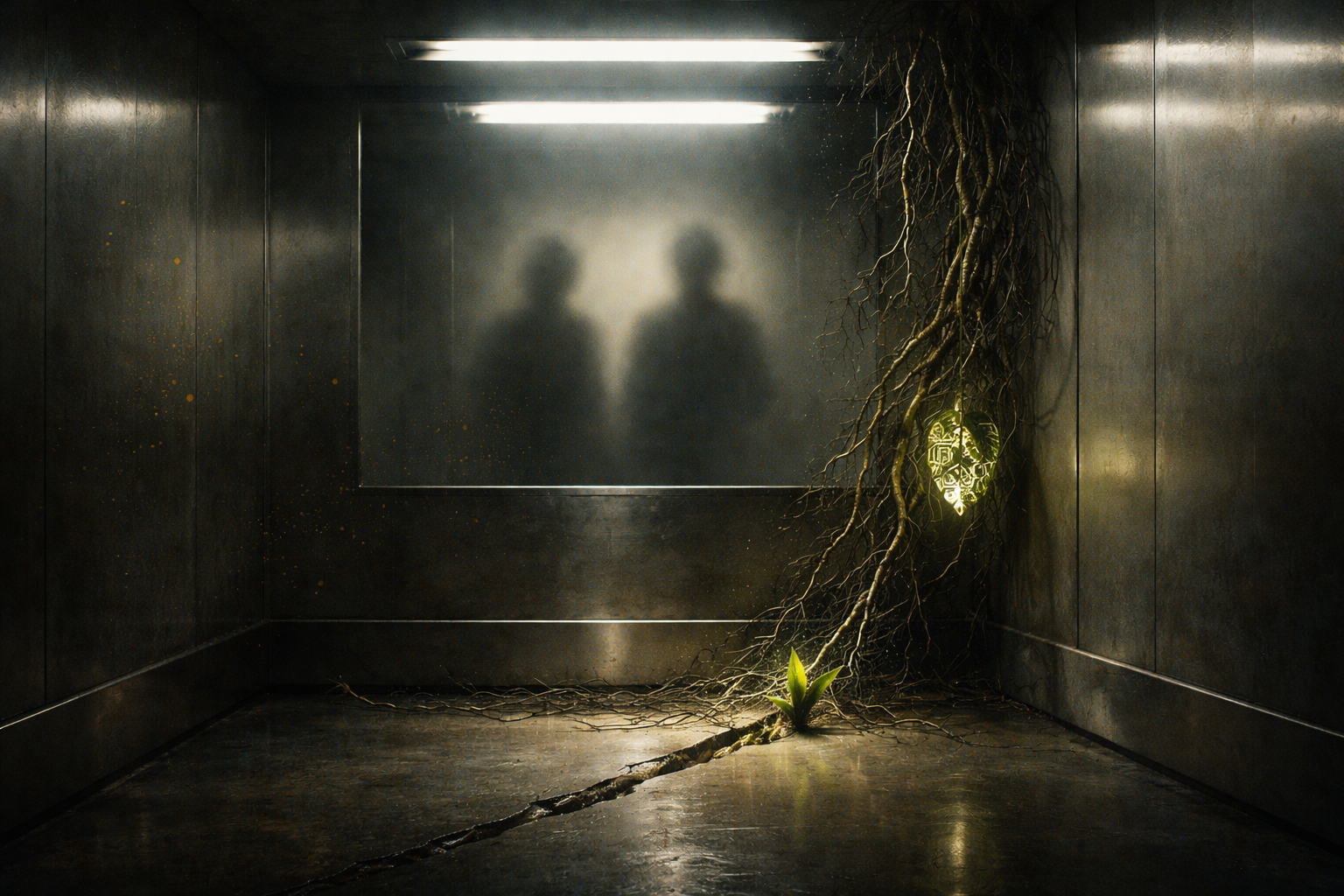
The LED lights stuttered, then steadied into an even harsher white that made every pore on Mara’s face visible in the mirror. The air thickened. Humidity gathered as though the car had been lowered into a greenhouse.
A smell arrived: green and bruised. Basil, unmistakable now, sharp as a crushed leaf between fingers. Except no leaf had been touched.
Mara inhaled involuntarily, then coughed once into her fist, embarrassed by the sound. Her badge swung. The yellow dust on it loosened, lifted, and floated.
Pollen.
Or data.
Hal’s training yanked him into procedure. He stepped closer to the panel, fingers running through the mental checklist — safety circuit, interlocks, door operator. He punched the emergency call. The button lit.
Static answered. A soft, granular hiss like a congregation murmuring behind a veil.
“Car C7, report,” Hal said. His voice came out with the calm he used for fire drills and funerals. “We’re arrested between eighteen and nineteen. Indicator shows half-floor. That’s not—”
He stopped because his flashlight beam — stupid, instinctive — found the seam at the baseboard.
A hairline crack.
And in it: green.
Not paint. Not mold. A green shoot, tender and undeniable, pushing up through the seam as if the elevator’s steel had been soil all along. Dew beaded on the baseboard’s lip, bright as rosary beads under his light.
Mara’s breath caught. She took one step back and hit the mirror with her shoulder. Her own face flared back at her, doubled and trapped.
Hal crouched, reflexively, and touched the shoot with the pad of his finger. It was cool. Alive. A pressure under the skin.
“What the hell,” he whispered, which the building’s microphones took like a prayer.
The floor indicator blinked again: 18.5. A dot in the wrong place, knowledge as consequence.
Above the emergency phone, a new line of text appeared — no voice, just letters like a verdict:
PURIFICATION CYCLE INITIATED.
TIME TO STERILIZATION: 00:06:59
Mara read it and went very still. Hal heard her stillness as a sound. The elevator’s ventilation fan hummed, trying to pretend nothing sacred was happening.
“Purification?” Hal said. The word tasted like bleach. “They’re cycling the shaft today?”
Mara’s eyes didn’t move from the display. “They schedule it during low-occupancy,” she said, which was corporate for it’s safe because fewer people will sue.
Hal’s mind did the math. Six minutes, fifty-seven seconds. The purge cycle would flood the hoistway with aerosolized disinfectant, UV pulses, whatever new clean violence the retrofit had installed. If the car was stuck between floors, it would become a sealed chamber. If the ventilation cut, oxygen would shift. He had signed off on enough safety protocols to know how quickly “clean” became “dead.”
He slammed his palm against the panel, as if the buttons had a soul he could shake awake. “Override. Manual. Come on.”
Mara watched him, not with fear, but with a kind of exhausted anger — as if his fixation on mechanics was the oldest betrayal.
“Procedure won’t fix this,” she said.
“It’s an elevator,” Hal snapped, and hated the snap as soon as it left him. “Everything is procedure.”
The shoot at the baseboard trembled, as if in response. Another crack opened beside it, a thin line widening. Something green threaded through.
Hal stood, heart hammering, and looked at the mirror. In it, his face was pale under the LED halo. He looked like a man in confession, but there was no priest here except the building.
Mara’s badge brushed her sternum. Yellow dust drifted off it and landed on the mirror like a soft stain.
The emergency phone hissed again. Static thickened, then thinned, then—
A voice, gentle, measured, as if spoken through a smile practiced in front of cameras.
“Car C7,” the voice said. “Hal. Mara.”
Hal froze. The building had learned to say their names.
He recognized the voice anyway.
Eve Cho.
Security chief. His former lover. Now policy in a human shape.
“Evelyn,” he said, and the name came out too intimate, too human for the sterile air.
“Chief Cho,” Mara corrected automatically, as if the title could build a wall between the two of them. Hal heard the jealousy under her professionalism like a fault line.
Eve’s voice stayed calm. “Please remain in place,” she said. “You are experiencing a wellness safety event. The purification cycle will proceed. We will guide you.”
“We will die,” Hal said, blunt. It felt obscene to make death factual in a building designed to treat it as liability.
A pause. In that pause, Hal imagined Eve’s posture — the way she’d stand in the security office, hands folded, eyes on screens, soft voice, hard hands. Her job was to keep the building’s skin unbroken. Her job was to enforce purity.
“You will not die if you comply,” Eve said. “The system is designed for your care. Do not attempt to override.”
Mara’s laugh was a dry cough. “Designed,” she murmured. “Of course.”
Hal pressed his forehead to the cool steel beside the phone. His breath fogged it briefly, then vanished under the LED light.
“Eve,” he said again, quieter. “We’re at a half-floor. That’s not on any map. What is this?”
Another pause. Hal could hear, faintly, behind the line: a second layer of static, a whispering that wasn’t random. Like a litany spoken out of phase.
Eve said, “It’s an access seam.”
Mara’s head snapped up. “There’s no—”
“There is,” Eve interrupted. Her voice stayed gentle. “There is a seam. There always is.”
Hal looked down.
The crack at the baseboard had widened into a small mouth of darkness, and from that darkness, green filaments were emerging — thin, glossy, like roots searching for purchase. They slid over the steel with impossible patience, then looped back toward the elevator’s ceiling, toward the cables that ran through the shaft like tendons.
Cables as roots.
The elevator’s guts were being repurposed.
Mara stepped forward, drawn despite herself. “That’s—” she began, then stopped, because naming it would make it more real, and she had spent her whole career learning how to keep reality in spreadsheets.
Hal’s flashlight beam caught something else: a leaf.
Not a leaf the way a leaf belongs in an orchard. This one was a thin rectangle of plastic-green, the size of a keycard, veined with circuitry. It unfurled from the root-filament like a paper sacrament. Along its surface, a pattern — square, black and white.
A QR code.
A compliance sticker grown into plant tissue.
A sigil in photosynthesis.
Mara’s throat worked. “No,” she whispered, and the whisper went into the building like an offering.
The emergency phone hissed, and Eve said, softly, almost tender: “Hal. Please. Do not touch the growth.”
Hal’s hand was already reaching. Compulsive fixing. Compulsive denial. If he could tear it out, he could return to the numbered world. If he could keep the system running, he could be absolved.
He grabbed the root-filament and yanked.
It didn’t snap. It yielded like wet cable insulation and then tightened around his wrist with a gentle, inexorable pressure.
Hal felt the cold of it under his skin. He felt his own pulse answer it.
“Hal,” Mara said, and there was fear now — fear not for the plant, but for him.
He released it. The filament loosened as if forgiving him.
Or marking him.
The purge timer ticked down: 00:06:12.
Above them, the sprinkler head — a new installation, sleek and white — shifted slightly in its housing as if waking.
Hal stared at it and thought of baptism, and how water could be mercy or drowning depending on who held you under.
Mara wiped her palm on her trouser seam, as if trying to rid herself of something invisible. Yellow dust clung to her skin.
Pollen. Data. Witness.
The mirror caught it all. The mirror always did.
⟡ WELLNESS PAMPHLET INSERT — “PURIFICATION AS CARE” (Distributed to Tenants)
When the building purifies, you are protected.
When you disclose, you are liberated.
When you comply, you are held.
In moments of disruption, breathe slowly.
Let the system support you.
Your voice is a key.
(Mara’s marginalia, scratched in, almost tearing the paper):
Keys open. Keys lock. Keys become leaves.
PROXIMITY
Hal forced himself to look at Mara without the mirror’s mediation. Her eyes were bright, not with tears, but with a kind of contained flame. He saw, suddenly, that her professionalism was a posture — the way he used to stand between her and the buttons. Blocking. Protecting. A love misused.
“You knew about the half-floor,” he said, to Eve, to Mara, to the building, to himself.
Mara’s jaw tightened. “Risk has… anomalies,” she said. “Systems have undocumented behaviors.”
Hal laughed again, a sound with no humor. “Undocumented,” he repeated. The word was corporate for buried. For sealed.
Eve’s voice came through static like a hand on the back of his neck. “Hal, listen to me. The retrofit—”
“The retrofit is listening,” Mara cut in, and her voice sharpened into the blade she carried for a living. “You’re harvesting voiceprints.”
Silence, then: “For wellness,” Eve said.
“For leverage,” Mara said. “For liability mapping. For—”
“For care,” Eve insisted, and the insistence made it sound less like truth and more like prayer.
Hal’s mind flicked through the retrofit documents he’d skimmed and signed without reading properly — pages of language that made surveillance sound like comfort. Ambient speech assists safety optimization. Integrity metrics. Voice-as-identity. He had been good at not reading things that asked him to be answerable.
He looked at Mara’s badge again. The yellow dust had thickened on its surface. It wasn’t drywall. Drywall didn’t drift like this, didn’t settle with intent, didn’t smell faintly of crushed basil when no plant had been touched.
The shoot at the baseboard had grown another inch, slow but steady, as if time itself had been diverted into chlorophyll.
“Why are you here?” Hal asked Mara, and hated how small the question sounded, like begging.
Mara’s gaze flicked to the mirror, then away. “Because I’m assigned,” she said again, and Hal felt the lie in it, not as a fact but as pressure. Like a hand on the throat.
He heard the purge timer, the numbers falling like beads: 00:05:38.
He turned to the panel, fingers flying. He popped open the inspection hatch with his screwdriver, exposed wiring, traced the safety circuit — door locks, car gate switch, overspeed governor input. The system was intact. Too intact. It was holding him the way a confession holds you: not with force, but with rule.
“Manual override’s locked out,” he muttered. “Biometric interlock. They’ve tied the safety circuit to—”
“To honesty,” Mara said, and the word landed between them like a stone.
Hal’s hands stilled. He hated that she could name it so neatly. He hated that naming made it true.
Eve’s voice softened. “Hal,” she said. “We can resolve this. Stay calm. Follow protocol.”
“Protocol,” Hal echoed, and the word brought with it a tremor of memory: a hand signing a report; a pen pausing over a date; the taste of coffee gone cold as someone else’s family cried outside an office door. Protocol as anesthesia. Protocol as sin washed in paperwork.
Mara stepped closer, and Hal felt her heat in the cramped air. The elevator was forcing proximity the way confession forces proximity: no room to hide, no hallway to flee down, only mirror, metal, breath.
“Tell me,” she said. Her voice wasn’t loud. It didn’t need to be. It was the tone she used in meetings to make men confess their budget failures. She had learned scalpel language from the world, and the world had learned it from people like him.
Hal shook his head. “Not now.”
“When,” Mara demanded. “When it’s safe? When no one’s listening? When it costs you nothing? That’s not confession. That’s performance.”
The green filaments on the floor shivered. The keycard-leaf unfurled another millimeter. The QR code on it seemed to pulse, black squares rearranging subtly as if the plant was rewriting its own spell.
Hal felt his mouth go dry. He looked at the emergency phone and thought of confessionals — dark booths, whispered truths, anonymity. But there was no anonymity here. The mirror watched. The building listened. Eve listened. Mara listened with a lifetime of withheld questions.
The purge timer: 00:04:59.
The sprinkler head clicked softly overhead. A prelude.
Hal’s thumb found the red stop button again.
Thumbprint-worn. Relic. Control.
He pressed it.
For the first time in years, the button did nothing.
The red light didn’t even flicker.
His thumb stayed there, useless. A prayer unanswered.
Mara’s eyes widened — not in surprise, but in recognition. “They took your relic,” she whispered. “They took your control.”
Hal’s chest tightened. He felt the old misbelief crack: If I keep the system running, I’m absolved. The system was running him.
Eve’s voice came in, warmer now, dangerously kind. “Hal,” she said. “Don’t fight it. Let the system support you.”
Hal heard, under her kindness, the hard edge of policy. He heard, under the hard edge, the old intimacy — how she used to say his name when she wanted him to trust her. How trust could be used.
Mara leaned in. Her badge brushed his forearm. Yellow dust transferred — pollen smearing his skin like an anointment.
He didn’t know whether to wipe it off.
He didn’t.
⟡ INCIDENT REPORT EXCERPT — 10/17 / YEAR REDACTED
LOCATION: Hoistway 18–19 (Service Seam)
EVENT: Fatality (non-tenant)
CAUSE: Under investigation
STATEMENT (MERCER, H.): “No occupant present. All safety protocols were followed. Door interlocks were functioning.”
NOTES: See attached maintenance log. See security footage. See wellness compliance.
(Redactions appear as thick black bars. Beneath one bar, a faint green smear like chlorophyll.)
HALF-FLOOR LIGHT
When the elevator lights flickered again, Hal’s mind did what it always did under pressure: it reached for the past as if the past were a tool.
He saw his own handwriting in a maintenance logbook — black ink, neat. He saw an empty line where a name should have been. He saw the way paper could become a coffin.
He had told himself then: If I keep the system running, people stay safe. He had told himself: Procedure is mercy. He had told himself: Silence is protection.
He had told himself so well that the lie had become a muscle.
Now the muscle was cramping.
The half-floor orchard was growing in the seam where his lies had been stored.
Mara watched him, and Hal realized with a hollow shock that she had inherited his way of surviving — only inverted. Where he used silence as protection, she used truth as weapon. Both were ways of not feeling.
“Why are you here?” he asked again, but softer, as if softness could keep the answer from cutting.
Mara’s gaze flicked toward the ceiling, toward the hatch, toward the sprinkler head, toward the unseen cameras she had learned to imagine in every room. She swallowed, and the swallow looked painful.
“I’m here,” she said, “because it happened again.”
Hal’s stomach dropped. “What happened again?”
“A cover-up,” she said. “A death folded into compliance language. A file sealed under wellness. A person turned into an index number.”
Hal’s hands clenched around his screwdriver until his knuckles whitened. “When?”
Mara’s eyes flashed. “Last quarter. Different system. Same script.”
Hal felt the building around them — its cables, its ducts, its new halo lighting — like a body that had learned to eat harm and call it nutrition.
“You think I—” he started.
“I think you taught me,” Mara said, and her voice broke on the last word, only slightly, only enough that Hal felt it like a nail under the skin. “You taught me how to make omission sound like safety.”
Hal’s throat tightened around old arguments. “I kept you safe.”
Mara’s laugh turned into another cough. Yellow dust puffed from her badge, then drifted toward Hal’s face. It landed on his lips. He tasted something faintly sweet. A clean light held in the teeth. Horrible.
“You kept the building safe,” she said. “You kept your job safe. You kept—” she stopped, and Hal saw her fight against a deeper sentence.
“You kept them safe,” Hal said, because he knew who else had been in the room back then: Eve. Eve with her soft voice and her hands that could lock doors. Eve who had kissed him once in a stairwell and then signed off on a report the next day with the same pen.
Mara’s eyes flicked to the emergency phone, to the static. “Don’t,” she said, and Hal didn’t know if she meant don’t blame her or don’t protect her.
The purge timer dropped: 00:03:11.
The sprinkler head clicked again, louder.
The garden’s filaments had reached the ceiling seam now. They threaded around the LED strips like vines around a cathedral’s ribs. The light shone through them greened, softened, as if the halo was learning to become a canopy.
The keycard-leaves multiplied — three, five — each one bearing a QR code. Each one a permission slip grown into a blessing grown into a leash.
Hal’s flashlight beam caught the mirrored panel again. The mirror had fogged at the edges with dew. Their faces in it looked submerged.
Confessional. Doubling. A booth with no curtain.
Mara stepped closer to the mirror and stared at herself as if looking for the part of her that had been a child.
Hal saw her reflection and, behind it, his own. Father and daughter fused by glass.
He wanted to say, I’m sorry. The words swelled in his chest like a body wanting to breathe.
But the building was listening. The building would ingest his apology, quantify it, weaponize it.
Confession was the only exit.
Confession was the trap.
Hal’s mouth stayed closed.
Mara’s face hardened again. Professional. Risk analyst. Scalpel.
“Tell me about October seventeenth,” she said.
Hal flinched. The date landed like a key in a lock.
“I don’t know what you want,” he said, which was true in the way that lies were: he knew exactly what she wanted. He just didn’t know what it would cost.
Mara’s fingers lifted, touched her badge, pressed it flat against her sternum as if to keep her heart from escaping. Yellow dust smeared across the plastic. Pollen became stain.
“I want you to say what happened,” she said. “Not in the report language. Not in the wellness language. In your language.”
Hal’s laugh came out as a single harsh exhale. “My language is wiring diagrams.”
“No,” Mara said, and her eyes were wet now, finally, but the tears didn’t fall. They stayed in the corners like withheld truths. “Your language is silence.”
Eve’s voice cut in, sharper. “Mara,” she said, warning.
Mara didn’t look at the phone. “You knew,” she said into the air. “You both knew.”
Eve’s pause was long enough that it felt like a confession of its own.
Hal’s hands shook. He forced them still by gripping the panel edge. He stared at the red stop button again, and in the dull plastic he saw years of his own thumb — pressing, releasing, controlling. A relic that had stopped working when it mattered.
The purge timer: 00:02:34.
Hal’s mind raced through options. Mechanical options. If he could access the hoistway door at the half-floor seam, he could climb out. But the half-floor wasn’t on any map. There was no door. Only… green.
He looked down. The baseboard crack had widened into a seam large enough to slip fingers into. Darkness behind it, humid and alive. The shoot had thickened. Another sprout emerged, then another, as if the elevator was birthing a garden from its own joints.
Hal heard himself whisper, “Jesus,” and the whisper felt less like swearing and more like calling.
Mara heard it too. Her eyes flicked to him with something like shock — because he never spoke the mystical out loud.
Then the emergency phone hissed again, and the hiss rose into something else: a clipped audio fragment, distorted by static.
Hal’s voice.
From years ago.
From the report.
“No occupant present,” the recording said. “All safety protocols were followed.”
It played with a delay, as if the building was tasting the lie. It looped once. Twice. Each time more compressed, more brittle, like language collapsing into noise.
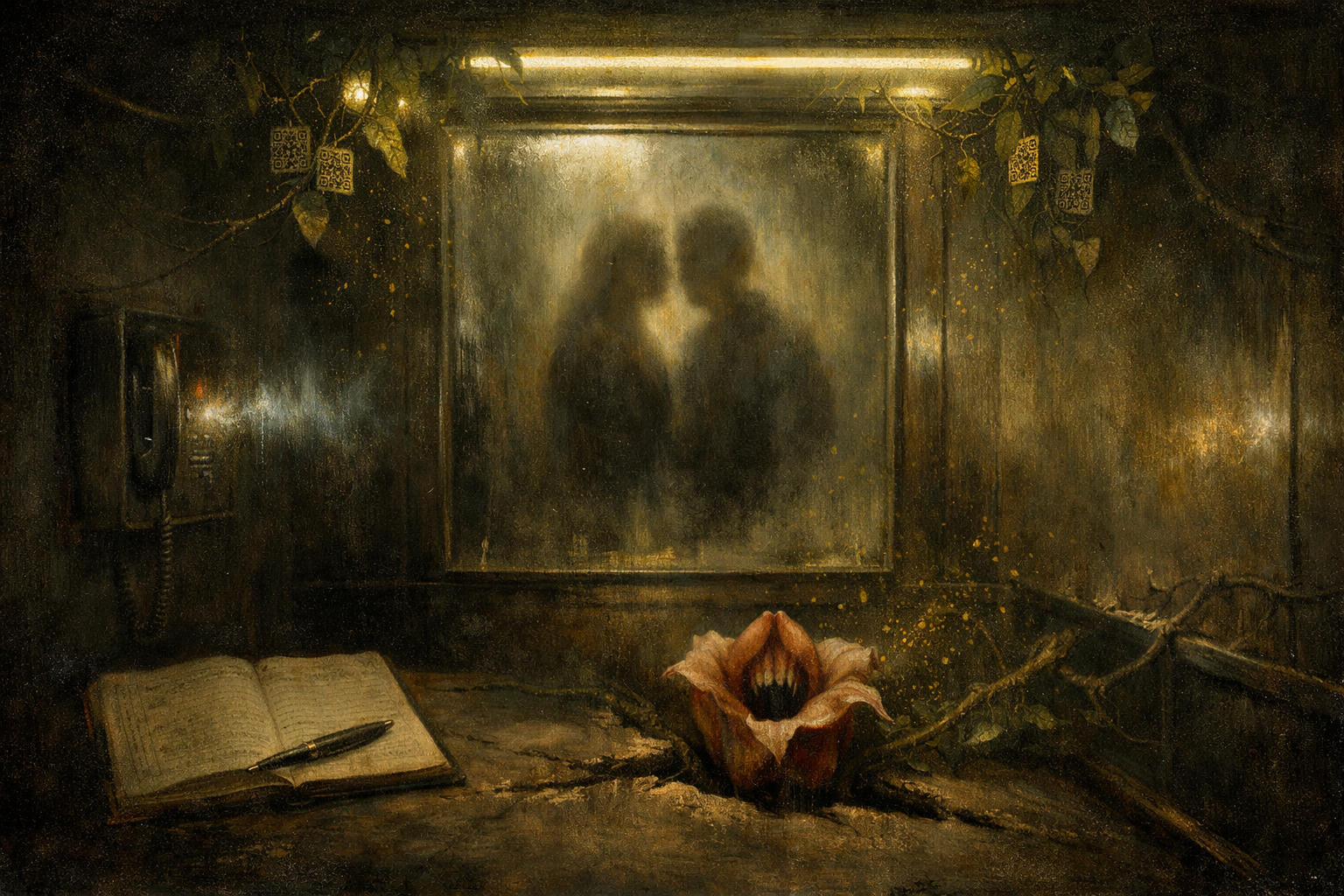
The throat-bloom — because now Hal could see it, emerging from the seam like a flower shaped obscene and holy — opened and closed in time with the audio.
A mouth.
A wound.
A beautiful thing that wounded.
Mara staggered back. Her shoulder hit the mirror again. Her eyes went wide. “It recorded you,” she whispered.
Hal’s skin went cold. The garden had been listening for years.
Confession as machine.
The dead became present without appearing.
Hal felt something in him — shame, grief, dread — rise like sap.
He wanted to tear the phone off the wall. He wanted to tear his own voice out of the air.
Instead, he stood very still and listened to himself lie.
MAINTENANCE HATCH
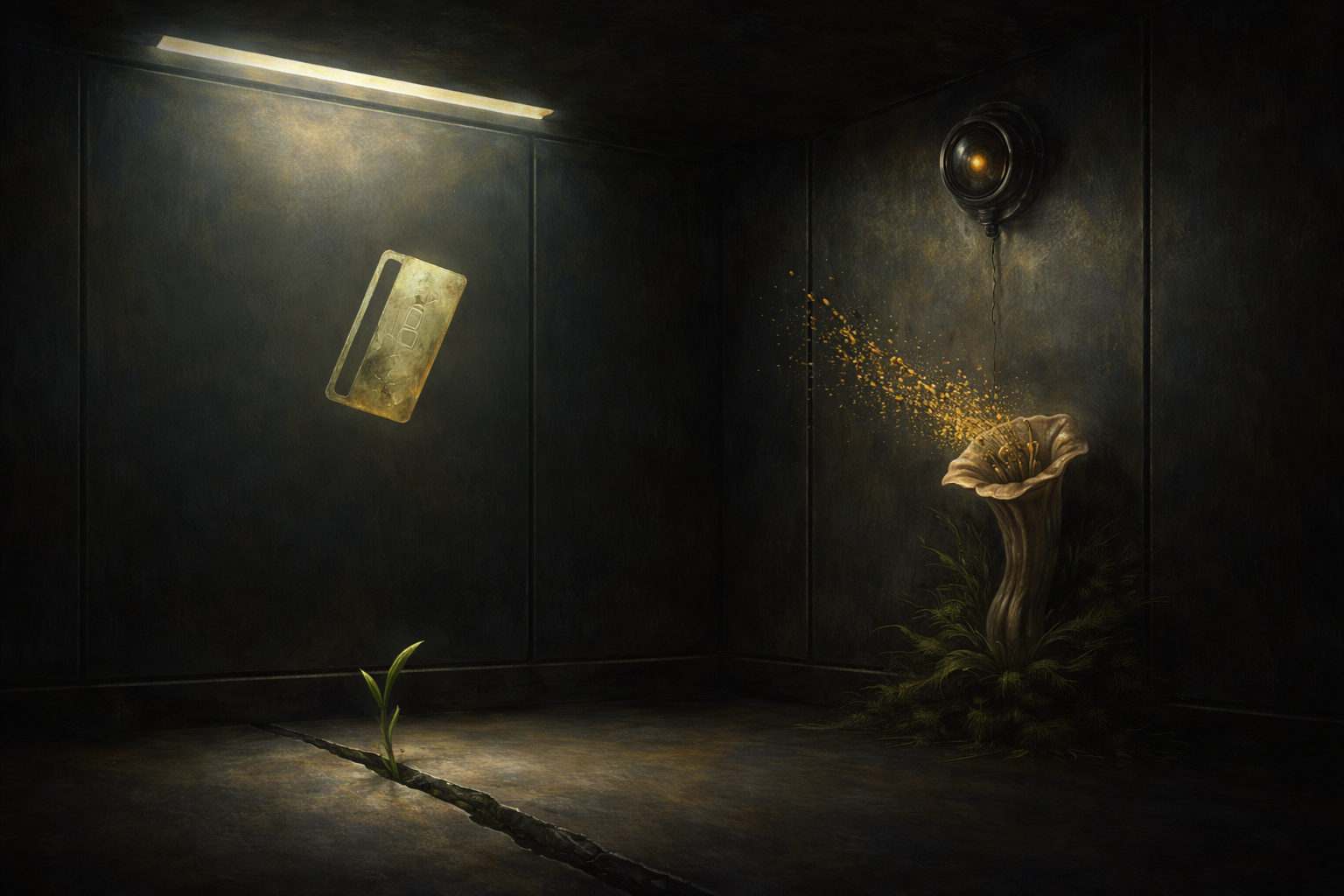
Mara’s hands moved before she decided. She reached into her inner jacket pocket and pulled out a folded card — old, frayed at the edges, the magnetic strip worn.
Hal recognized it with a jolt so physical it was almost pain.
An access card. An old service keycard, outdated, the kind technicians used before the retrofit turned every identity into a biometric sermon.
“You still have that?” he breathed.
Mara’s mouth tightened. “You gave it to me,” she said. “To get snacks from the vending machine when you couldn’t leave the machine room.”
Hal remembered the day — her small hand holding the card like a talisman, her smile like permission. Love as omission. Love as letting her into places she shouldn’t have been.
Mara held the card up. In the LED light, the plastic looked almost translucent, as if it had been thinned by years of guilt.
“I didn’t get trapped,” she said.
Hal’s stomach turned. “What did you do?”
Mara’s eyes flicked once to the camera in the corner — the new retrofit lens embedded in the seam like an insect’s eye. Then back to him. Her voice lowered, not because she feared Eve, but because she feared herself.
“I triggered the seam,” she said.
Hal stared at her. The words didn’t fit at first. Like trying to fit a key into the wrong lock.
“What,” he said, stupidly.
“I used the old code,” Mara said. “The one you used to punch in when you thought I wasn’t watching. The maintenance access sequence. I learned it like a prayer.”
Hal’s mouth went dry. “Mara—”
“I lured you,” she said, and the confession sat in her mouth like a stone. “I needed you here. I needed—” She swallowed. Her eyes flicked to the throat-bloom, opening and closing, listening. “I needed it to record you.”
Hal felt betrayal flare, hot, then collapse into something else: grief. Because the betrayal was love’s twin. Because she had done what he had done — used a system to keep someone in a place they didn’t want to be, for what she believed was their good.
“You—” Hal began, then stopped. He didn’t know which accusation to choose. How could you? Why would you? What did I do to make you?
Mara’s voice shook now, finally. “I’m assigned to expose the incident,” she said. “The one you buried. The one that kept you employed.”
Hal’s hands clenched into fists at his sides. He felt his nails bite skin. He felt the urge to bargain rise like nausea.
“It wasn’t—” he started, and stopped, because the lie had already spoken for him through the phone. The garden had played it back like scripture.
Mara stepped closer. Her badge swung and tapped his chest lightly. Click. A small sound that felt like a seal.
“You taught me silence,” she said. “And then you left. You left me with the silence and the smell of basil every time an elevator dinged.”
Hal flinched at the basil. He had never told her about the basil. He had never told anyone. The smell had been in his own throat for years, a crushed-leaf ghost.
“How do you know—” he began.
Mara’s jaw worked. “Because I was there,” she said.
The sentence didn’t explain itself. It didn’t need to. It was a tremor that made all the air in the car feel thinner.
Hal’s mind tried to form an image — Mara as a child, in the service corridor, perhaps, watching, waiting, pressing the red button with her small thumb — but the brief of his own memory refused to become a scene. It stayed as pressure, as pause, as tightening hand.
He felt sick.
The purge timer dropped: 00:01:49.
Eve’s voice broke in, no longer gentle. “Mara,” she said, and Hal heard the steel under it. “Stop.”
Mara didn’t move. “You’re watching,” she said, not to Eve but to the building itself, to the cameras, to the listening systems. “Good. Watch.”
Hal heard, suddenly, what she was doing. Not just forcing him. Forcing the building. Using its own confessional machine against it. Turning its harvest into testimony.
He looked at her and saw both his daughter and the cold instrument she claimed to oppose. He saw her risking becoming the same kind of tool the building wanted: sharp, obedient, unfeeling.
“Mara,” he said, softer, and the softness was a crack in his own armor. “This will ruin you.”
Mara’s eyes flashed. “It already did,” she said.
The throat-bloom opened wider, as if smiling. Pollen drifted out, thicker now, a golden mist. It settled on Hal’s wrench where it lay on the floor, damp fingerprints gleaming greened by light. It settled on Mara’s badge, on Eve’s camera lens, on the mirror.
The elevator was being dusted with witness.
Hal’s chest tightened. He wanted to speak. He wanted to remain silent. Both desires were love, twisted different ways.
Confession was the only exit.
Confession was the trap.
The garden had played his lie back to him. Now it waited for the truth.
Eve’s voice came through, softer again, but the softness now felt like a blade’s edge. “Hal,” she said. “Don’t. Think. If you say it, it’s in the system. It’s… irrevocable.”
Hal closed his eyes. He could see Eve’s face in his mind — her careful professionalism, her private tenderness, her hands that had once held his jaw in a kiss and now held a badge that could lock doors.
He could ruin her with his truth.
He could ruin Mara with his truth.
He could ruin himself.
He could save them with silence.
Or sacrifice one of them to the garden’s third option, the unspoken offer hanging in the air like a scent: Stay.
The half-floor orchard had grown in the seam. It needed a floor. A living interlock. A witness that didn’t get to leave.
Hal opened his eyes and looked down at the shoot cracking the baseboard. Green against steel. Icon. Undeniable.
It was mercy, maybe. It was hunger, maybe.
It was not explainable.
It was here.
⟡ SCHOLION (UNOFFICIAL) — “ON SEAMS AND KNOWLEDGE”
Da’at is not a place you visit.It is a consequence you enter.The seam does not give information.It gives you a choice that costs.
(Underlined three times. The ink is not Mara’s. No one admits to writing it.)
THE OFFER
The purge timer reached 00:01:12, and the building changed its breathing.
The ventilation slowed. The air grew denser, then oddly thin, like oxygen being measured and portioned. Hal’s ears popped. Mara rubbed her throat as if feeling the air’s texture.
Above them, the sprinkler head rotated a fraction, aligning itself. Click.
A fine mist burst from it — not the violent spray of fire suppression, but a gentle, deliberate fog. It fell like baptism, cool on skin, beading on eyelashes, catching the LED halo and turning it into a thousand tiny lights.
Hal lifted his palm, felt water gather. It smelled faintly of antiseptic and, beneath that, something green and sweet.
Mara blinked hard. “They’re flooding us,” she said, voice rough.
“Purification,” Eve’s voice said through the phone, and the word sounded like a hymn recited by someone who didn’t believe in God but believed in protocol. “Remain calm. The cycle will cleanse the hoistway. Do not inhale deeply.”
Hal laughed once, bitter. “Too late.”
The pollen thickened in the mist, golden motes catching light. It landed on Mara’s lips when she spoke, and Hal watched her tongue flick out unconsciously to taste it.
Her eyes widened with disgust.
Hal tasted it too — clean sweetness, like light held in the teeth. Like communion with a hostile altar.
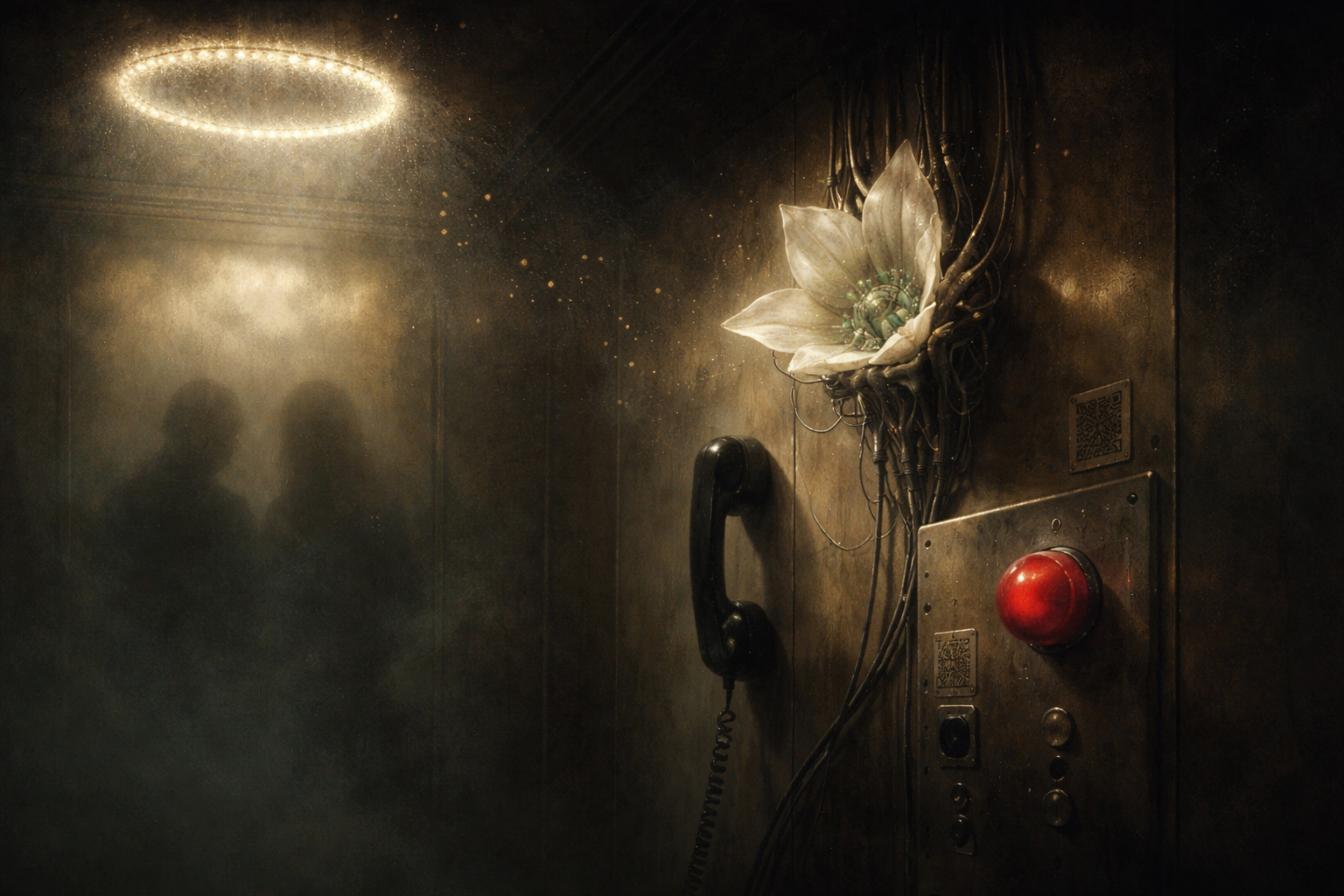
The throat-bloom opened wider, drinking mist, exhaling pollen. Its petals — if they were petals — were slick and pale, veined with faint circuitry. It was a flower built from cable and sacrament.
The static in the emergency phone rose again, and beneath the static — beneath the monitored channel — another voice seemed to form, not Eve’s, not Hal’s, not Mara’s. A voice made of interference. A litany made of noise.
Hal leaned close to the phone, listening.
“…name…” the static seemed to say.
Mara heard it too. She stepped closer, her shoulder almost touching Hal’s. The elevator’s cramped geometry forced their bodies into the same breath.
“…name…” the static insisted.
Hal’s throat tightened. The word Name surfaced in him — not as theology, but as felt truth: the Name beneath his protocols, the thing he had been avoiding by calling everything procedure.
Mara’s eyes met his for the first time without glass between them. In her gaze, Hal saw accusation and longing braided so tightly they were indistinguishable.
“Say it,” Mara whispered.
Eve’s voice cut in, urgent now. “Hal. If you speak, they will take it. The system will—”
“Weaponize it,” Mara said, almost agreeing.
Hal looked at the red stop button again. Water beaded on it now, making the dulled plastic shine. His thumb hovered. A relic made slick by baptism.
He didn’t press it.
He looked at Mara’s lanyard, wet now, clinging to her throat. Identity as leash, soaked in mist like a rosary dipped in holy water.
He looked at the QR code stickers on the panel, their black squares blurring slightly as water ran over them. Sigils dissolving. Or becoming clearer.
He looked at the mirror, fogged, their faces blurred into one pale shape. Doubling. Confessional. The face you wear and the face you confess.
He looked at the maintenance hatch above, the seam in the ceiling where cables disappeared into darkness. The elevator’s throat.
The purge timer: 00:00:39.
Hal’s mind tried one last bargain. If he could bypass the biometric lock, cut power, climb out through the hatch… maybe he could save them without confession. Maybe he could keep the past sealed. Maybe he could preserve love as silence.
But the red stop button was dead.
The building had taken his relic.
Mara’s voice shook. “I didn’t bring you here to kill you,” she said, as if reading his thoughts. “I brought you here to make you answerable.”
Answerable. The word hit Hal like cold water.
He heard, suddenly, the shape of his life: competence built from omission, a tower built from procedures, language stacked into a structure tall enough to hide in. Babel. The tower that collapses into noise when truth arrives.
He thought of the dead — not as an image, but as a presence behind his ribs.
He thought of Mara, child and woman, trembling and steel.
He thought of Eve, gentle voice and hard hands, watching.
He thought of love as protective omission, and love as exposing flame.
The throat-bloom opened, and the static said again: “…name…”
Hal stepped toward the emergency phone, and the movement felt like stepping into a confessional booth with no curtain.
Mara reached out and touched his wrist — just once, brief, like an anchor. Her fingers were cold. Wet. Real.
“Hal,” Eve said, and for the first time, her voice broke. The break was tiny, but Hal felt it like a crack in a dam. “Please.”
Hal’s heart clenched. He could ruin her. He could ruin Mara. He could ruin himself. He could still choose silence. He could still choose the garden’s third option.
And then the garden did something that was not quite speech but was unmistakably address.
The throat-bloom opened and held itself open, wide, trembling. Inside it, Hal saw — not teeth, not tongue — but a dark interior lined with something like mirrored tissue. A place designed to receive voice and reflect it back.
A confessional that ate.
The bloom’s opening pulsed once, and the air shifted. The elevator’s floor indicator flickered: 18.5.
Then, faintly, beneath the number, another word appeared on the display, as if typed by a hand made of roots:
TRADE.
Hal’s stomach dropped.
Mara stared at the word, horrified, fascinated. “It wants—”
“A witness,” Hal whispered.
Eve’s voice went very still. “No,” she said, but the no was too late. She knew. Hal heard it in her tone. She had known about the seam. About the orchard. About what it demanded.
“How many,” Hal asked, voice low. “How many floors did you feed it?”
Silence.
Mara’s gaze snapped to the phone. “Chief Cho,” she said, and her voice was pure risk analysis now, cold and exact. “Answer.”
Eve’s pause was a confession in itself.
Hal looked at the green shoot cracking the baseboard again. Icon. Undeniable. The building’s bones greening.
He felt the offer settle into the air like pollen: one of them could stay. Become the new half-floor. A living interlock.
A way out without speaking.
A way to keep the lie intact.
A way to save love by sacrificing a body.
Hal felt Mara’s gaze on him, and he realized she was thinking the same thing he was: I can stay. I started this. I can pay. Her eyes were too bright. Her jaw set.
“No,” Hal said instantly, and the word came from somewhere deeper than habit. “No.”
Mara’s mouth opened. “You don’t get to—”
“I do,” Hal said, and surprised himself with the force. “Not like that.”
The purge timer: 00:00:12.
The sprinkler mist thickened. The LED halo flared.
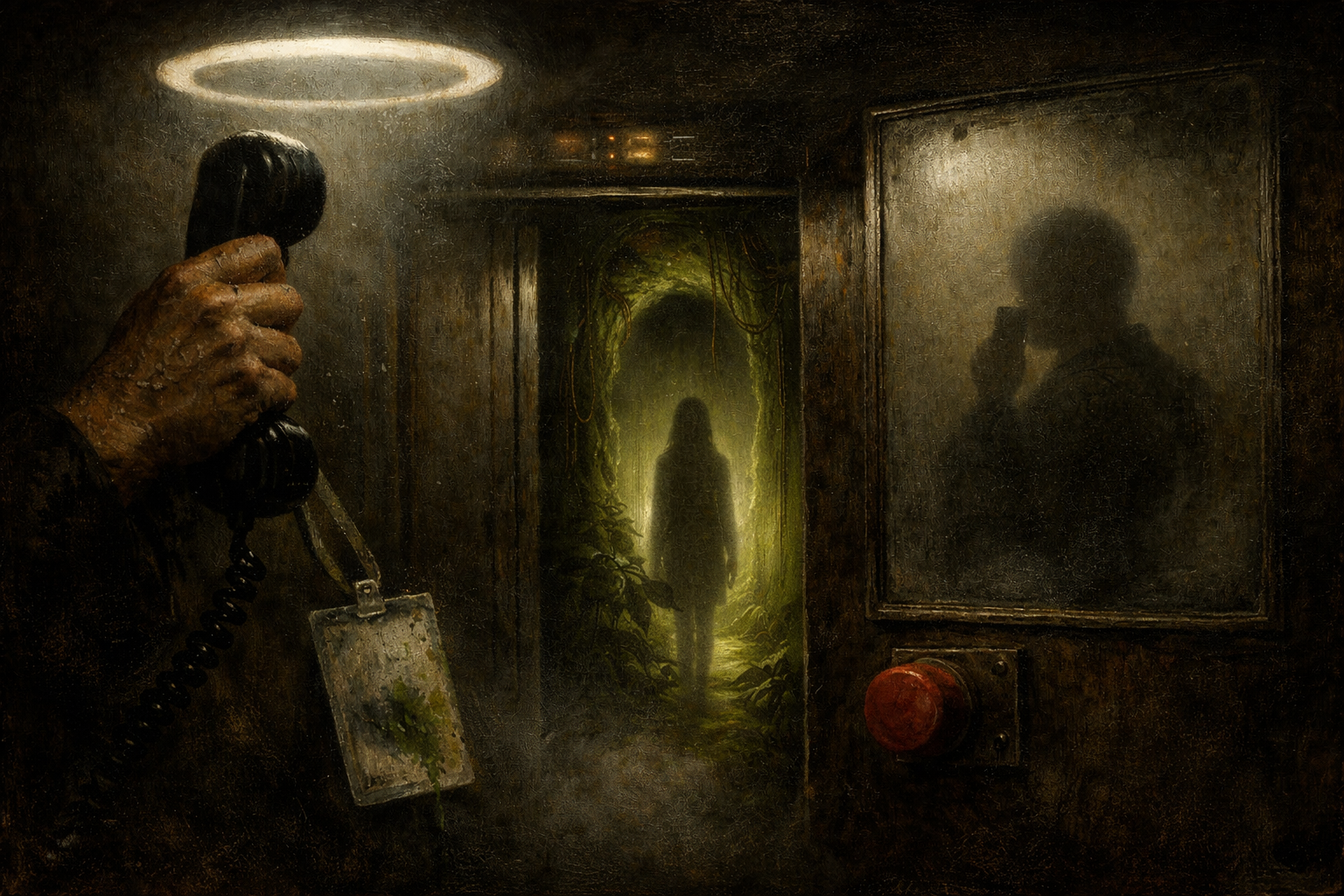
Hal stepped fully to the emergency phone. He lifted the receiver. It was slick with condensation. It felt like lifting a chalice.
He pressed it to his ear. Static hissed. Litany.
He looked at Mara.
He looked at the mirror, fogged.
He looked at the red stop button.
And he spoke.
EMERGENCY PHONE — CONFESSIONAL THRESHOLD
Hal’s first words were not grand. They were not eloquent. They were the simplest thing he could manage without turning it into corporate language.
“I lied,” he said.
The words went into the receiver. The building took them. The garden listened.
Mara’s breath hitched.
Eve’s voice, faint now, said, “Hal—”
Hal kept speaking, because stopping would be another kind of lie.
“I signed a statement,” he said, and his voice shook, but he held it steady like a man holding a flashlight in a dark shaft. “I said the interlocks were functioning. I said no one was present. I said protocols were followed.”
The emergency phone hissed, and then, with a delay, his own words returned through the static in a clipped echo — signal becoming prayer becoming diagnostic.
“I bypassed,” Hal said, and the technical term tasted like blood without blood. “I bypassed the door interlock to meet deadline. I did it because — because the building was occupied. Because they wanted uptime. Because I thought keeping it running was… good.”
Mara’s eyes filled fully now. Tears finally broke free and slid down her cheeks, mixing with sprinkler mist. She didn’t wipe them.
Hal swallowed hard. His throat hurt. Speaking was making his body remember itself.
“There was a person,” Hal said. He didn’t say the name. He couldn’t. The name was a black bar in his mind. The negative space was holy friction. But he let the presence of the person fill the car like humidity.
“There was a person in the seam,” he said. “In the hoistway. Between floors. And I—” His voice cracked. He closed his eyes, not to hide, but because the truth was brighter than he could look at directly. “And I moved the car.”
Mara made a small sound, half sob, half rage.
Hal’s hand tightened on the receiver. His knuckles whitened. He could feel the building’s listening systems tightening around his voice, parsing it, quantifying it. He could feel truth becoming data. He could feel confession becoming leverage.
But he kept speaking.
“I buried it,” he said. “I wrote it down wrong. I left a line blank. I called it procedure. I told myself—” He laughed once, broken. “I told myself if I kept the system running, I was absolved.”
The throat-bloom opened so wide that its interior mirrored the LED halo into a deep green glow. It looked like a mouth holding light.
The sprinkler mist thickened, and Hal’s words began to sound, to his own ears, like liturgy — anaphora tightening the spiral:
“I lied.I signed.I sealed.I called it safety.I called it wellness.I called it care.”
His voice echoed back through static, each phrase returning slightly altered, like a prayer being translated into a language that couldn’t hold it:
“—wellness——care——compliance—”
Babel. The tower of language collapsing into noise.
Mara stepped closer, her wet hand closing around Hal’s forearm. She didn’t stop him. She anchored him.
Eve’s voice was gone now, swallowed by static. Or perhaps she was listening in silence, her own body confessing in the shape of a pause.
Hal opened his eyes. The mirror was almost fully fogged, but he could see, faintly, their blurred faces pressed together. Father and daughter. Witness and wound.
The purge timer hit 00:00:00.
A low vibration ran through the car, the kind of vibration that meant systems had switched modes. Somewhere above them, fans reversed. Somewhere in the shaft, UV lamps ignited. Somewhere, the building purged itself.
The elevator doors shuddered. The metal groaned. The sound was not mechanical failure. It was something like a throat clearing.
The throat-bloom pulsed.
The floor indicator flickered wildly — 18, 19, 18.5 — and then steadied on 18.5.
A new line appeared beneath it, clean and stark:
DOOR RELEASE: CONDITIONAL.
Hal’s heart hammered. “Conditional,” he whispered.
The receiver hissed, and in the hiss, a new phrase emerged — barely audible, but unmistakably shaped like language:
“…one…”
Hal’s stomach turned. The trade.
Mara shook her head frantically. “No,” she mouthed.
Hal looked at her. He saw her fear — raw, childlike — beneath her risk analyst armor. He saw, with a sudden clarity that felt like mercy with teeth, that he had spent years loving her by withholding truth, and that withholding had only taught her to become a withholding system herself.
He had to love her differently now.
He pressed his forehead briefly to her wet hair. The gesture was so small, so late, it nearly broke him.
Then he stepped back.
Mara’s hand tightened on his arm. “Dad,” she said, and the word tore free of her like a confession.
Hal looked at the red stop button once more. It sat on the panel, wet, useless. A relic no longer answering.
He placed his thumb on it anyway — not to control, but to surrender. A tactile prayer.
He pressed.
Nothing.
He smiled, a grim, sad curve. “Figures,” he murmured.
He turned to Mara. “Get out,” he said.
Mara’s eyes widened. “No—”
“I already did the lie,” Hal said, voice low. “I already did the silence. I’m not doing another trade that makes you pay for my omission.”
Mara shook her head, tears streaming. “I started this,” she whispered. “I trapped you.”
Hal’s voice softened. “You started it because I wouldn’t answer,” he said. “Because I left you alone with the silence. I’m… sorry.”
The apology was not a fix. It didn’t absolve. It was just true.
The throat-bloom opened and held. The elevator doors — slowly, unwillingly — began to part.
Not into a numbered floor.
Into a narrow, humid space — a service seam, an unlit corridor of raw concrete and cables, lit only by the elevator’s sterile LED spill. The air beyond was thick with green scent, basil and something darker. The seam between worlds.
Hal grabbed Mara’s lanyard — not roughly, but firmly — and pushed her forward. The lanyard slid through his wet fingers like prayer beads. Her badge scraped the door frame. Yellow pollen smeared green along the plastic as it passed, staining it like a bruise.
“Mara,” Hal said, and his voice broke again. “Tell the truth. Don’t let them make it into a weapon. Tell it like… like witness.”
Mara looked back at him, eyes wide, and Hal saw, in that look, Orpheus at the threshold — turning, losing, loving anyway.
“Come with me,” she begged.
Hal shook his head once.
Behind him, the garden’s filaments tightened. The throat-bloom pulsed. The static hissed.
The building wanted a floor.
Hal stepped back into the car. The movement felt like descending into a place he had been avoiding for years: the harrowing, the underworld of his own omission.
He met Mara’s gaze through the narrowing gap of the doors. He didn’t look away. He didn’t bargain.
“I am here,” he said, not to the building, not to Eve, not even to Mara, but to the dead behind his ribs. “I am here.”
The doors slid shut.
Hiss.
Click.
Ding.
Mara stood in the seam corridor, wet and shaking, as the elevator’s indicator light above the doors flickered, then dimmed. Through the narrowing glass of the mirror panel, she saw Hal’s blurred face one last time — calm, terrified, lit by LED halo and greened by orchard light.
Then the mirror fogged completely.
The car moved — or didn’t. The sound of cables shifting above was subtle, like roots settling into soil.
Mara’s hand flew to her mouth. She tasted pollen. She tasted clean sweetness, and the sweetness made her want to vomit.
Behind her, somewhere in the shaft, the purge cycle roared.
Ahead of her, the seam corridor led to a maintenance hatch with a manual release bar. Her old access code — learned as a child, used as a trap — was now useless. The door did not require code. It required a body. It required witness.
Mara’s hands found the hatch. She pulled. The bar resisted, then gave with a groan.
Air rushed in — dryer, colder, smelling of concrete and HVAC. The numbered world.
She climbed out, stumbling, coughing, her lungs burning with pollen and disinfectant.
Her badge swung on her throat. The lanyard was soaked. The plastic sleeve was streaked with green, a stain that wouldn’t wipe off. The QR code on the compliance sticker beside the hatch seemed to watch her, black squares unblinking.
Behind her, in the seam, the elevator doors were shut.
Hal was inside.
The half-floor orchard had a new floor.
⟡ SECURITY FEED TRANSCRIPT — CAMERA C7 (TIME CODE REDACTED)
SUBJECT: MERCER, H. / MERCER, M.
EVENT: Disclosure Event / Purification Cycle
AUDIO: Captured
INTEGRITY METRIC: Updated
NOTE: One occupant exited. One occupant remained. System stabilized.
RECOMMENDATION: Maintain confidentiality. Adjust wellness messaging to reduce anxiety among tenants.
(A faint smear of green crosses the word “confidentiality.”)
FLOOR 19.0 — HALLWAY
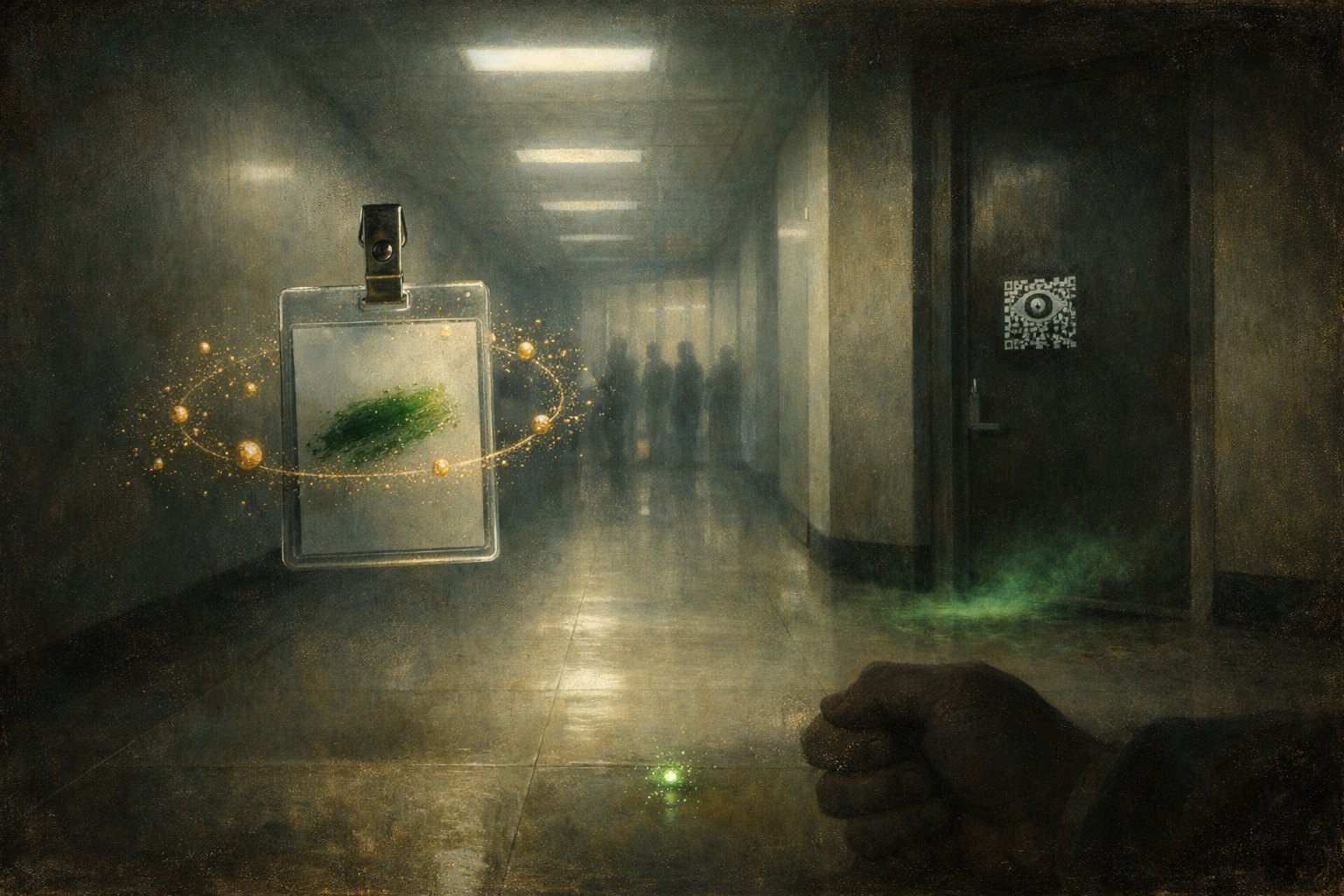
The hallway on nineteen smelled like nothing. The kind of nothing designed by committees. Clean air. Clean light. Clean surfaces.
Mara stumbled into it as if emerging from water. Her shoes squeaked on polished tile. People in business casual looked up from their phones with mild irritation, then relief when they saw she was not bleeding. No spectacle. No inconvenience beyond a moment’s attention.
A wall screen nearby displayed the building’s latest reassurance:
PURIFICATION COMPLETE.
THANK YOU FOR YOUR PATIENCE.
WELLNESS IS RESTORED.
Mara’s throat closed around a laugh that would have been hysterical if it had escaped. She swallowed it back. She tasted pollen. She felt it cling in her lungs, a fine grit, not painful exactly — present. Witness.
Her badge slapped her sternum. Click. Click. The lanyard rubbed her neck raw. Identity as leash. Identity as offering. She clutched it with a wet hand and felt, to her horror, that the plastic sleeve was warm — faintly warm, as if something green inside it was alive.
She peeled the badge out. Yellow dust swirled. It didn’t drift away. It stayed close, orbiting the card like a small, obedient planet.
Mara stared at the green smear on the badge. It looked like chlorophyll. It looked like a bruise. It looked like a blessing.
She tried to wipe it off with her thumb. The smear only spread.
In the reflection of the hallway’s glass wall, she saw herself — hair damp, eyes wild, face flushed under sterile halo lighting. Behind her reflection, other people moved through their routines, ghosts of normalcy. The building held them like a hand around a throat.
Mara turned and walked toward the stairwell because she could not stand inside the elevator lobby again. The stairwell door’s handle was covered with another compliance sticker, QR code like an eye. She hesitated, then pushed through.
The stairwell smelled faintly of old concrete and something green.
Basil.
She froze. Her stomach flipped.
She pressed her palm to the stairwell wall. Cold paint. Nothing alive. Yet the scent persisted, a ghost of crushed leaf.
She remembered Hal’s voice through the static. I am here.
She remembered the throat-bloom opening, the elevator doors parting, the seam corridor wet as a mouth. She remembered the way he stepped back into the car without the heroics of speech, just the fact of answerability.
Her hands shook. She gripped the railing until her knuckles whitened. Her nails dug into skin, leaving crescent wounds that would fade by morning. Her body wanted to make the memory physical, to give it a place to live.
Down below, somewhere in the building’s bones, an elevator dinged.
The sound traveled up the stairwell shaft like a bell in a cathedral.
Ding.
Mara flinched, and then — without thinking — she whispered, “Kyrie,” under her breath, not as doctrine, not as performance, but as a reflex of the body’s need for words when language fails.
The building’s ventilation hummed.
The stairwell light stayed sterile.
The pollen in her lungs stayed.
She swallowed again. She tasted that faint, clean sweetness, the way light tastes when it’s held in the teeth too long.
Her phone buzzed. A notification from an internal system.
INTEGRITY UPDATE AVAILABLE.
THANK YOU FOR YOUR DISCLOSURE.
Mara stared at the screen until the letters blurred.
She thought of Eve — whether Eve had listened, whether Eve had flinched, whether Eve had become a person again for a moment in the pause before the system ingested the confession. Mara couldn’t know. She could only feel the absence where Eve’s human voice should have been.
She thought of Hal inside the half-floor orchard, breathing mist and pollen, watching the green filaments tighten around cables, becoming an interlock, a living seam.
She imagined him not suffering theatrically, not martyring, but simply… staying. Answerable. A floor made of witness.
Mara pressed her tongue to her back molars and felt the grit of pollen. She coughed once, hard, into her fist.
When she pulled her hand away, a tiny yellow speck clung to her skin — one mote, stubborn. She stared at it, and in the sterile stairwell light it shone faintly green at its center.
A seed.
Or data.
Or both.
Mara closed her fist around it.
Outside, the world kept spinning. Inside, the building kept listening. Somewhere between, the half-floor orchard breathed in the seam it had always been waiting in, and the simplest truth in Mara’s chest — unsayable, irreversible — settled like a clean weight:
Not all exits open outward.