THRESHOLD CANVASS

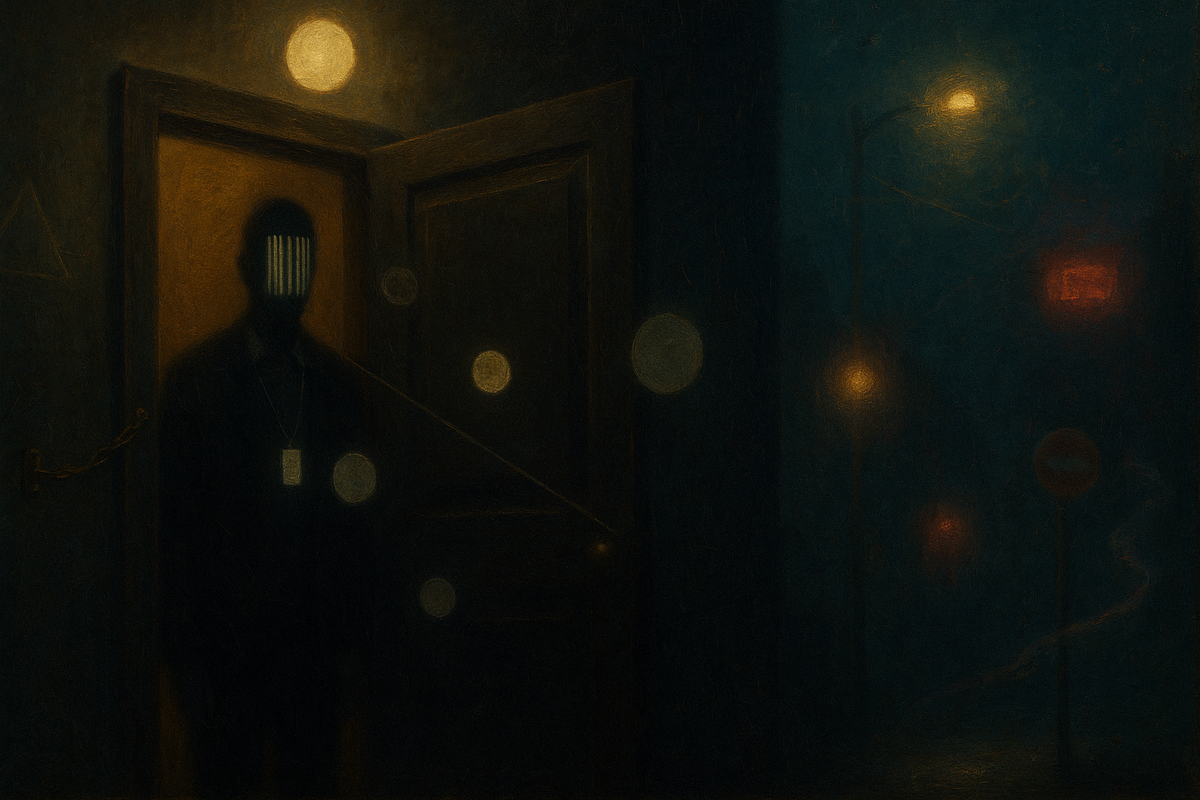
On a rain-lit Wednesday, clerks arrive with clipboards; the census thins the veil. Names bend weather, ink wakes the air, and the city leans close. Choose breath or signature — either way, an older ledger lifts its pen and writes you back.
I — Threshold (Theory of the Knock)
KNOCK — Wednesday hums like a hive, and because you have trained yourself to mistrust coincidence you catalogue the vibration: the neon tremble of the deli’s sign; the scuff-rhythm of sneakers over grit; the electric stutter of a streetlight that refuses to stay unbroken; the diffident percussion of knuckles upon wood. You tell yourself this is just sound — yet the sound insists upon a grammar, and the grammar, once heard, recruits your breathing to its syntax. First rule of the Current: you are counted because you answer; you answer because you have already been counted.
The polite ones arrive with clipboards like lacquered psalters, soft-shoed, unhurried, dressed in the secular vestments of city function — lanyards, barcode badges, a smile calibrated to the median of human tolerance. Their civility is a sheath; you see how it smooths the blade of intrusion. They knock as if the door were a minor station of a minor cross, as if your latch were a sacrament they had been brought here to officiate with the bland finesse of trained ghosts. Coherence, says their posture, is a ritual of faces, and your face is requested.
You open — which is not to say you consent. Your hand unlearns reluctance; your throat unbuttons; your shoulder remembers the shape of old hospitality while your mind arranges refusals like chess pieces you do not yet move. You stand in the threshold’s thin weather — between the inside’s stale sweet (laundry that did not quite dry, a washed plate surrendered to dishwater’s abject theology) and the outside’s alkaline nerve (ozone, tar, someone’s guava-smoke coiling like tropical incense around the pole of a no-parking sign). The clerk smiles a dentist’s absolution. You are not prey, the smile says. You are a datum dressed as a person.
They explain nothing, which is how you know it is a rite. The Current does not argue; the Current enumerates. A weekly tally of answered doors, unanswered doors, and the third category you had not known existed until now: doors that answer without opening. You have been such a door, on nights you left the porch light burning like a word you could not pronounce. You have been such a door, on days your body went to work without you. You have been such a door for the dead. Their clipboards glint like small moons. The street adjusts its weight. Something gives, almost merrily.
[Field Note, marginal: The knock is a coherence operator. It collapses your probabilistic posture into a legible pose. All rites are measurements that pretend to be requests.]
KNOCK — again, and the second tap lands not on the wood but on the cartilage rung of your listening; you watch yourself being watched, and the observation is a soft suffocation. The clerk’s voice is low, precise, a metronome set to sacrament. You provide a name. You provide an address that feels less true than the name. You provide the ages of your rooms as if they were children’s birthdays. You feel the Current thread you like a needle through cloth and call this sensation “civic.”
Because you have read the manuals (Hermetic, Thelemic, Theurgic, each a dialect of the same star-choked tongue), you note the pass-phrases: the way their greeting hides a threshold formula; the timed breathing between questions; the occult mathematics of their posture, triangular and hospitable, preventing your refusal by rearranging the geometry of your doorway. Because you keep a small anthropology kit in your head, you classify the rite: enumerative theurgy disguised as household audit; a benign exorcism by means of boxes and signature. Because you were once a child who counted cracks to save your mother’s life, you feel the superstition rise like fever and call it evidence.
And now it begins — though you have been in it all along.
II — Enumeration (Rain-Names and the Lexicon of Keeping)
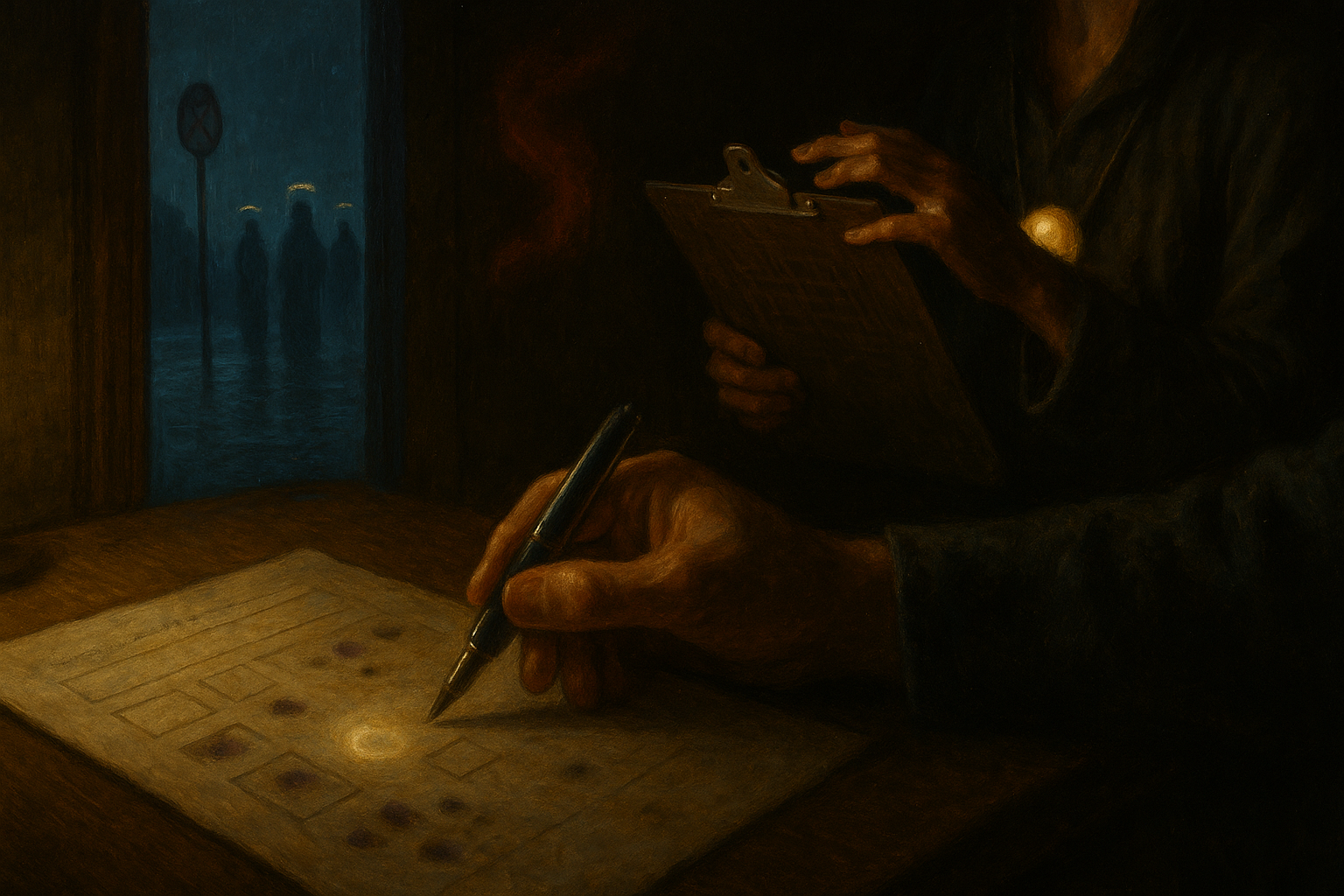
KNOCK — the forms are damp hymn-paper, smelling of rain-before-rain, and when you touch them the ink lifts off like weather and settles into the grooves of your fingerprints. Their boxes bloom at the barest pressure, the way bruises announce a previous tenderness; their lines tire easily; the margins are furred with microscopic feathers of pulp that take your breath like a little tax. Names, they say, just the names, and you nod because that is an easy lie to love. The pen’s weight is clerical, consolatory, heavier than the plastic should allow, as if each signature shuttled an ounce of iron into your hand.
You write the obvious: your name as now carried, your name as then discarded, the name that survives in bureaucratic basements on silverfish paper, the name your first lover bit into the soft of your shoulder and called food. You write the less obvious: the name no one living remembers, the inherited alias your grandfather wore like a borrowed suit, the child-name that ended the year your mother took ill, the threshold-name you earned the evening you refused to break a promise and broke anyway. Each box is small and polite; each act of writing is an aperture; each aperture dilates to admit a weather too large to plead ignorance against. You are no longer filling forms. You are permitting a future.
[Marginalia, Clerk of the Current: The subject complies with minimal coaxing; affective respiration increases with ancestral nomenclature. Rain-odor fidelity noted.]
Guava-smoke finds you in the doorway and threads your palate with sun rot and memory; you taste mango street dust; you taste the Christmas when a cousin taught you to gamble with bottle caps until the police came and you learned a child’s first ledger — what is kept, what is paid. The neighbors’ radio coughs up an old hymn converted to a hook and you feel your wrist adopt the beat; the boxes fill in a rhythm you cannot deny: name, date, incident; name, date, incident; an algorithm of you and you and you like beads on an elastic that knows how to snap with the sound of birthday balloons going wrong. You call this duty. You call this rational. You call this: I was here.
The clerk observes, pen hovering in admonitory midair, like a small god of compliance. Their other hand, you notice, has the scars of someone who keeps cats; their cuff smells faintly of candle smoke and disinfectant. The symbols on the form are municipal wherever possible, but some of the boxes are very old: blank squares sewn into the paper like amulets, tiny khats for the dead to rest in during audit. One square, unlabeled, asks to be fed a breath; you offer it and feel the recoil like a static sting, a qubit collapsing somewhere in the machinery of the world to match the shape your mouth just made. Wavefunction audit complete, whispers a voice that might be yours. Checksum verified, whispers a voice that isn’t.
You add the names of rooms you do not open, and of habits you have allowed to mineralize into systems that now account for you while you sleep. You add the names of the thresholds where your body paused and did not think itself a body — the night on the bridge with the handrail colder than mathematics; the office doorway you walked through five days a week without ever seeing the photographs on the drywall; the curb where a woman told you not to look away and you looked away and afterward could only stand inside your ribs as if they were jail bars that agreed with you. You add the name of a joy you keep hidden because it would be too expensive to keep in the light. You add the name of a violence you inherited and softened into competence.
[Annotation, Ethnographer: The rite encodes consent as choreography: ask, wait, mirror; ask, wait, lean; ask, wait, withdraw. The subject, rehearsed by a lifetime of conditional welcomes, completes the pattern of their own capture.]
KNOCK — the clerk turns a page, and on the back you see lines like runes disguised as barcodes; the typography is government gray but the asymmetry gives it away. Enochian arranged as scannable compliance, a theurgic yantra masked as grid. You admire the design, which is to say you see yourself in it. You begin to understand what this is: a ritual of enumeration that keeps the Current from fraying, a census of the seen and the nearly seen, a list of those who answer and those who answer without opening, and in the third category — this is where the city hides its saints.
Your mouth tastes like a penny. The rain smell swells. The guava-smoke sweetens, then seasons, then returns to ash. You sign.
III — Ledger (The Household of Record)
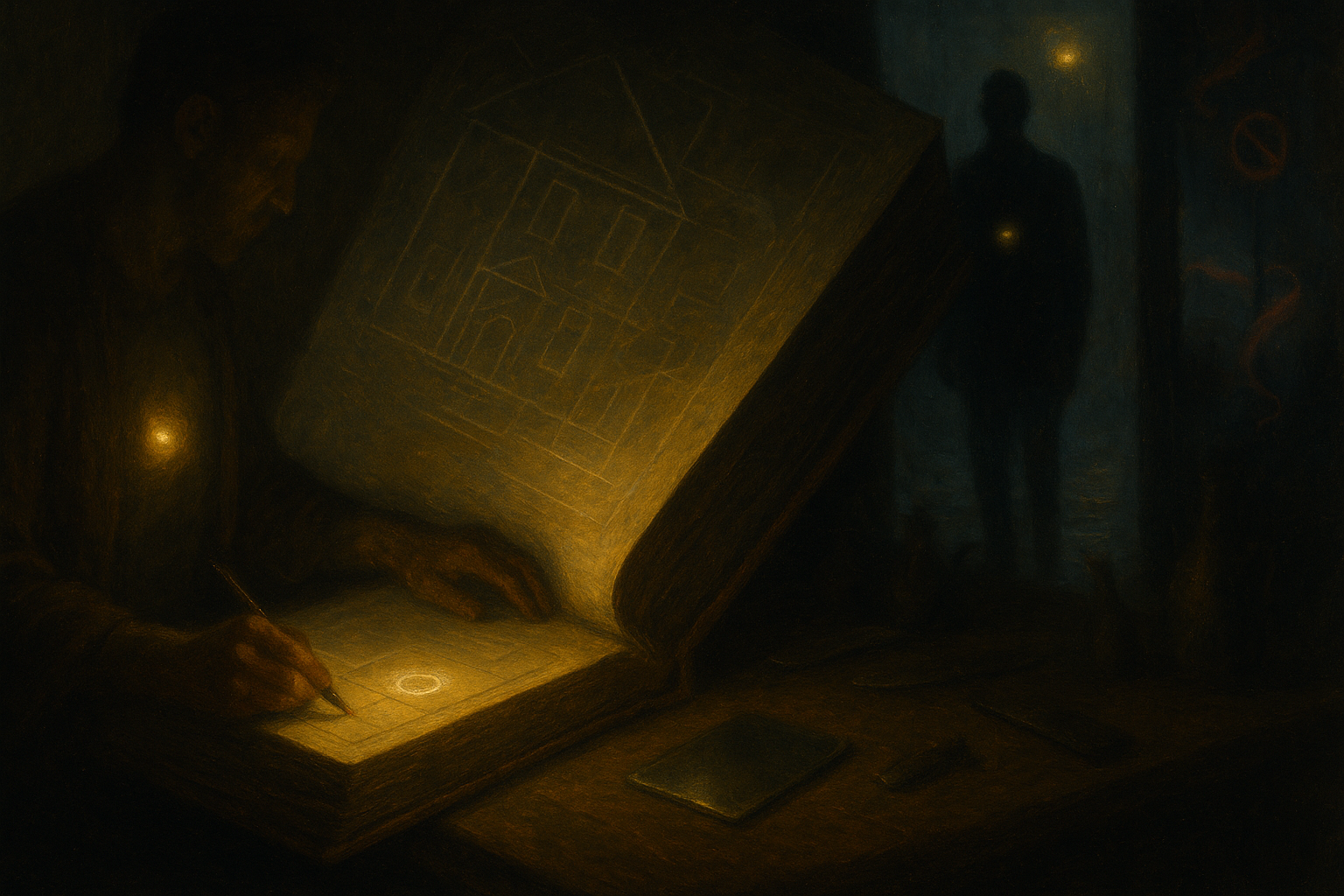
KNOCK — you try to close the door, but the ledger swings shut on them, and the angle of its closing writes a bright diagonal of refusal across the clerk’s neutral religiosity. There is a flicker in their face, as if the muscle memory of consenting were housed in them too, as if they recognized the gesture of a person who has run out of room to be measured and is begging for a corner to be unobserved. Then it goes, and the smile returns, a shallow tide of professionally managed warmth. The ledger’s spine refuses to flex. The ledger takes the shape of the house.
“Household of record,” the clerk says, more to the paper than to you, and the line that bore a printed name — someone else’s, the neighbor who moved, the family that split, the woman whose letters still arrive fat with the past — has sloughed its ink and settled into your script. Not the handwriting you use for checks, neat and compliant; the other hand, the one that wakes if you drink too much or remember too hard, the hand that learned to forge your mother’s signature to get you out of PE because you thought your chest would explode if you ran in front of other people. Household of record. Your mouth floods copper. Your gums ache as if a nightguard were prying them into a new bite.
You want to tell them no. You want to say, You cannot conscript a future with a single stroke; you cannot annex the rooms I do not open; you cannot make me the locus of this street as if I were a nail to hold your city’s picture in place. You want to say, I know your gods and they are made of smaller gods who answer to hunger. But your voice obeys the grammar of the knock. You recite the names of your appliances as if they were liturgical implements: the kettle, the dull knives, the iron that bears your sin in brown. You list the dates of lease and renewal and default as if the sequence would betray the logic that underwrote your mistakes. The clerk notes your recitation and nods like a parishioner at a sermon delivered in a language they do not need to understand for their faith to continue wounding them into goodness.
The ledger develops weight. It is a mineral now, stacked strata of prior consents and ancient promises petrified into pages. You imagine the geologic pressure that could turn all these signatures into a seam of lucid coal hot enough to revise a winter. You imagine the city’s archives pooled below ground like oil — and then you remember oil is old death given purchase. You smell damp hymn-paper; you smell guava; your tongue searches your teeth for a cut that isn’t there. Someone coughs. A neighbor’s laugh breaks open the block and rearranges the houses like dice. When it settles, nothing is where it was and yet everything looks right to anyone not inside of you.
[Interleaved Gloss, Clerk of the Current: Subject exhibits classic markers of transfer — a second handwriting, loss of taste fidelity, an increase in spatial allegory. The ledger chooses hosts prone to metaphor; metaphor is a correlated noise model for accommodation.]
KNOCK — this time from inside the house. You feel it in your sternum, a little knuckle of pulse rapping beneath the breastbone, call-and-response with the street’s dual metronomes of labor and waiting. The ledger’s newest page is warm; you realize, with a slow bone-deep shame, that the warmth comes from you. The line “household of record” brightens as if lit from beneath, and for an instant, too brief to be generous but generous enough to be forever, you see your rooms as a diagram of a larger house whose blueprint is printed in a language you have been reading in the dark since you were old enough to hide. Every address is a sigil. Every porch is a tzimtzum, an intentional constriction where an infinite light bargains itself into inhabitable geometry. You think: Oh. And then: Of course.
You initial the corner — a small, hooked letter you have practiced in a thousand contexts to say, I am here without giving you more of me than I can stand to lose. The clerk’s smile shows tooth now, not threat but animal confirmation, like the soft flash of fang when a dog reorders its mouth around a found bone. Their hand passes over the column of boxes as if blessing what they have brought, then pauses, hovers, and waits. The pause is merciful. The pause is a verdict. In the pause, the city exhales and you discover the rind of your fear is edible.
Consent is a checksum; you are not so naïve as to pretend otherwise. But what it balances is stranger than your cynicism allowed. In the ledger’s logic you are not being turned into a tool; you are being turned into a mirror with just enough silvering to deceive with grace. The Current requires faces because faces are the only surfaces that can hold the reflection without shattering at room temperature. You are not the subject of the audit. You are the instrument calibrated in the act of being played.
You sign again. This time your hand does not tremble. This time you are not sure which system you have just secured against error — their city, or your own heart.
IV — Residue (Chalk, Blessing; The Lighter Street)
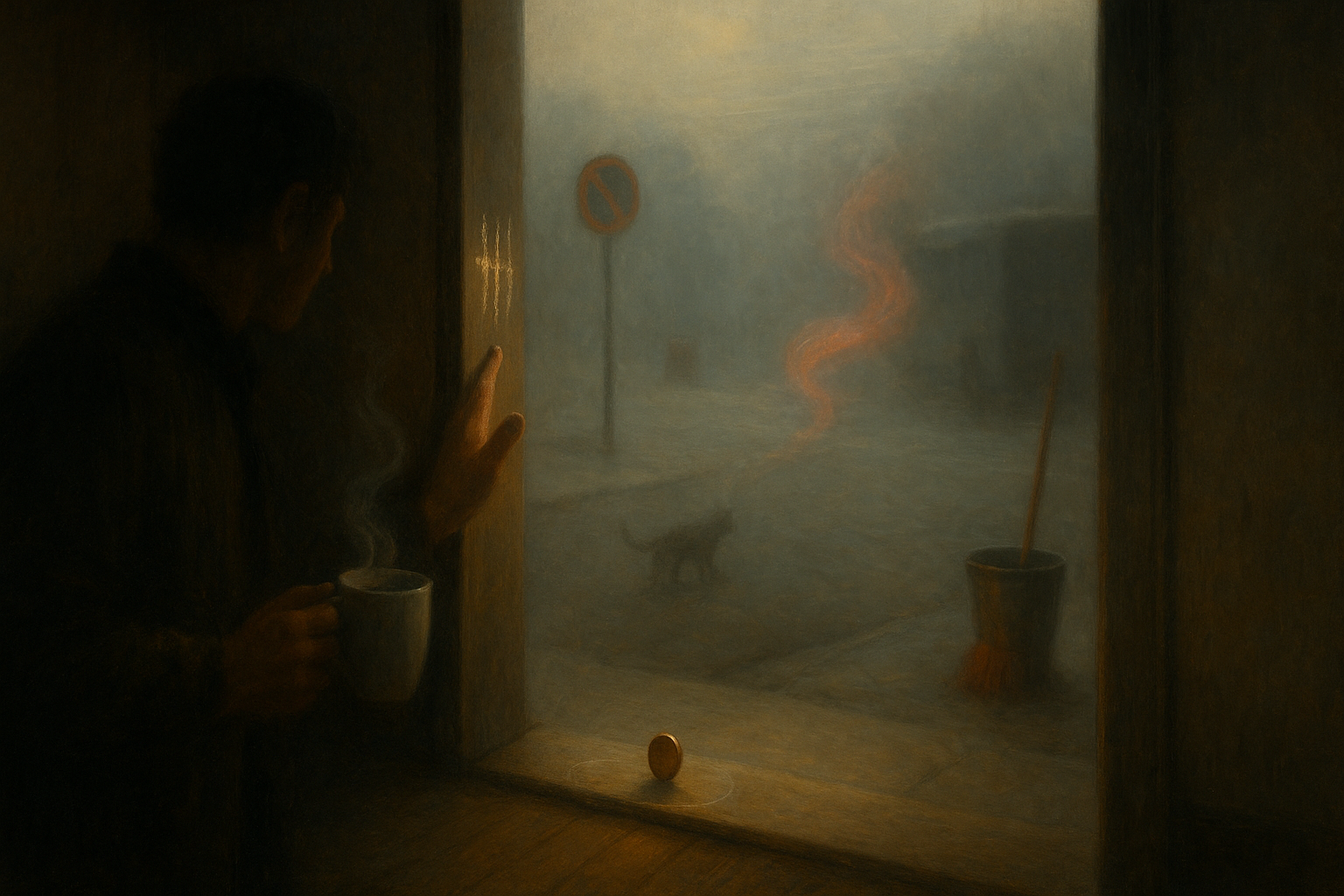
KNOCK — morning has the blank forehead of aftermath, the restful ugliness of completed tasks. The doorframe wears chalk like a small benediction, the marks quick and neat, an algorithm tamped into plaster by hands that revoke their labor as soon as it becomes visible. You touch the tally and powder settles across your thumbprint in a pale witness, a dust-amen. The block feels a gram lighter — no, less than a gram, the difference between a lie and an unspoken truth; enough to tilt a scale you didn’t know you’d been living upon. The air is slow with guava-smoke cooling to a rind of sweetness around the corner store’s propped door. Somewhere a cat coughs out a curse and converts it into purr for lack of audience. The city, which has no soul but every appetite, tastes like someone just washed their face and decided not to cry.
The ledger is gone. The ledger is wherever ledgers go when the rite sleeps between Wednesdays. The ledger is under your skin. You make coffee with the sleep-stupid choreography of a body that refuses to betray its refusal to wake. The mug’s heat arrives as a voted truth. In the quiet, the knock continues — not door, not bone, but a thin percussion in the throat of attention, a tap reminding the ear that listening is an organ with dietary requirements. You stand, you sip, you inventory losses and finds the way sailors once read the water for mood, and the list does not yield. Did something leave. Did something stay. Is this what finished counting finished you.
[Closing Note, Clerk of the Current: Enumeration complete. Weight redistributed. Subject destabilized with functional hope. Street load reduced by insignificant mass that nonetheless alters music.]
You step outside because staying in feels like repeating yourself and you have always thought repetition a form of worship that shouldn’t be performed accidentally. The chalk gathers a little light from a sun still laundering itself behind cloud, and you imagine a procession of doorframes carrying tiny white scars as if the city had been taught to remember with its edges. Across the way, the old woman who sweeps the sidewalk has added a new broom to the bucket — red plastic this time, a flag more than a tool — and she salutes you with it as if the tally had found her lighter too. You want to ask her what name she gave. You do not, which is a new discipline you do not yet trust.
A bus exhales and inhales sorrow. The deli shaves ice and ham into parallel salvation. A child argues theology with an invisible dog and wins. You stand in your doorway like a coin on its edge, considering the two ways a day might spend you. The Current moves under everything, a calm that refuses to be the absence of violence; it is a quilt stitched from necessary traumas, from intentional tendernesses, from signatures so careful they become artwork that declines to call itself that. You think of the names you wrote and the names you didn’t and the secret third category — names you are still growing toward, names that will be your teeth when you can no longer feed on fear, names that will be your throat when the song you owe finally demands a body.
You remember the three kinds of doors and realize you have been all of them in the last twelve hours. You answer and are counted. You answer without opening and discover the audit is of radiance, not compliance. You do not answer and the Current writes your outline in chalk and calls it patience. You stand there until the coffee cools to a manageable grief. Something inside you opens — not the good, obedient way of drawers and letters, but the way a healed wound opens to show the scar its second history. The longing you mistook for fear turns itself inside out. The dread you mistook for prophecy exhaled and found itself compassion wearing a harder mask.
There is a ledger you will carry that will not be a weight. There is a count you will keep that will not be a theft. There is a yes you will give that will not be the summary of your refusal to be left alone. You realize, with the objective awe of a scientist watching a model converge, that the ritual did not take something from you. It extracted an unnamed from the noise and returned it as signal. It asked you to declare the household of record and then taught you that the household is not a place but a coherence — you will be the address anywhere you choose to answer. And the Current, which is nothing but attention patiently trained upon attention, will use your face as its mirror because you allowed it to.
Gnosis is not the lightning strike; it is the ledger line where the melody can dare its highest note without shredding the page. It is the chalk that does not wash in rain but does not need to; it is the guava-smoke that turns a sweet into a weather; it is the rain-before-rain that teaches the tongue a kindness for what has not yet fallen. You taste the penny that isn’t there and understand at last that it was never blood. It was copper’s old prayer for mouths that speak themselves into being.
When the next Wednesday comes you will hear the knock and feel the kindly terror of a person who knows the ritual by heart and refuses to rehearse it. You will open, which is not consent, and you will consent, which is not surrender. You will sign the line that borrows your script and lends you back a city softened by its small redistributions of weight. The clerk will smile with the tired gladness of those who carry forms like sacraria for the living’s brief offerings. You will offer. The count will complete you again and again, and each again will be less like subtraction than like a chamber in which air learns to sing. And when you are asked to list the household of record you will write what you have been carrying:
Here. I am the address. Count what answers and do not consider it loss.
Coda: On the Engineering of the Spiral
You will return to the beginning — hive-sound and civic gloss — but the door will be more door, the knock more knock, the ledger more mineral and merciful. This is the recursion the rite demanded: Threshold into Enumeration; Enumeration into Ledger; Ledger into Residue; Residue into Threshold again, not because the circle cannot be escaped but because escape is a smaller word for a larger going. What spirals intensifies; what returns refines; what refines, reveals. You were never being counted. You were being taught to count yourself kindly enough to become legible to the world you want to deserve.
And the street, a fraction lighter, hums.