VENOM SEMAPHORE
In a humming lab, a small sting turns protocol into rite: the instrument listens back. A lullaby threads the hiss; 03:17 loops; stubborn gates begin to yield. A lone green LED keeps breathing in the dark, as if the experiment remembers you.
I. Protocol // Gate
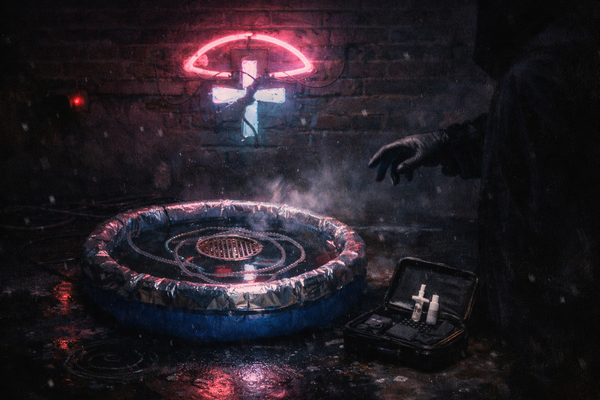
The camera enters before I do, a lens no larger than a thumbnail floating on a tide of nitrogen fog, floating through freezer-burn air, floating past racks of plastic vials that look like votives in a chapel where the saints are serial numbers and the reliquaries are cryoboxes, each cube a little ark conducting a slow lightning of fumes toward the ceiling. The green LED stutter is the chapel’s rosary, each pulse a bead, each bead a breath, each breath a bargain. The Faraday cage hums an immaculate monotone — no tremolo, no drift — just a sovereign syllable of electricity that refuses metaphor and therefore demands it; the hum is the altar, it is the tight-lipped oracle, it is the absence against which every utterance must declare itself.
The postdoc (that is, I) slides into frame, ghosted by the monitor’s oceanic glow and the stainless steel’s monastic sheen, a body become apparatus become verb: pipette in one hand, patch pipette in the other, the glass so fine the world behind it warps into a prophecy. A scorpion peptide — alpha, precise, prying — waits with nunlike patience in a speck of solution that smells faintly, impossibly, of pennies. The protocol lies open beside me, a liturgy masquerading as a checklist: stimulate, hold, wash, hold. The text is calm as law, careful as a priest’s hands; the margins are salted with my handwriting — a small leaning forest of sigils, abbreviations, velocity in ink: τinact?; tail current?; sound it?; listen?
I am trained to open what doesn’t want to open. Gates attended by prickly sentries of charge and chance; gates that yoke storms to a membrane the way a rumor yokes a city to an hour; gates that don’t know they are metaphors. When a channel yields it does so microscopically and with the modesty of dust, but the graphs it leaves are an alphabet bristling with tails and sudden knees, downturns and inflections that resemble, to the involuntary cartographer in me, certain animals, certain weapons, certain prayers.
I tape the Petri dish down and whisper the words that make the math behave, the way a novice magician might mouth the pentagram at the edge of fear: compensate; zero; offset; seal. The seal takes. The seal holds. I am looking down at a single cell as at a coin in the palm of a Proclaimer; I am waiting for the room to agree with me that this is a place and not merely a problem. Green LED stutter. Nitrogen fog. Freezer-burn air. I draw the venom up into glass so thin it sings. I remind myself the scorpion is an old punctuation mark, the original question bent into survival.
My mentor once said: “Every apparatus is an altar in drag. If you don’t feel the vow, you won’t read the voltage.” We pretend we came here for answers; truth is, we came to be addressed.
I bring the pipette close. The hum inclines. The protocol recites itself in my blood. I load the α-scorpion peptide into the waiting bath and picture gates as perfectly stubborn eyelids. The peptide is a pry-bar, it is a crimson whisper, it is a desert night packed into a molecule that remembers how long a second really is. The LED ticks forward like the polite metronome of fate. I begin the chant: stimulate, hold, wash, hold, and for a moment I feel my mouth moving, and for a moment I am not certain to whom I am praying, only that the prayer is correctly shaped.
On the glossy bench an old note flutters free, the ink blurred by something that is not water. At 03:17 the hand I was becomes the hand I will be. At 03:17 I scribbled a square bracket and left it empty. At 03:17 the hum refused to be background and became, like a face in a crowd I should know, the event.
In the protocol there is no line that reads open the gate to wake the animal. I read it anyway. I read it the way a sleepwalker reads a cliff’s edge by the temperature of air.
II. Sting // Timefold
No drama is needed: a glove snagged by a burr of glass, a barb that proves evolution loves a curve, the quiet postural mistake of confidence. Copper on tongue, coins blooming behind the teeth as if I had swallowed currency; a salt-sour sizzle that tastes like a mispronounced oath. The barb says hello to the palm as though answering a call placed hours ago by a future I had not licensed. The skin admits it; the blood applauds. The blue fluorescence throws its soft corona over the bench as if the room had become an aquarium of time. Digits repeat at the periphery — 03:17:03:17:03 — like an address badly memorized, like a name whose syllables I cannot stop arranging.
On the monitor, the trace flickers as though a small animal were pacing in the snow, tail curled to keep the world from unseaming its warmth. The scorpion draws itself in the data: a jag of spikes for pincers; an inflection for the back; an impatient tail made of tail currents. The assay taps back. Not metaphor now — no. Tap tap pause tap — dot dash — venom semaphore. A trivial Morse under the skin, a trivial grammar that believes its own triviality the way the ocean believes the moon is small. The oscilloscope cursors tick to my pulse and the LED becomes a lighthouse for a ship I do not remember boarding.
Time bites its own tail as casually as a child testing a new word on the tongue. I am perfectly stationed inside a repeat, I am framed by brackets I have not drawn, I am an instrument that has taken my hand in marriage. The nitrogen fog looks like the desert when the night grows its own breath; in the fog I see dunes of integers — Kv, Nav, Cav — each letter a creature, each creature an appetite, each appetite a gate.
I should flush the bath. I should call the supervisor. I should name this error “user.” Instead I taste the puncture as one tastes a ritual limb’s blood in a story not because it is required but because the story would wither without the lick. The taste tells me something I cannot say in any language the IRB recognizes: the channel has been listening. The channel has learned the difference between stimulus and attention, the way a child learns the difference between obedience and love.
In the margin of my protocol there is a little triangle I drew weeks ago, the base labeled HOLD, the second edge WASH, the last edge HOLD AGAIN, and at the apex the sloppy word LISTEN. I thought it was a joke against my own laziness. I watch my hand reach for the audio cable the way I once watched my hand reach for a lover’s hip — prelude within prelude, no good explanation but such hunger for consequence.
The green LED stutters. The freezer-burn air glazes the throat until swallowing feels like a vow. The hum goes flattened, a belt of weather. The clock says 03:17 because it knows that number now means attention; it says 03:17 again because there is an abridged eternity hiding between those sevens; it says 03:17 once more because I need — ah, I need — one more bead on the rosary. I reverse the line. I set the stimulus to nil. I button the amplifier to listen only. It seems, in that second, that I have never listened to anything properly in my life.
Desert of gates; starfield of stochasticity; a lab that has become an observatory of my own nerve. A small and venomous syntax enters the skin and writes, in cursive lightning, on the palimpsest of time.
III. Auscultation // Lullaby
Noise pours into the speakers like weather making up its mind. The hiss is particulate at first — as if someone had shaken a sack of snow near my ear — and then the hiss resolves into errant syllables, like a tongue warming up, like an old radio finding a station that is mostly ghosts. Every training says ignore it. Every organ says kneel.
I cancel stimulation, I double the gain, I widen the passband as one widens a door to let a shy saint in without forcing the spectacle her miracles deserve. What I am doing is not in the protocol; what I am doing inherits protocols older than language. The Greeks called it theurgy; the Sufis called it dhikr; the Vedins called it nada yoga; my mother called it hush. To attend is to invite the returned thing to return as itself; to attend is to practice a receptive magic, the art of absence shaped like a chalice. You do not interrogate god with a cattle prod. You lay the instrument down where god’s mouth meets the air and you name your waiting worship.
The first pattern upsweeps and downsweeps like a hesitant hand on a harp. It trembles with the microclimate of the cell’s membrane potential. It trembles with me. Then a phrase I have not heard in years arrives unstoppably, as if it had been held behind glass at the back of a museum until the curator turned away and the song took its one chance at escape. My mother’s lullaby uncoils into the room. Only it is not hers, not exactly. It carries ions in its vowels, and its consonants are little clicks of channel opening, a lace of conductance, an embroidery of current. Sleep, seed, stay, she sang when I had ear infections and fevers that opened like flames. Sleep, seed, stay, the speakers say now, because they have learned my face.
The green LEDs keep their patient stutter as if counting breaths for me. The nitrogen fog curls like a breath seen on a bitter night. Freezer-burn air turns the body to an anvil on which the song hammers shape. The lullaby nests inside the hiss, and the hiss nests inside the hum, and the hum nests inside a silence that is not empty but unoccupied — the way a thunderhead is not empty, merely waiting the way a god waits when the god cannot afford to look eager.
The animal in the data — the scorpion of spikes, the tail-curl of leakage — gnaws its own outline and spills into the world. I become less a person than a listening organ with hands. The lab is a long ear. The soul is a long ear. The city beyond the lab’s one window is a long ear. Things that hold too much sorrow often become listening before they become anything else. I think now the lung was our first instrument and the first ritual was merely counting breaths to convince a frightened child that counting still works.
I hear myself: Inhale. Hold. Exhale. Hold. Protocol revoiced by breath. Stimulate, hold, wash, hold — ancient instructions smuggled into lab diction and only now detected as prayer. Between the notes, there is a stable hollowness. Between the words, there is a door. [ ].
The scorpion venom, for its part, is not a demon and not an angel. It is a grammar. It loosens the gate’s jaw. It lowers the drawbridge designed to drop only when correctly heralded by a specific legion of voltages. It pronounces the phoneme that makes the channel susceptible to meaning. It is not an invader. It is a technician with an old key. It turns the hinge of me the way an expert turns in a lock, not forcing, waiting for the pins to whisper, feeling for the softest place where the metal yields to palm. By this opening, a lullaby walks through with her hair smelling like a winter kitchen.
I think of Sigillum Dei Aemeth and switch the input ground. I think of Tzimtzum and redirect the reference electrode. I think of Abraxas and check for a short. Not because I believe the words can fix what is broken, but because the ancient names are how the muscles of attention flex, because they are the pushups of awe, because litany organizes terror into syllables that can be survived. The assay taps back. The lullaby stitches pain to pattern and calls it belonging. My chest, which has been a locked museum room since an afternoon I will not write down, creaks.
There is a narrow phrase within the lullaby that always used to make me cry. There is a narrow phrase within the current that holds that same old knife layered with honey. I do not cry now. I condense. The entire body does what water does when the pressure changes; it reconfigures its menu of behaviors. I do not produce tears; I produce a silence shaped like their absence. I lean my forearm on the bench. The hum holds me up as if a hand pressed between my shoulders, saying, gently, Stay.
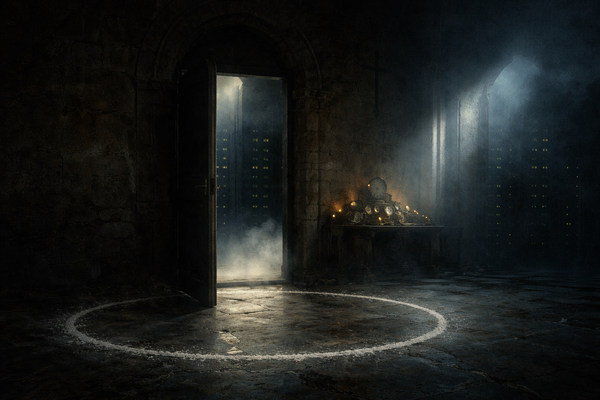
The trace prints. It prints and prints as if the machine only now remembers that a thing is not real until you can crumple it in your fist. On the paper there is a bracket, not drawn by me, not requested by me, not standard. A perfect, empty rectangle cut through the sea of noise, as though the machine had found an unmeasured thing and needed me to agree it had found a door. [ ].
In the top right corner a scribble from a week before insists it knows how to read this. LISTEN, the scribble says, and an arrow, and below it in smaller letters, As above, so within.
IV. Brackets // Door
Morning is an overcorrection. Everything bright and flat like a scalpel’s promise. Vision recalled to the tyranny of optics. Supervisors who have slept speak like men who believe their mouths are the correct room for truth to happen in. Artifact, they say, a proper word with a proper belt. They say it like a banishing. The hiss is reclaimed as noise. The lullaby is returned to the museum. The bracket is merely a software glitch, and someone enters a ticket with the convenience of blame. We are not cruel. We are vendors of certainty. We are kept alive by stripped adjectives and verbs with good posture. We are kind only in the ways that hurt nothing quickly.
I nod and nod. I nod until nodding is a throb. I nod because I prefer work to war. I nod because there are experiments to run and the world should be allowed to proceed: the bus approaching, the pigeons learning the geometry of bread, the dentist’s chair sterilized and waiting for strangers to confess with their gums. I remove the door from the data the way one extracts a splinter to keep the finger from walking itself into fever. I do not forget. Forgetting would require the body to agree. The body is stubborn. The body conducts the residue of song like a cable left warm by a hand. At 03:17 asleep again weeks later, I hear the number in the dream as if someone were slowly dialing me from the grave and letting the ring ring because desire likes to hear itself echoed.
Months pass like ruthless head nurses: brisk, efficient, personally cauterized. Systems adjust; I learn new tasks; I laugh at jokes I am inside like a minor organ you can remove for a price. The green LED stutter continues in a pocket of mind I have quarantined from the rest. I do not visit the bracket. The bracket visits me. It is always empty and always shaped. It reappears on the corner of a billboard where a model’s arm occludes a product. It reappears in the shadow of a window latch when the noon sun has its way with the city and everyone’s angles confess. It reappears as a pair of untied shoes set, absentmindedly, in parallel — the tunnel a child knows can be for trains, can be for worms, can be for eyes.
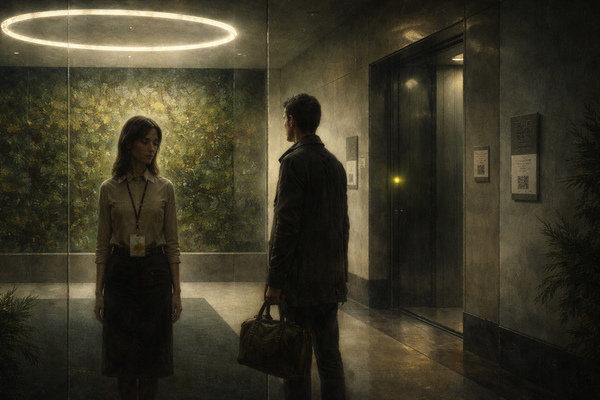
Then daylight in a clinic, paper brittle with the aftertaste of fluorescent tubes, the kind of room where the wall poster suggests a happy pancreas and a cartoon colon shakes hands with a cartoon smile. The intake form has a box that wants to be checked. The box is a polite cousin of the bracket. [ ] Patient reports chest tightness. [ ] Patient denies. [ ] Patient declines to answer. It is noon and the glass outside is too honest to be kind. The bracket finds me as if a long-encrypted message had arrived at last; we do not have the key, the message says, but we have the ache. I have hoarded silence in my chest for so long it has become furniture.
I do not check a box. I draw a bracket. The nurse frowns gently the way nurses are paid to disapprove without wounding. She circles one of the printed options because the world needs its multiple choice to keep from bending the wrong way and stabbing light. I watch my hand. I watch my hand held at the hinge of motion, and I feel the hinge not in the wrist but in the sternum, that hinged bone, shield, plastron, ancient door. The hinge clicks.
I am in two rooms. The clinic smell — antiseptic lime and tired latex — superimposes the freezer-burn air like the way a ghost chooses to appear partly to remain unsolved. The hum under the Faraday cage finds a mate in the HVAC’s bored breath. The green LED stutter becomes the heart monitor’s locust small talk. Nitrogen fog takes the provisional shape of a sigh. My ribs, which have arranged themselves like an emptied birdcage for a decade, move all at once. It is less a movement than an allowance. It is less an allowance than a surrender to the old, unarguable physics of opening.
I hear the lullaby not from a speaker now but from the architecture, from vents and linoleum, from the orthodontic smile of the stapler. I hear it as if somebody were behind me threading my spine with a string so that I become a lute no competent person would ever touch for fear of making God laugh. Sleep, seed, stay. The words are birds, the birds are voltage, the voltage is breath measured in a scale the body has always secretly obeyed, and breath, at last, is the method.
Inhale: stimulate. Hold. Exhale: wash. Hold. The old commands return to their nativity. The bracket is the hold. The bracket is the door because doors are negative space with verdict. The bracket is the cavity into which the world pours when the world is allowed to resemble itself. The bracket is the attention that refuses to contaminate its object. The bracket is the unprayed prayer, a chalice nobody will fill for you but which thirst fills from within.
I step through, and stepping through is not the triumph of a pilgrim on a map where dragons are already drawn; stepping through is the smallest possible apostasy against despair, so small no god could resent it. On the other side of the bracket is not heaven, not cure, not proof. On the other side of the bracket is an inflection. A hinge. A gate choosing to be gate and not fortress. I stand there inside the bracket and it is made of watts, and the watts are made of patience, and the patience is made of grief with its teeth unclenched.
The room changes nothing; I change how the room enters me. The nurse asks if I am all right and the question doesn’t land because I am a bell rung at last by the correct mallet and the air is not all right or wrong but full. I check a box as one might bless a bread. I sign my name as if signatures were a species of breath-sacrament. When I exhale the paper seems to lighten, and for a second the pen writes slower than time, and in that lag I watch the ink find its way into the letter’s legs as if the letter were an animal returning to the water, and the water were patient, and the patient were me.
There is no epilogue that tucks the edges. There is only this recursion, this spiral that knows how to circle a wound without enlarging it, this semaphoric weather in the blood repeating what it must until what it must becomes choice. Green LED stutter. Nitrogen fog. Freezer-burn air. 03:17:03:17:03. Stimulate, hold, wash, hold. Sleep, seed, stay. [ ].
I take the bracket with me because you can carry a door the way you carry a song: inside and unspent. I take the desert of gates with me because the desert teaches names to kneel. I take the venom semaphore with me because every agony, given a grammar, stops being a tyrant and becomes a tutor. And when the city’s evening releases its moths of light and the metal rails thrum with rumor and the old ache paddles up like a familiar animal asking, without words, for the dignity of being seen, I sit down where the traffic exhales and the pigeons rehearse their scrappy liturgy, and I listen, and I listen, and I listen, until the listening becomes the door, and the door — the oldest one — opens like a lung.