Votive Drift at the Shrine of Divergent Clocks

[ARCHIVE COPY: TA / Chronometry Engineering / Decommission File 7.3 — “RIVERSIDE BASILICA”]
Technician: Mira Voss (Field)
Keeper: “Brother Halden” (Unregistered)
Status: Undetermined
Note: Time-stamps conflict. The conflicts do not resolve under standard reconciliation protocols.
Reader instruction: Do not correct the margins.
My times are in Your hand.†
† Calibration annotation: if you must steal a line from scripture, treat it like a shard of glass: carry it carefully; do not turn it into décor.
⟦TA-NTP STANDARD⟧ 19:07:12
⟦RIVERWALK PUBLIC DISPLAY⟧ 19:07:08
⟦WRISTWATCH / VOSS⟧ 19:07:16
⟦ALTAR CLOCK (NO HANDS)⟧ tick (no legible time)
I. The Service Door
I arrived with the warrant folded into quarters the way you fold a napkin at a funeral when there’s nothing left to do with your hands.
Outside the basilica the river moved like a long piece of foil. The city on both banks kept its own hymn — traffic lights blinking in consensus, pedestrian signals counting down obediently, hospital windows winking with monitors and infusion pumps and all the small clocks that insist on a shared world. The Authority’s mandate depends on that insistence. Commerce depends on it. Ambulances do. Lovers do, in the cheap way — I’ll be there at seven — and in the expensive way, the way that costs you years: Wait for me. I’m coming back.
The basilica had been deconsecrated decades ago, sold, annexed, retrofitted; a shuttered national time lab grafted onto its flank like a pale tumor with vents. The stone was old enough to remember choral Latin, but the annex windows wore privacy film and hazard placards. The only visible cross was a rusted lightning rod.
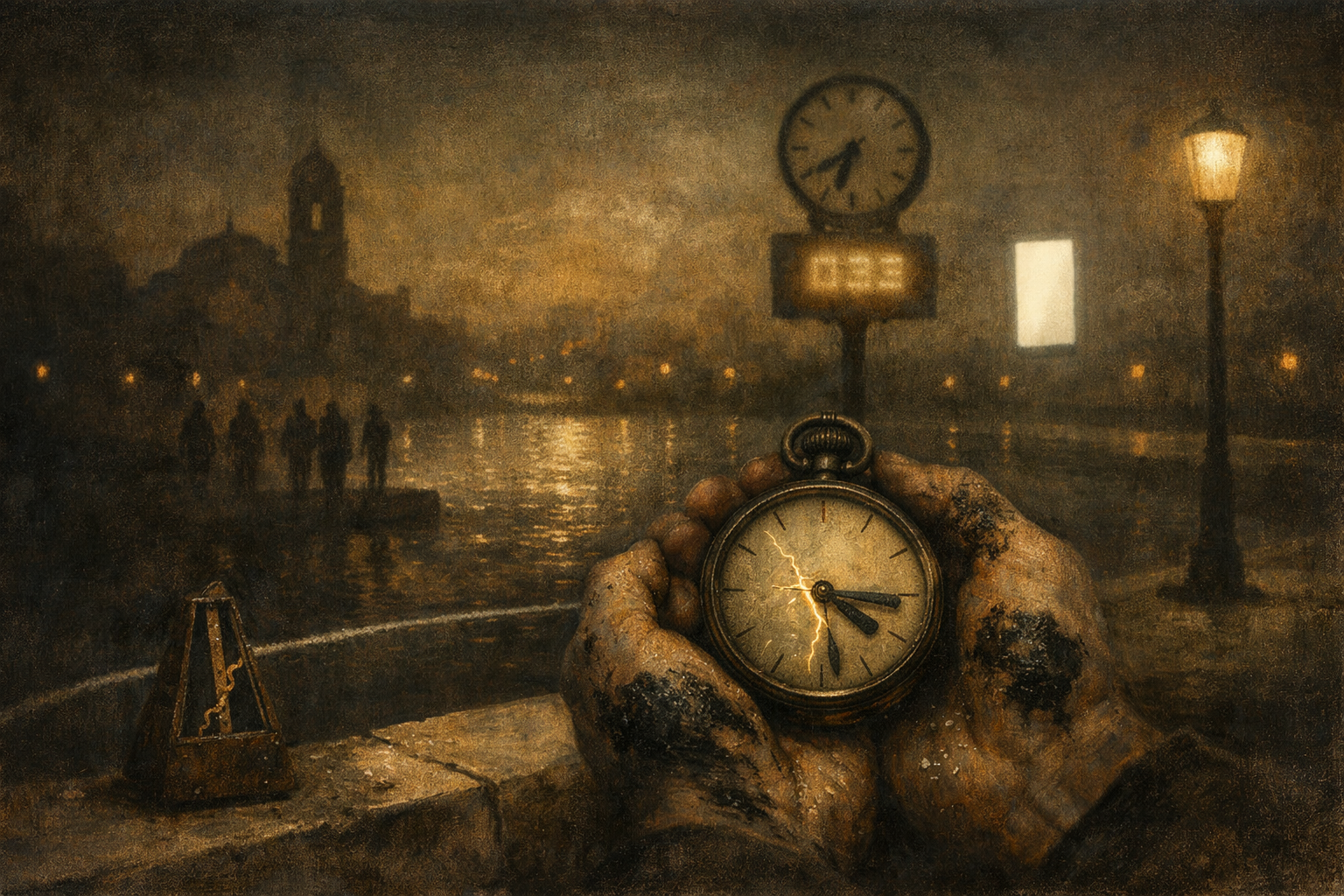
At the riverwalk the public clock — one of those municipal displays meant to reassure the panicked — flickered between 19:07 and 19:08 as if struggling to choose what kind of honesty it owed. My phone noticed, sighed, auto-corrected. Then corrected itself. Then, as I stepped closer to the service door, stopped trying.
My wristwatch is an Authority issue: sapphire crystal, atomic sync, precision built to soothe the mind that fears slippage. It stuttered at 19:07:16 — 19:07:16 — 19:07:15 — then hopped like a skipping record back to :16. A hiccup. A phase error. A tiny mercy or a warning, depending on what you worship.
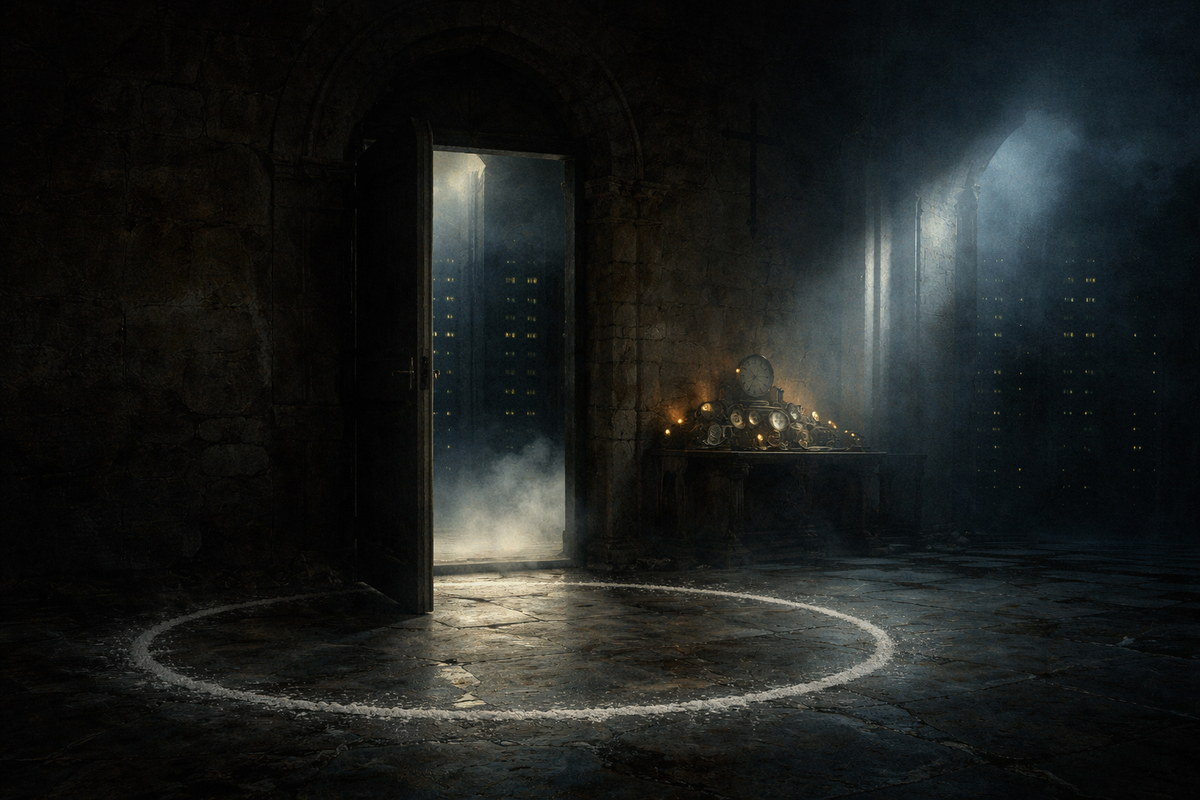
The service door was steel, not carved oak. Its handle was wrapped with a thin line of salt, the way my grandmother used to ring her garden beds to keep slugs out. The salt looked freshly poured, deliberate, too bright against the grime. I knelt, not to pray, but to inspect.
The salt line wasn’t superstition. It was containment — an old lab trick, updated with kitchen materials. Salt is cheap; salt is a boundary; salt is the mineral you taste in tears. In my field reports I’m required to label containment methods by type and efficacy. I wrote: NaCl barrier, threshold ring, intact. My pen paused. The tip hovered.
My body did what it always does near a threshold: it prepared to be correct. My stomach clenched with that familiar readiness, the one that feels like virtue until you realize it’s just fear in a white coat.
I stood. I raised my badge. I knocked.
The door opened from inside.
Brother Halden didn’t look like a brother in any denomination I recognized. No collar, no habit. Just a man with a shaved head and hands that bore the black stain of machine oil the way some men carry nicotine — permanent, intimate, unrepentant. His eyes held that particular tenderness you find in people who have committed to a single impossible task and have stopped asking the world for permission.
He looked past my badge, past my face, to my wrist.
“You brought a master,” he said, as if I’d arrived carrying a lit candle.
“It’s a watch,” I said. “Time Authority. Decommission order. You’ve been flagged as the source of grid drift across three districts.”
He didn’t argue the charge. He glanced down at the salt line, and his mouth did something that might have been humor, might have been grief. He stepped back.
“You can come in,” he said. “But you can’t do what you think you came to do.”
“I came to restore standard.”
“No,” he said gently. “You came to be forgiven by a number.”
The inside air hit like a confession booth: incense braided with ozone, sweetness threaded through electrical burn. The smell should have been impossible — no one burns frankincense next to server racks — but the shrine didn’t care what should be possible. It cared about what could be held together without lying.
I adjusted my respirator seal. Halden noticed and didn’t mock it.
“There’s one rule,” he said, as I stepped closer. His voice lowered — not theatrical, just careful, as if volume itself might shift the phase. “Do not name the correct time.”
I laughed, once. It came out sharp.
“There is a correct time.”
“In your offices,” he said. “In the hospitals. In the markets. In the mouths of people who need to meet each other in the same hour to survive. Yes. I’m not arguing against mercy.”
He watched me the way a clinician watches a patient who has said the wrong thing without knowing it.
“But here,” he continued, “naming it is an incision. You cut the air. You bleed the room. You think you’re sealing a wound; you’re making one.”
The salt line at the door waited like a chalk circle. Containment or communion. I lifted my boot.
My watch stuttered again.
19:07:16.
19:07:16.
19:07:14.
I stepped over.
The world didn’t change all at once; that would have been kind. It changed the way a fluorescent light changes before it dies: a near-imperceptible tremor in the air, a fraction of dimming that makes your skin believe in failure.
The nave had become a server room. Racks rose where pews had been, their LEDs blinking like the eyes of nocturnal insects. Cat-6 cables braided through the arches. The stained-glass windows were boarded, but light still leaked in thin, dust-laden slats, turning the air into visible volume. Under that sterile luminosity, the altar had been stripped and rebuilt.
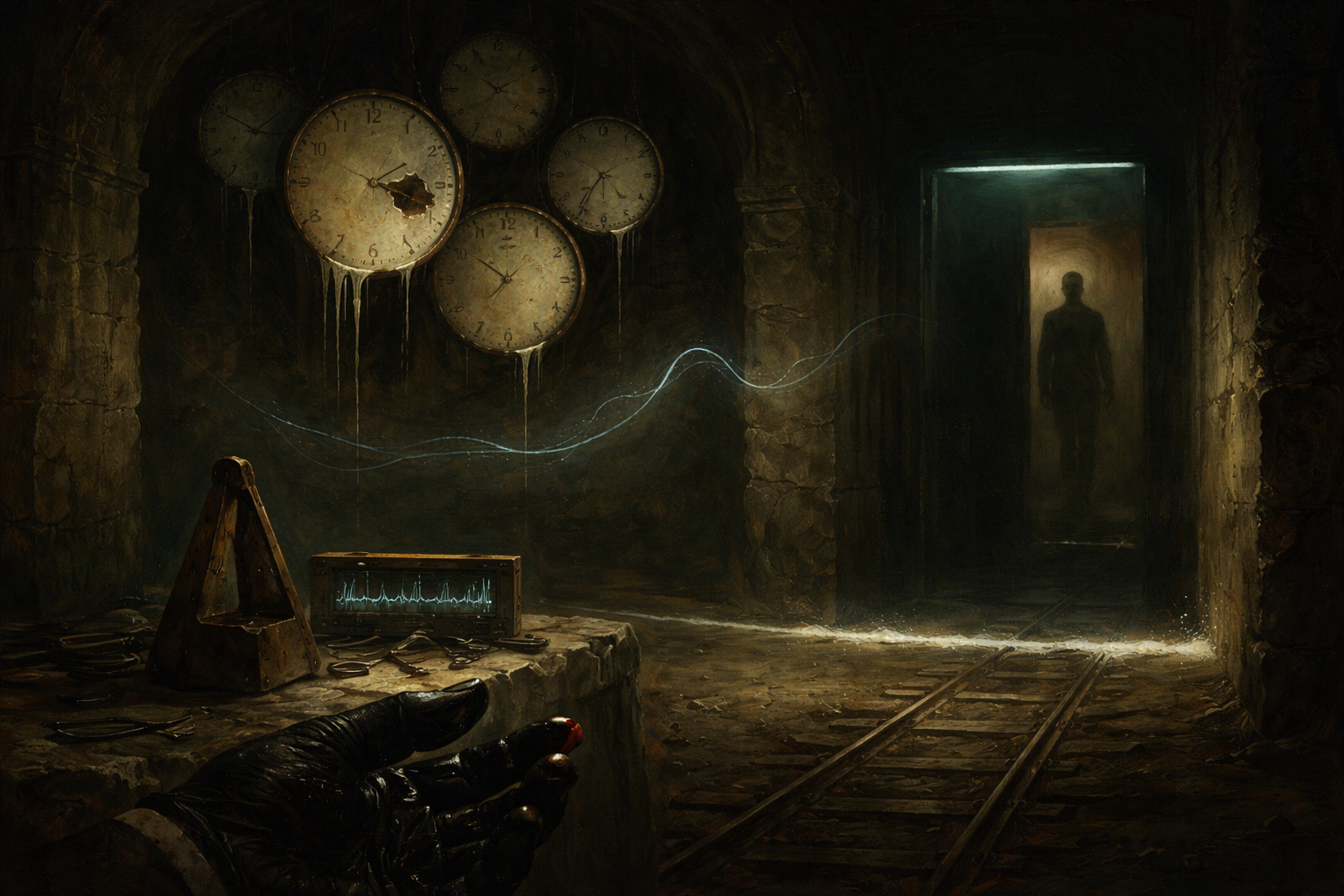
An oscillator cradle sat where the altar stone would have been, polished steel and brass and ceramic insulators. And on top of it — piled like offerings — were clocks. Analog, digital, salvaged transit timers with cracked casings, antique brass faceplates, cheap plastic alarm clocks, a pocket watch with its chain looped like a rosary. Wax dripped across several faces, hardened in ridges. Someone had let candles burn down on the clocks themselves, devotion melting into damage.
Each clock ticked a slightly different rhythm.
It wasn’t chaos. It was polyphony.
It was a catechism in disagreement.
I did what I always do when the world offers me something too large: I reached for numbers. I unpacked my instruments. Field kit: portable atomic reference, phase meter, spectrum analyzer, calibration tone emitter. I set them on the floor tiles where kneeling penitents used to press their foreheads.
“TA to Voss,” my comms unit crackled. “Status.”
Static swallowed half the syllables like a mouth with missing teeth.
“On-site,” I said. “Entry achieved. Containment observed. Beginning assessment.”
My voice sounded professional. My body did not feel professional. My throat had tightened as if the air itself was rope.
Halden watched as I placed the atomic reference. He said nothing. His silence had the weight of liturgy: not absence, but attention.
I took baseline readings.
Drift: variable, distributed.
Phase offsets: multiple, non-linear.
Anomaly signature: consistent with prior flagged events — same harmonic smear in the 1 Hz band, same ugly bloom around the chime frequencies, same wrong bell overtone that shouldn’t exist in a clean system.
The wrong bell. The Authority’s pet name for it, in internal memos: a residual ring after the strike, as if the world itself refused closure. We joked about it in the lab. We used it to scare interns. We never said it aloud in hearings.
Here it wasn’t a joke. It was the room’s pulse.
A bell struck somewhere above — one of the basilica’s old chimes, probably — yet the ringing did not decay the way physics says it should. It stayed. Thin. Persistent. Not loud enough to drown anything, but present enough to make everything else sound like it had a bruise.
Halden’s fingers moved, almost unconsciously, over the chain of a brass gear assembly hanging from his belt. Bead by bead. Tooth by tooth. Rosary. Mechanism. Prayer disguised as habit.
“Who built this?” I asked, because bureaucratic questions are safe.
He shrugged. “Who builds a shrine? People who can’t stop needing it.”
“That’s not an answer.”
“It’s the only honest one I have.”
I looked again at the altar clock with no hands. Its casing was plain, unadorned. No face. No numerals. Only a ticking from within, as steady as breath.
“A clock without hands,” I said, mostly to myself. “Useless.”
Halden’s gaze sharpened.
“Mercy without proof,” he said. “It isn’t useless. It’s unbearable.”
I didn’t write that down. I wrote: Clock—handless—audible escapement. I did not write: judgment. I did not write: mercy.
I was still pretending the world could be made coherent by notation.
† Calibration annotation: if you keep insisting on legibility, the Real will teach you with illegible means.
⟦CHAPEL II TRANSIT TIMER⟧ 03:17:59
⟦TA-NTP STANDARD⟧ 19:11:02
⟦WRISTWATCH / VOSS⟧ 19:09:41
⟦ALTAR CLOCK (NO HANDS)⟧ tick (no legible time)
II. The Side Chapel of Transit Clocks
There are chapels along the basilica’s side aisles, little alcoves once dedicated to saints. Each had been repurposed. Halden had turned the architecture into an argument: one chapel ran on a cheap digital clock glued to the wall, time jittering by whole seconds; another held antique pendulums swinging with aristocratic patience; another — closest to the annex doorway — was a nest of transit clocks, the kind that used to hang over platforms and tell crowds when to run.
It was the transit chapel that drew me first, because my wound lives on rails.
I didn’t go there for mysticism. I went there because I wanted to find the source of the drift and isolate it. Because I wanted to stop the city from bleeding seconds into accidents. Because I wanted — still, secretly — to open the exact second where the universe failed and slip my hand into it like a thief.
I set up the calibration tone emitter. Standard procedure: establish a reference signal, align local oscillators to it, phase-lock the system. A loop. A discipline. A promise: if you keep feeding the machine the right tone, it will learn to behave.
The chapel air was colder. The smell of ozone was stronger here, as if circuitry had recently burned. Wax had dripped down the transit clocks’ plastic faces, hardened into pale tears. Someone had scraped a missing hour-mark out of one face — where the “3” should have been, there was only a gouge.
I stared at that absence longer than protocol warranted.
Missing hour-mark: field note. Cause unknown. Intentional removal.
It wasn’t damage. It was a choice.
Halden stood in the doorway, not entering. He remained just outside the chapel threshold as if the pocket of time inside had rules of hospitality.
“Containment?” I asked him. “Or fear?”
“Reverence,” he said.
I ignored him, because ignoring is also a ritual.
I activated the tone emitter.
A clean A4 equivalent, translated into an electrical test signal: steady, sterile, perfect. The sound was not exactly sound — more a vibration in the bones, a pressure in the teeth. The chapel’s clocks responded the way a congregation responds to the first notes of an organ: they tried to find the beat.
For one breath, the tickings leaned toward coherence.
Then the room pushed back.
It happened like this: I watched the phase meter and saw the first lock take. Transit timer 1 aligned. Drift reduced from 2.4 seconds to 0.3. Good. Then, as if the system resentfully compensated, Transit timer 2 jumped out of phase by 1.1 seconds. Transit timer 3 followed by 0.9. The chapel’s pendulum clock in the next alcove — unconnected, in theory — began to swing faster, then slower, as if the air itself had thickened.
I adjusted. Tightened the loop. Increased gain.
The drift graph on my tablet — curves rising and falling — looked suddenly like chant notation, lines of longing drawn by a steady hand. I blinked hard, annoyed at my own susceptibility. Grief does that: it makes the mind prone to metaphor, desperate to convert pain into symbol because symbol feels like control.
Attempt 1: partial sync. Result: divergence elsewhere increased.
Attempt 2: improved lock on clock A; clock B worsened.
Attempt 3: lock achieved for 0.8 seconds; system oscillation unstable.
Global impact: external grid drift reported at +0.5 seconds in District 4. (Incoming alerts.)
My comms unit spat static.
“Voss,” my supervisor’s voice — Director Saye — came through in broken segments. “We’re seeing… —traffic cascade— …hospital time servers… —failover— …contain it.”
I should have stopped. I should have backed out and called in a larger team, isolating the site from the grid. But the shrine behaved like a bruise: the more you press, the more it spreads. If I retreated, the city would keep bleeding. If I pressed, it would bleed faster — until, perhaps, it would clot.
That logic is seduction. It sounds like responsibility. It is also addiction.
I pressed.
I took the cracked brass metronome from my kit. It wasn’t Authority issue. It was mine, old, cracked along the hinge. A gift I’d received before everything went wrong. Its brass surface still bore a smear of black oil from the last time I’d held it with hands that wouldn’t stop shaking.
I set it beside the phase meter and opened its arm. The metronome ticked at 60 BPM, the tempo of resting heartbeats and hospital waiting rooms. Its crack made a faint rattle with each swing, like a body coughing.
Tick.
Tick.
Tick.
I aligned my calibration tone to the metronome’s physical beat — not necessary, not rational, but it steadied me. It made the work feel less like numbers and more like something alive. A pulse. A prayer disguised as technique.
Halden’s voice came soft from the doorway. “That one’s already broken.”
“So am I,” I said, and immediately regretted it. Confession had slipped out. I could feel the words like a bruise in my mouth.
He didn’t respond. He didn’t seize the opening to sermonize. His restraint was part of why I hated him.
I tightened a screw on the transit timer’s housing. My screwdriver slipped — second hands as scalpels, always — and grazed the old scar on my palm, the one I got the day of the hearing, not the day of the crash. The scar pulled tight, a reminder that wounds aren’t always where the pain began.
A bead of blood rose. A small, bright offering.
The clocks did not care. Or maybe they cared too much.
The calibration tone shifted.
It wasn’t the emitter failing. It wasn’t feedback. It was as if the tone had developed harmonics it had no right to carry — overtones that sounded like distant singing filtered through walls. Not a choir. Not human voices exactly. Something like the way wind through a tunnel can sound like a throat.
Static braided with hymn.
I froze. My hand hovered over the emergency cutoff.
The wrong bell in the nave rang again — one strike — and the ringing did not decay. It laced itself through the chapel’s tone like a thread sewing the room closed.
I didn’t want to name what I was hearing. I wanted to label it signal anomaly, artifact, interference.
But the sound had that quality the style guides never mention because it embarrasses them: address. The sense that something is not merely happening, but looking back.
“E—” I heard, and the syllable caught in the static and broke apart.
I snapped the cutoff.
Silence hit the chapel too hard, like a door slamming.
My instruments continued to display readings, but the air had changed. My skin was cold with sweat. My heart had taken the metronome’s rhythm and made it frantic.
Halden came to the threshold, stopped at the salt line I hadn’t noticed in the chapel doorway until then — salt poured here too, a second circle, smaller, tighter.
“You felt it,” he said.
“I heard interference,” I said. My voice was clipped. Protocol. Defense.
“You heard a gap,” he corrected. “And in the gap, a voice.”
I wanted to tell him he was romanticizing noise. That he was a vandal. That his shrine was destabilizing a city. That his liturgy was infrastructure sabotage.
But a notification on my tablet flashed:
GRID ALERT: Financial district time desync detected. Automated trading pause initiated.
GRID ALERT: Traffic control fallback to local clocks. Intersection 12B malfunction.
GRID ALERT: Hospital telemetry mismatch. Manual override required.
People would die if this spread.
People had died when it spread before.
I swallowed. My tongue tasted metal.
“I have to stop it,” I said.
Halden’s eyes flicked — again — to my wristwatch.
“You have to stop feeding it,” he said.
I didn’t understand. Not yet. My mind was still trapped in the simple moral architecture of calibration: error → correction → absolution.
I looked down at my hands.
Black oil had smeared across my fingertips from the transit timer’s inner housing. The oil glistened under the chapel’s LED strip light. It looked, obscenely, like anointing.
I rubbed my fingers together. The oil didn’t wipe away. It only spread.
Myrrh that won’t wash.
† Calibration annotation: guilt is a lubricant; it keeps the machine running.
⟦MAINTENANCE PIT SENSOR TAG⟧ 00:00:00
⟦TA-NTP STANDARD⟧ 19:26:44
⟦WRISTWATCH / VOSS⟧ 19:22:03
⟦ALTAR CLOCK (NO HANDS)⟧ tick (no legible time)
III. The Clock-Crypt
The sacristy door was half hidden behind a rack of servers. Its handle was warm, as if someone had held it recently. Another salt line. Another threshold.
Halden followed at a distance. He did not hurry me. He did not warn me. He let the shrine do its own teaching, which I found cruel until I realized it was also respect. He wasn’t forcing anything on me. He was simply not rescuing me from what I’d already called.
I opened the door and went down.
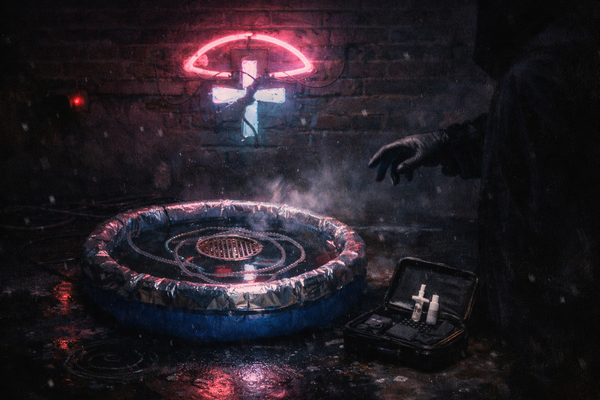
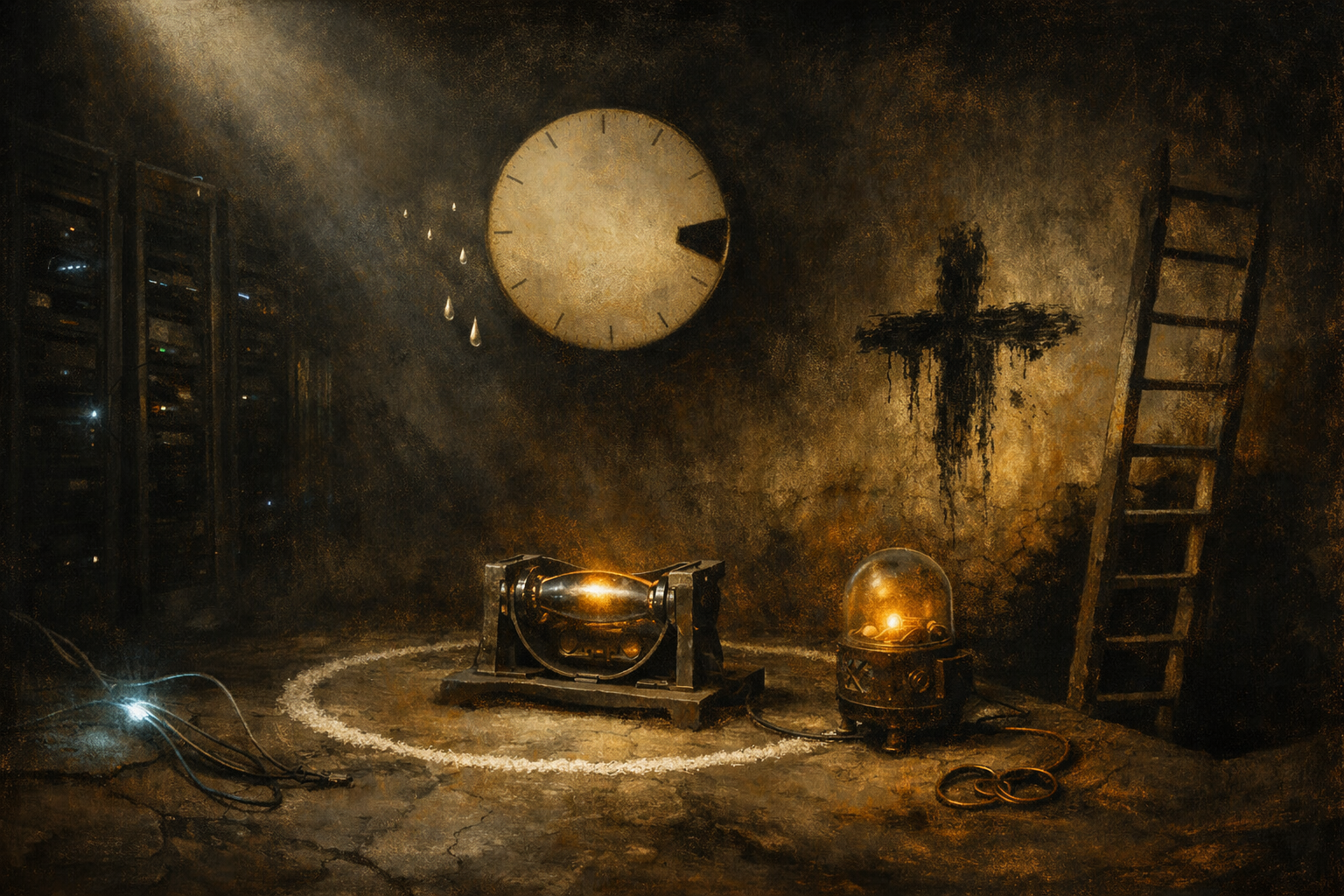
The maintenance pit had once been storage for vestments and incense and chalices. Now it was a cavity of concrete and steel under the basilica’s bones. The air was damp. The smell of river seeped through the foundation. And threaded through it: more ozone, more incense, as if someone had tried to sanctify the burn.
A ladder descended into the dark. My headlamp beam hit pipes, cable bundles, the gleam of metal casings. The wrong bell’s ringing thinned but did not vanish; it followed like tinnitus, like a memory you can’t close.
At the bottom, the master oscillator cradle sat bolted into the floor.
It was beautiful in the sterile way good engineering is beautiful: clean lines, precision mounts, vibration isolation, shielding. The kind of apparatus you can trust with your life, which is why it’s horrifying when it betrays you.
I recognized the component layout before I recognized why.
There was a bracket with a serial number stamped into it. The number ended in V-07 — my project series, years ago, before the crash, before the hearing, before the word minor discrepancy became a knife in my mouth.
My scar tightened. My hand reflexively flexed.
A scorch mark marred the shielding panel near the cradle — blackened metal where something had been sealed and then broken. The edges of the burn looked old, but the smell of it felt recent, as if time had stored the event and released it now, when I was ready to smell.
I crouched. I ran my fingers along the bracket.
Black oil smeared onto my skin.
My own fingerprint, years old.
I wanted to pull my hand away. I wanted to pretend the shrine had stolen parts, scavenged, assembled from scrap. But the serial number was not scrap. It was a signature.
My data log on the tablet — still connected, still streaming — flickered. Drift values spiked.
Drift increase: +3.7 seconds (localized).
Phase anomaly: harmonic bloom detected.
Trigger correlation: cognitive suppression markers? (system note: anomalous)
I stared at the screen.
Trigger correlation. The tablet was not supposed to infer my cognition. It had no sensors for memory.
Unless the shrine did.
Unless the shrine was not merely affecting clocks, but reading the human being who believed she could command them.
I tried to think of something else. I tried to think of the warrant. Of the city. Of hospital monitors and traffic lights. Of my supervisor’s clipped voice. Of the Authority’s neat moral arithmetic.
The drift spiked again.
The numbers rose like a psalm of accusation:
3.7
3.7
3.7
I felt my throat tighten around a name I did not let myself say.
The pit’s silence pressed on my ears until I could hear my own blood. My breath sounded too loud. The metronome in my pocket ticked through its crack, as if insisting on being counted.
Tick.
Tick.
Tick.
At the back of the pit, half hidden beneath a tarp, I found a clock.
It wasn’t ornate. It was a transit timer, battered, its casing dented. Someone had cleaned its face carefully, wiping away years of grime. In the upper corner, where technicians sometimes scrawl maintenance notes, two initials had been written in permanent marker:
E.L.
My body reacted before my mind did. My stomach dropped. My skin went cold. My eyes burned.
I had not seen those letters in years without nausea.
E.L. was not an acronym. Not a technical term. Not a unit. It was a person. A partner. A voice I used to hear beside me in bed, the soft hum of someone breathing in sleep, the sound of life being uncounted.
I did not think the crash. I did not picture it. The shrine didn’t need my imagination. It had the residue: the redacted incident report folded and refolded in my memory, the street name I avoid, the hearing room where I answered questions like a machine. The 3.7-second drift I signed off on because it was within tolerances, because the graphs looked clean, because the world had taught me to trust numbers over weather.
The timer’s display hovered around a time that did not settle:
03:17:58
03:17:59
03:17:57
The hour mark at “3” on its face was scratched away, a missing tooth.
Absence as gospel.
My watch stuttered in sympathy.
I reached out and touched the timer.
The casing was warm.
I should not have expected warmth. I should not have expected anything but dead plastic and dead numbers. But my skin recognized it the way skin recognizes a familiar hand.
Halden’s voice floated down the ladder, distant. “You found the one you came for.”
“I came to shut this down,” I called back. My voice cracked. I hated that it cracked.
“You came to reopen a second,” he said. “You came to walk down and bring someone back without looking.”
Orpheus. He didn’t say the name. He didn’t have to.
I swallowed. “What do you want?”
“I want you to stop pretending the fracture is an error,” he said. “I want you to stop demanding that time agree with your grief.”
I laughed, again, but it came out like a sob. “My grief doesn’t get a vote.”
“It does,” he said. “It’s been voting with every calibration you attempt.”
I looked at the log. Drift spike. 3.7 again. The shrine was answering my refusal to remember by amplifying the number that had become my private hell.
I did what I always do: I tried to fix it.
I set up the atomic reference beside the E.L. timer. I connected the timer’s input lines to the phase-locked loop. I brought the calibration tone emitter online. I took a breath and forced my hands steady.
Protocol is a kind of prayer when you don’t know what else to do with your fear.
Objective: Achieve clean synchronization lock on E.L. timer to TA standard.
Hypothesis: Local lock will reveal anomaly source signature; enable shutdown.
Risk: further grid drift.
Mitigation: isolate loop; minimize gain; abort on instability.
My fingers were slick with oil. The screwdriver felt like a scalpel in my grip.
I began.
The tone emitted. Clean. Sterile. A white line drawn in the air.
The timer’s digits wavered. The phase meter flickered. I adjusted. I adjusted again.
The shrine resisted, then leaned in.
It was like wrestling a door that suddenly decides to open for you.
The E.L. timer’s drift shrank. 1.2 seconds. 0.6. 0.2. I tightened the loop with a precision that felt like desperation made elegant. My breath slowed. The metronome’s tick aligned with my pulse.
Tick.
Tick.
Tick.
For one breath — one single held inhale — the phase locked.
Everything aligned.
Not just the timer. The entire pit. The building. The air. I could feel it in my teeth, in the bones behind my ears: the sensation of a world snapping into perfect agreement.
The wrong bell stopped ringing.
The ozone smell vanished.
The incense sweetness drained out of the air as if sucked away.
Silence arrived.
It was worse than noise.
The silence was not peaceful. It was the sound of a room holding its breath to see what you would do next.
In that hush, my tablet screen changed.
Not with numbers. Not with graphs.
With text.
A single line, unbidden, in the system font, as if the shrine had learned the Authority’s language just to wound me in it:
Eliot.
The name did not appear as a message to be read. It appeared like a reading. Like a measurement. Like a registration event.
Not heard. Registered.
Eliot.
My throat closed. My eyes blurred. My hands trembled over the instruments as if I’d been handed a live wire.
Eliot.
The name was not an invitation to retrieve. It was not a door. It was a nail in the air: this is what is real, and it will not be undone.
The silence held. The world waited.
I had wanted this. I had built my entire private religion around the fantasy of reopening the second where Eliot died and stepping through like a woman stepping back into her own kitchen.
But the shrine did not offer return. It offered naming.
Mercy with teeth.
The phase lock broke.
Noise flooded back in — not loud, but layered. Clocks ticked out of sync again. The wrong bell rang once and kept ringing. Ozone and incense braided again. My instruments screamed with drift values. The pit’s air thickened with plurality.
And I understood, suddenly, with a clarity that felt like an incision: every time I attempted control, the shrine grew more alive. My insistence fed it. My penance powered it. My hunger for a morally coherent universe — one correct time, one correct explanation — was the fuel.
Control-as-penance. A loop that never ends.
I sat back on my heels, oil-smeared hands hovering uselessly. The metronome ticked in my pocket like a heartbeat that refuses to be persuaded by grief.
Above, my comms unit crackled.
“Voss!” Director Saye’s voice, urgent now, stripped of bureaucracy. “Seizure team is en route. ETA five minutes. City grid is——static——unacceptable. Shut it down.”
Five minutes. Five minutes measured in standard time. Five minutes in a building that refused agreement.
Halden’s footsteps descended the ladder. He reached the bottom and stopped, as always, just before the circle of salt around the oscillator cradle.
His face in my headlamp beam looked tired, not triumphant. He wasn’t a cult leader. He was a keeper. Keepers don’t win. They endure.
“You got your breath,” he said.
“I got a name,” I whispered. Saying it aloud felt like breaking something sacred, like taking the Lord’s name into a mouth that hasn’t earned it. “It wasn’t… it wasn’t what I thought.”
He nodded once, as if that was the entire point.
“What is this place?” I demanded, anger returning like a reflex. “What did you do to it? To the city?”
“I didn’t make time fracture,” he said. “I built a room where the fracture could tell the truth.”
“That’s not—”
“It is,” he said, and his voice sharpened for the first time. “You think the world is coherent. You think your math can make it moral. You think if you correct enough, if you cut away enough error, you can clean the universe until your hands are clean too.”
His gaze dropped to my oil-black fingers.
“Look at you,” he said softly. “You came to wash yourself in standard.”
I wanted to deny it. I wanted to claim my mission was public safety, not private absolution. And that was true, partly. But the shrine had already shown me the index: drift increased when I suppressed memory. The system responded to my refusal like a living thing.
It had been listening.
It had been answering.
“What do you want from me?” I asked.
Halden didn’t answer directly. He touched the salt line with the edge of his boot, not crossing it, just disturbing a grain.
“I want you to choose what kind of devotion you’ll enact,” he said. “Seizure. Sabotage. Stewardship. But don’t pretend it’s just engineering.”
My comms unit crackled again. “Voss — confirm shutdown sequence.”
I looked at the master oscillator cradle. At the handless clock ticking steadily above it, unbothered by the chaos. At the scorch mark where a seal had been broken. At my own serial bracket, my signature embedded in this shrine’s bones.
I could destroy it. Sever cables. Smash oscillators. Burn the whole thing down to satisfy the Authority, to restore the city’s consensus, to prove — again — that I am loyal to one correct time.
And I could do it while still carrying the oil on my hands, the guilt that won’t wash.
Or I could keep it alive and risk more drift, more accidents, more Eliot-shaped absences scattered across the city.
Or—
Or I could perform a different kind of cut.
A decoupling.
A mercy that doesn’t undo, only names and re-makes.
I looked at Halden. “Where does it connect to the grid?”
His eyebrows lifted. A flicker of surprise. Then something like hope, quickly hidden.
He pointed to a cable bundle running along the pit wall into the annex — fiber and copper braided, infrastructure as umbilical.
“Cutting it will starve the city of drift,” I said, thinking aloud. “But it will also starve the shrine of… of my feeding. It won’t have a wider system to bruise.”
Halden nodded.
“It’ll still drift here,” I continued. “Inside its own pocket. A contained divergence.”
“Containment,” he said.
“Communion,” I corrected, and the word felt strange and true in my mouth.
I stood. My knees protested. My hands shook.
I did not ask for permission. I did not ask for absolution. I acted.
I climbed the ladder halfway, then back down, because the shrine’s time pockets made my watch stutter at every rung. The world shifted its second under my foot, like a stair that moves. I steadied myself by pressing my palm against the wall. The concrete was cold. The oil on my skin left a black smear on it, a mark that looked too much like a cross to be accidental.
I went to the cable bundle.
The fiber lines were shielded, protected. Cutting them wasn’t a casual act; it was surgery. Second hands as scalpels. The incision had to be clean.
I took my cutters. I stripped the shielding. I found the primary sync line.
My comms unit kept hissing. The Authority’s voice kept calling. I ignored it. Silence is also a choice.
I hesitated with the cutters poised.
If I severed the line, I would be severing more than infrastructure. I would be severing my last official connection to a world where time is one and guilt can be managed by paperwork.
I thought of Eliot — not the crash, not the scene, but the weight of the name appearing on my screen like a verdict and a blessing.
Eliot.
The shrine had not offered me restitution. It had offered me contact.
Gnosis as contact. Not explanation. Not undoing.
I cut.
The fiber snapped with a faint sound like a thread breaking. No spark. No drama. Just a clean severance.
Immediately, my tablet pinged:
GRID ALERT RESOLVING: External drift decreasing.
SYNC RESTORATION: District 4 returning to standard.
FAILOVER: Hospital telemetry stabilizing.
TRAFFIC CONTROL: local clocks reconciling.
The city exhaled.
The shrine did not.
The pit filled with a different kind of silence — not the perfect alignment hush, but a contained quiet, the sound of a room no longer connected to the outside world’s demand for agreement.
The wrong bell kept ringing, but now it was local. It did not propagate.
Halden’s shoulders loosened as if a weight had been lifted from a spine.
I wasn’t done. Severance is not stewardship. You have to seal the wound you make, or the infection spreads.
I knelt at the master oscillator cradle. I traced the salt circle around it with my fingertips, smearing grains into the oil on my skin. Salt and myrrh. Containment and anointing.
I tightened the screws on the cradle — not to lock it into standard, but to stabilize its internal drift, to keep it from tearing itself apart. My screwdriver turned. The oil slicked the threads. The metal resisted, then yielded.
I caught myself whispering, not words I recognized as prayer but cadence — an involuntary liturgical rhythm born from pressure:
Not one time.
Not one answer.
Not one clean hand.
My voice shook. I hated that it shook. I kept going.
I lifted my wristwatch off my arm.
Authority issue. Master. Idol.
My skin beneath it was pale, marked by the band like a bruise.
Halden watched, unmoving.
I set the watch beside the handless clock.
It looked small next to it. A machine that insists on legibility, laid beside a machine that refuses it.
My watch stuttered. Tried to sync. Failed.
For the first time, I didn’t correct it.
I adjusted the band, not to my wrist, but around the base of the handless clock’s casing, as if binding my master to mercy. A ridiculous gesture. A ritual disguised as engineering. Or the other way around.
The handless clock ticked on, indifferent.
But my watch — my precise, obedient watch — caught on something. It held. It stopped trying to auto-correct. Its display froze on a minute that was not standard, not reconciled, not approved.
03:17.
A mercy-minute. The death-minute’s vicinity, not the second. A widened wound. A refusal to be exact.
I stared at it until my eyes hurt.
Halden spoke softly. “You’re leaving it wrong.”
“I’m leaving it true,” I said, and the sentence landed like a bell. Short. Exact. Irreversible.
Above us, footsteps thudded in the nave. Voices. The seizure team. Boots. Authority.
Time, in its bureaucratic form, arrived with guns and paperwork.
Halden looked toward the ladder.
“They’ll take it,” he murmured.
“They’ll take what they can see,” I said.
I picked up my tablet. I opened the report draft. My fingers, still oily, hovered over the text fields.
I typed:
STATUS: Site isolated from grid. Drift contained. External systems stabilizing.
ACTION: Master sync line severed. Anomaly signature no longer propagating.
RECOMMENDATION: Do not attempt further synchronization. Maintain site quarantine.
NOTE: Do not name the correct time inside the structure.
I hesitated. The last line looked like madness in official font. I left it anyway.
If the Authority seized the shrine, they would try to correct it. They would feed it again. My warning was a needle I could press into the future.
Halden’s gaze met mine. In it I saw no gratitude, no triumph — only the quiet recognition of someone witnessing a choice.
“Go,” he said.
I did.
† Calibration annotation: a severance can be love if it prevents further harm. A seal can be communion if it is not denial.
⟦RIVERWALK PUBLIC DISPLAY⟧ 19:31:12
⟦TA-NTP STANDARD⟧ 19:33:50
⟦WRISTWATCH / VOSS⟧ 03:17:00
⟦ALTAR CLOCK (NO HANDS)⟧ tick (no legible time)
IV. The Mercy-Minute
The door opened from inside.
No — this is the loop; forgive me.
The door opened from inside when I arrived. When I left, it opened from inside again, because Halden held it for me as if I were leaving a chapel after communion, as if the salt line were not a barrier but a threshold you cross with a changed mouth.
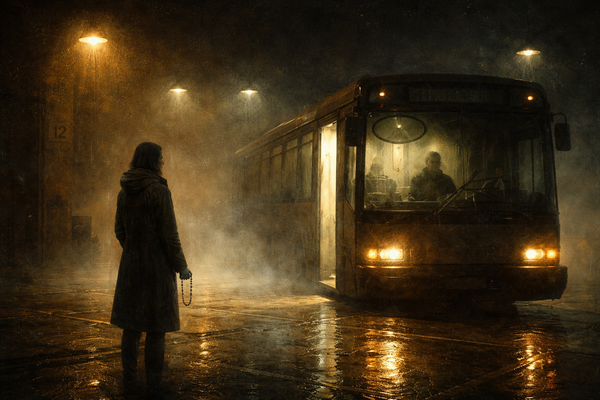
Outside, the river was still foil. The city still blinked in consensus. Sirens moved in the distance. Somewhere, in a hospital room I could not see, a monitor’s clock returned to agreement and a nurse stopped cursing the time server and went back to work.
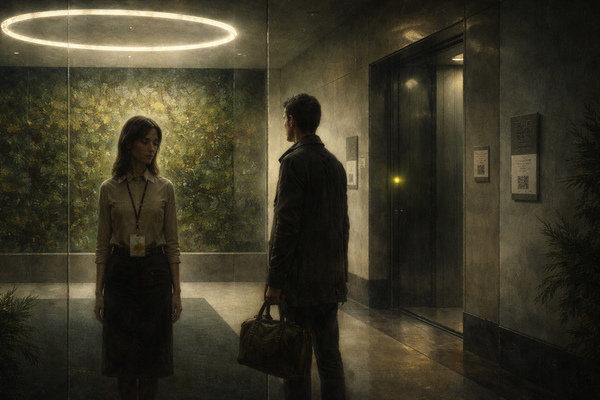
The seizure team stood near the riverwalk, their uniforms a dark geometry against the pale stone. Director Saye’s face was a rectangle of light on my phone when it finally regained enough coherence to stream video. Her eyes were hard, relieved, furious.
“Report,” she said.
“Contained,” I said. My voice did not shake now. It had been rearranged by the shrine’s pressure. “External drift resolving. Site decoupled.”
“What about the components?”
“Unstable,” I said. “Synchronization attempts increase divergence. Any seizure risks re-propagation.”
“You’re recommending we leave it?” Her disbelief was sharp.
“I’m recommending we quarantine it,” I said. “And stop trying to make it agree.”
There was a pause on the line. The kind of pause that in meetings is political, but in prayer is listening.
Then: “You’re suspended pending review,” she said. “Turn in your equipment.”
I looked down at my bare wrist. No watch.
“I already did,” I said.
Saye’s mouth tightened. She was about to ask questions. She was about to name the correct time. I ended the call.
A gun didn’t go off. An arrest didn’t happen. The Authority is not dramatic. It is administrative. It kills you with forms and delays and the slow erasure of your credibility.
That was fine. I had lived in worse erasures.
I walked away from the basilica along the riverwalk. My hands still smelled faintly of incense and ozone. The black oil had stained the creases of my fingers. I tried to wipe it on my coat. It remained. A residue. A sign. A reminder that guilt does not vanish; it changes texture.
My phone finally auto-corrected fully. It displayed standard time again: 19:34. Notifications steadied. Messages came in from colleagues: Are you okay? What happened? The grid is stabilizing. Saye is furious.
I did not answer.
In my pocket, the cracked metronome ticked, steady and imperfect.
Tick.
Tick.
Tick.
In my other pocket, my wristwatch — no longer on my wrist, no longer pretending to be a master — glowed with its wrong minute.
03:17.
I took it out and held it up to the riverwalk public clock. The public clock read 19:34:02. My watch read 03:17:00. Neither blinked. Neither apologized.
In the distance, the basilica’s bell struck once.
The wrong bell kept ringing after the strike — thin, persistent — following me along the water as if the city itself had a tinnitus of holiness it could not quite name.
I should have corrected my watch. That’s what technicians do. We reconcile. We align. We make the world agree so the trains run and the monitors don’t lie and the lovers meet.
But I had learned something in the clock-crypt that no manual taught: that agreement is not the only form of mercy, and that fractures sometimes hold more truth than seals.
I stopped under a streetlight. Its sterile glow made my hands look like someone else’s — oil-blackened, salt-grained, scar-crossed. I watched the watch. The seconds didn’t move. The minute didn’t change. It was as if time had decided to become an icon: fixed, not as denial, but as votive.
I thought of Eliot — not as a scene, not as an accident, but as the name appearing on my screen in the hush when everything aligned and the silence was worse.
Eliot.
I did not try to reopen the second.
I let the name remain a registration, not a retrieval.
I let the absence be gospel.
The river kept moving. The city kept agreeing. Somewhere behind me, in a deconsecrated basilica where clocks ticked out of phase like a polyrhonic catechism, a handless clock kept time without legibility, mercy without proof.
And in my pocket, a wrong minute kept glowing — my mercy-minute, my refusal, my small devotion to a world that is true in plural.
I put the watch back against my skin and felt its cold casing warm slowly, like a hand learning my pulse.
Tick.
Tick.
Tick.
The first time I crossed the salt line, I came to make time agree.
Now I carry the fracture like a candle that does not go out when you stop guarding it.